ECH Program on Oral Communication- EMI
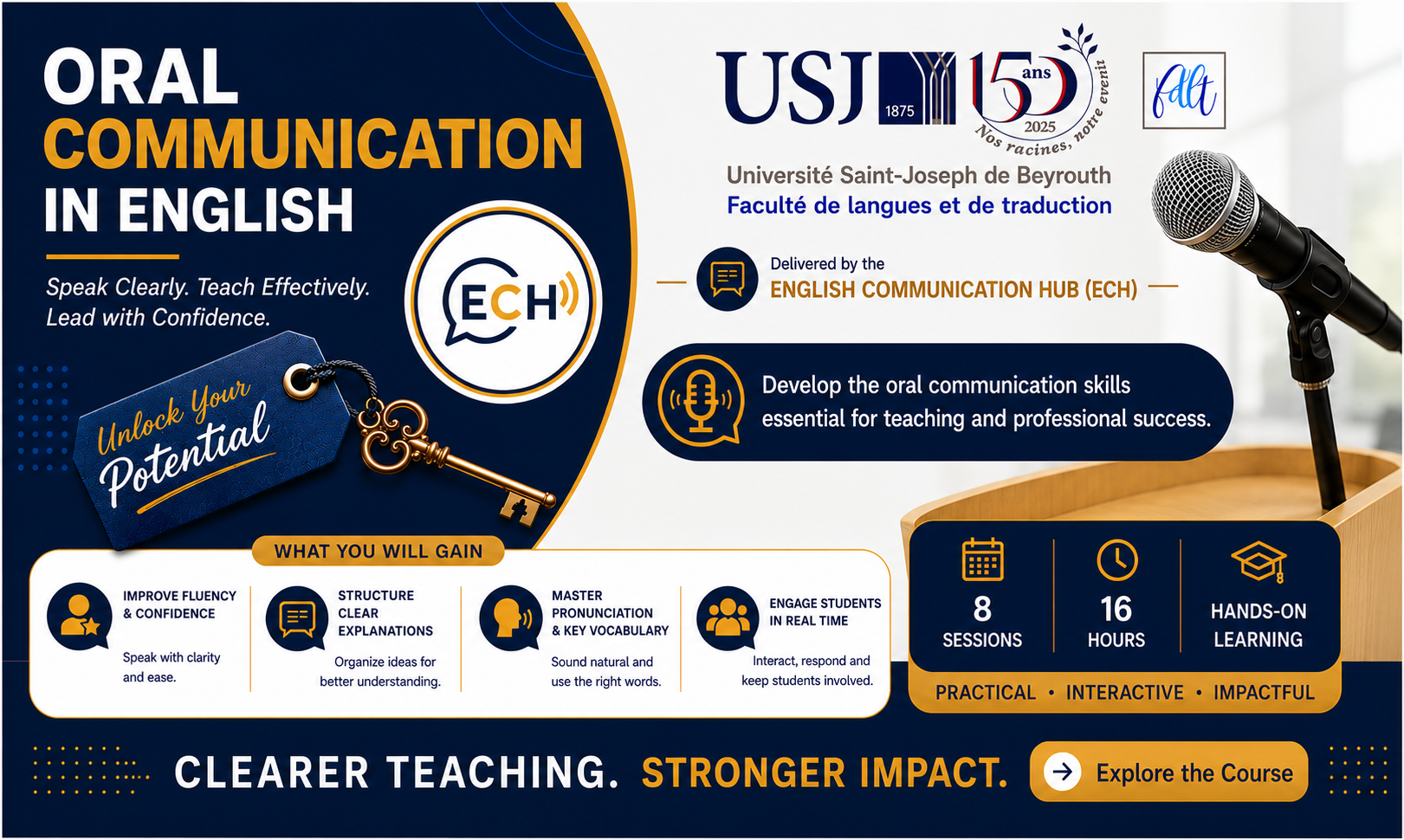
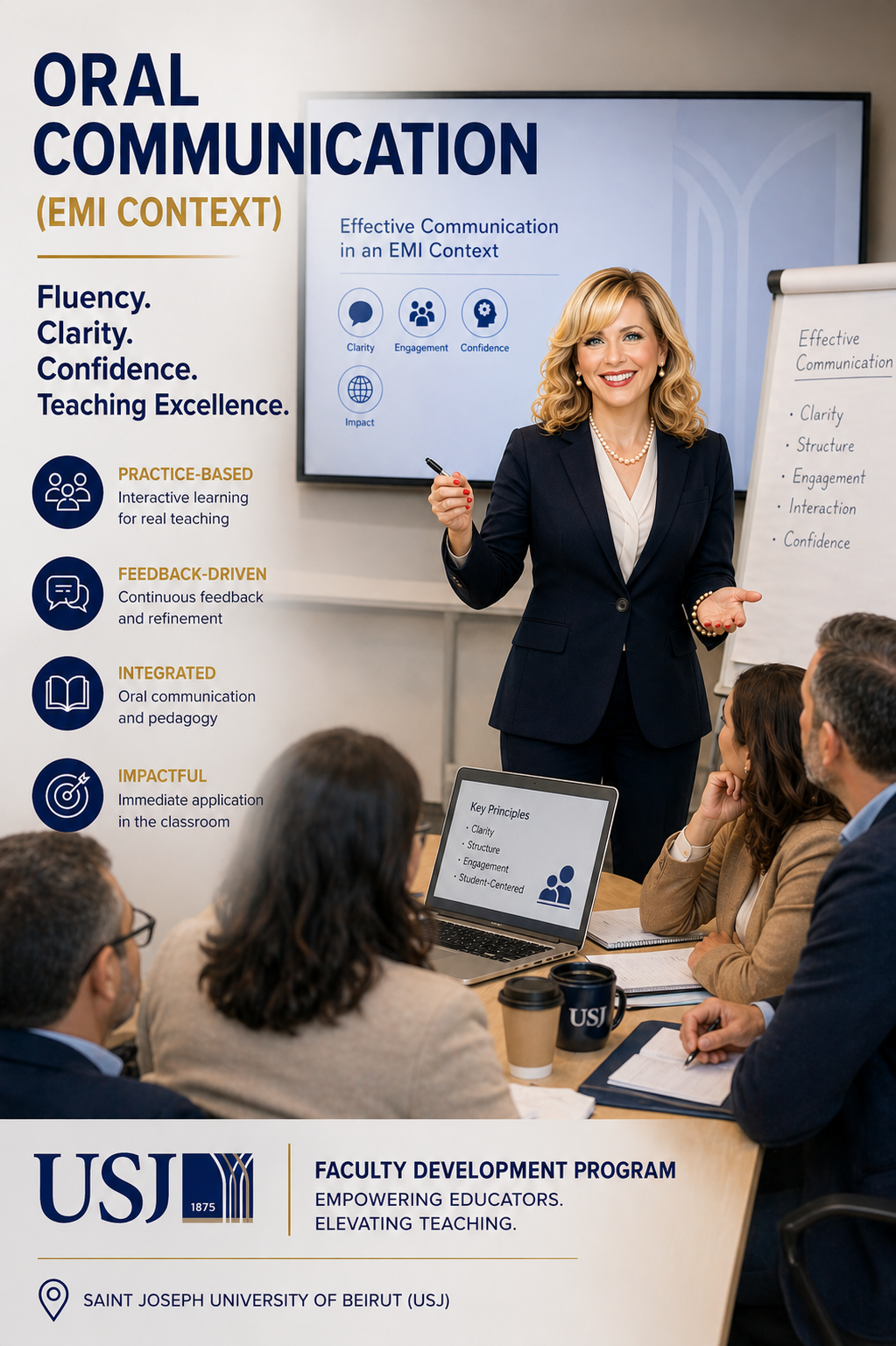
This program is aimed at educators who wish to hone their skills in oral communication in English-Medium Instruction (EMI) contexts.
It develops professors into clear and confident communicators in English, capable of teaching complex concepts using the structure, clarity, and engagement of the American teaching approach.
ORAL COMMUNICATION
English-Medium Instruction (EMI) Context
Clarity. Confidence. Teaching Excellence.
Saint Joseph University of Beirut (USJ)
OBJECTIVE
To empower faculty across disciplines to improve oral fluency, communicate clearly and confidently in English, and teach more effectively in an English-Medium Instruction (EMI) context.
CORE EMI PRINCIPLES
CORE EMI PRINCIPLES
Foundation of effective teaching in English.
Focus
-
- Communicating content clearly in English
- Supporting understanding in multilingual classrooms
- Creating structured and engaging learning experiences
Core Elements
-
- Clarity over complexity
- Structured delivery
- Scaffolding for understanding
- Comprehension checking
- Strategic use of language
- Student engagement
- Psychological safety
In Practice
-
- Use simple, direct language instead of complex or translated sentences
- Organize explanations using clear structure (e.g., What–Why–How)
- Break down complex ideas step by step
- Check understanding regularly through targeted questions
- Rephrase, repeat, and emphasize key concepts
- Encourage participation and interaction
- Create a safe environment where students feel comfortable speaking
Outcome
-
- Clearer and more effective communication in English
- Improved student understanding and participation
- More structured, engaging, and supportive teaching

SESSION 1 — Diagnostic & Launch
AGENDA (2 hours)
Purpose of the Session (0:00 – 0:10)
-
- Orientation (syllabus, website, session page)
- Reflection questions + synthesis
1 — Focus (0:10 – 0:20)
1.1. Initial Speaking Fluency
1.2. Awareness of Communication Gaps
1.3. Motivation for Improvement
2 — Core Elements (0:20 – 1:20)
2.1. Live Poll Everywhere Diagnostic (0:20 – 0:40)
2.2. Two-Minute Recording (0:40 – 1:00)
2.3. Initial Analysis (1:00 – 1:10)
2.4. Group Work (1:10 – 1:20)
3 — Core EMI Principles (1:20 – 1:30)
-
- Clarity over complexity
- Structured delivery
4 — Language Integration (1:30 – 1:45)
4.1. Natural vs Translated Speaking
4.2. Breakdowns in Speech
5 — EMI Principles in Action (1:45 – 2:00)
5.1. Clarity over Complexity
5.2. Structured Delivery
6 — Outcome (2:00 – 2:03)
-
- Strengths and challenges identified
- Priority defined
7 — Weekly Assignment (2:03 – 2:05)
-
- 2-minute structured recording
8 — Optional Work (2:05 – 2:07)
-
- TED Talk + reflection
Closing
👉 Clarity + Structure = Impact
SESSION 1 — DIAGNOSTIC & LAUNCH
See your reality. Start your transformation.
Duration: 2 hours
0.1. Orientation
- Syllabus
- Main program website
- Session 1 webpage
- Moodle (brief)
0.2. Reflection Questions
- Think about the best teacher you have ever had. What are their characteristics?
- What makes a teacher easy to understand when communicating in English?
0.3. Synthesis
- Key words: clarity, structure, examples, engagement
- Effective teaching = clarity + structure + understanding
1 — Focus
1.1. Initial Speaking Fluency
- What happens when you explain in English?
→ hesitation / translating / searching for words
1.2. Awareness of Communication Gaps
- Why do students not understand?
→ structure / clarity / pacing
1.3. Motivation
- Awareness (EI) → improvement → progress
2 — Core Elements
2.1. Poll Everywhere Diagnostic Click HERE 
- Questions
- Results
- Synthesis
2.2. Two-Minute Recording
- Explain a concept
- 2 minutes (group A then group B)
- No script
- Natural explanation
* This is not about recording quality. It is about capturing how you naturally speak.
* Hold your phone close — like a voice message.
2.3. Self-Analysis (Rubric)
Evaluate your recording
- Fluency
→ flow, hesitation, fillers, sentence completion - Pronunciation
→ clarity of key terms, word stress, intelligibility - Structure
→ organization, sequence, clarity of explanation
Identify
- 1 Strength
- 1 Difficulty
- 1 Priority for improvement
Prompt
- What did you do well?
- What made your explanation difficult to follow?
- What is the first thing you need to improve?
2.4. Group Work: 2-3
Task (3–4 minutes total)
Each participant shares 1 strength + 1 challenge
Peer Feedback: Partner(s) provide:
- 1 positive comment
- 1 suggestion for improvement
Focus
- Be specific and constructive
- Focus on clarity, structure, and delivery
- Keep feedback brief and actionable
Bonus/for discussion:
Which version is better? Why?
Version 1:
“So today we are going to discuss inflammation which is a process that occurs when there is some kind of injury or infection and it involves different mechanisms…”
Version 2:
“Today, we will explain inflammation.
Inflammation is the body’s response to injury.
For example, when the gum is infected, it becomes swollen.
What is one sign of inflammation?”
3 — Core EMI Principles: 2 for today
- Clarity over complexity
- Structured delivery
4 — Language Integration
4.1. Natural vs Translated Speaking: Do you translate before speaking?
- hesitation
- long sentences
- reduced clarity
Example
❌ Translated style:
“Today we are going to proceed to the explanation of the mechanism by which…”
✅ Natural teaching style:
“Today, we will explain how this works.”
4.2. Breakdowns in Speech
- fillers (uh, um, so…)
- sentence breakdown
- loss of clarity
Quick Activity (2 minutes)
-
- Take one sentence from your recording
- Rewrite it in a simpler, more natural way
Focus on:
-
- shorter sentence
- clearer idea
- easier to understand
Focus: Speak to teach, not to translate
5 — EMI Principles in Action
5.1. Clarity over Complexity
- one idea per sentence
- simple, direct language
- focus on understanding (not sophistication)
Example
❌ Complex:
“The inflammation process is characterized by a series of physiological responses…”
✅ Clear:
“Inflammation is the body’s response to injury. It causes swelling and pain.”
5.2. Structured Delivery
Use this model:
- Objective
- Clear idea (step)
- Example
- Question
Model (Oral)
“Today, we will explain inflammation.
Inflammation is the body’s response to injury.
For example, when the gum is infected, it becomes swollen.
What is one sign of inflammation?”
5.3. Mini Practice (Oral)
Use the first 1–2 sentences from your recording
Task
- Improve your opening using the structure:
- Objective
- Clear idea
- Example or Question
Speak (do not write)
- Practice your new version out loud (20–30 seconds)
- Focus on:
- clear start
- simple language
- slow, controlled delivery
Pair Practice
- Turn to a partner
- Each person delivers their new opening
Partner gives: 1 positive + 1 suggestion
Focus
👉 clear start
👉 simple language
👉 structured explanation
Final Reminder
👉 Don’t try to sound advanced
👉 Try to be understood
6 — Outcome
By the end of this session:
- You have identified what you do well
- You have identified what you need to improve
- You have a clear starting point for progress
What is your number one priority after today?
7 — Weekly Assignment
Record a 2-minute explanation of a concept from your course
Requirements
- Start with a clear objective
- Use a simple and clear structure
- Use simple, natural language
- Include at least 1 question to check understanding
Next session, we will work on fluency — so please bring this recording.
8 — Optional Work
8.1. TED Talks
- Choose one (from webpage)
- Focus on how they explain
8.2. Reflection
[Link to Form/pdf] || [Link to Form/doc]
- Clarity
- Structure
- Engagement
- Transfer
End
👉 Awareness → improvement (EI)
This is not a language course.
This is a transformation in how you teach.
Fluency is not enough.
Clarity + Structure = Impact.
Program FAQs
What is the course format?
The course is highly interactive, practice-based, and performance-driven.
Each session combines:
- Short, focused input
- Guided speaking practice
- Real teaching simulations (micro-teaching)
- Immediate feedback from the instructor and peers
Participants will:
- Record and analyze their own speaking
- Apply communication strategies to real teaching scenarios
- Engage in live activities using tools such as Poll Everywhere and Mentimeter
The course follows a progressive structure, allowing participants to build fluency, clarity, and confidence step by step.
Where will the sessions take place?
The sessions will take place at USJ (on campus), online, or hybrid.
What is the main objective of the course?
The Main Objective of the Course:
To transform how instructors teach in English by developing their ability to deliver clear, structured, and effective instruction in multilingual classrooms—moving beyond language fluency to achieve real student understanding and engagement in an English-Medium Instruction (EMI) context.
Who teaches the course?
The course is taught by Nada M. Salem, President/CEO of AFEE and IFWE.
 Nada M. Salem is a passionate educator with extensive experience in leading academic institutions in the United States and abroad. Over more than twenty years, she has taught school students, college students, student teachers, teachers, and leaders. She co-created and co- taught a methods course for teachers at The George Washington University Graduate School of Education. Nada is the Co-Editor in Chief of “Teaching World Languages: A Practical Guide- Arabic Edition” (The National Capital Language Resource Center, Washington, DC).
Mrs. Salem holds a teaching diploma, two master's degrees, one in translation and another in education, and has successfully completed most courses (40 credits) towards a doctorate (Ed.D.) in Curriculum and Instruction & Educational Technology Leadership at The George Washington University Graduate School of Education. Additionally, she holds an Executive Certificate in Public Leadership from Harvard University. Mrs. Salem formerly served as Administrative Director and Assessment of Learning Coordinator for AACSB Accreditation at the GWU School of Business’s Master of Science in Finance Program. In September 2019, Mrs. Salem was selected as a WOMAN LEADER by the University of Maryland‘s Kahlil Gibran Chair for Values and Peace. She is a member of the Marquis WHO'S WHO® list of Prominent Business Professionals, and she was featured among Marquis Who's Who's Top Executives in Education and Leadership.
Mrs. Salem is the Founding President/CEO of the American Foundation for Educational Excellence (AFEE), an organization whose mission is to help, on a worldwide basis, influencers, leaders, HR professionals, and managers of educational institutions, profit and non-profit organizations and corporations, to pursue excellence by improving leadership skills, managerial competencies and educational programs, namely through face-to-face and online trainings. AFEE is an Approved Provider for both HRCI & SHRM.
Mrs. Salem is also the Founding President/CEO of AFEE’s subsidiaries, the Center for Excellence in Languages: Teaching, Editing, Translating, and Interpreting, and the International Foundation for Women's Empowerment (IFWE) which seeks to empower all women and help them thrive on the personal and professional levels, regardless of nationality and religion.

TERMS OF SERVICE: We reserve the right, in our sole discretion, to reject or remove anyone who has registered or gained access under false pretenses, provided false information, or for any other action or behavior that we deem inappropriate, before, during or after the sessions, with or without prior notice or explanation, and without liability.
IMPORTANT DISCLAIMER: All rights reserved. The information on this page shall be considered proprietary information not to be used, copied or reproduced in any way. No part of our presentations / workshops / webinars may be reproduced, distributed, or transmitted in any form or by any means, including photocopying, recording, or other electronic or mechanical methods.