ECH Program on Oral Communication- EMI
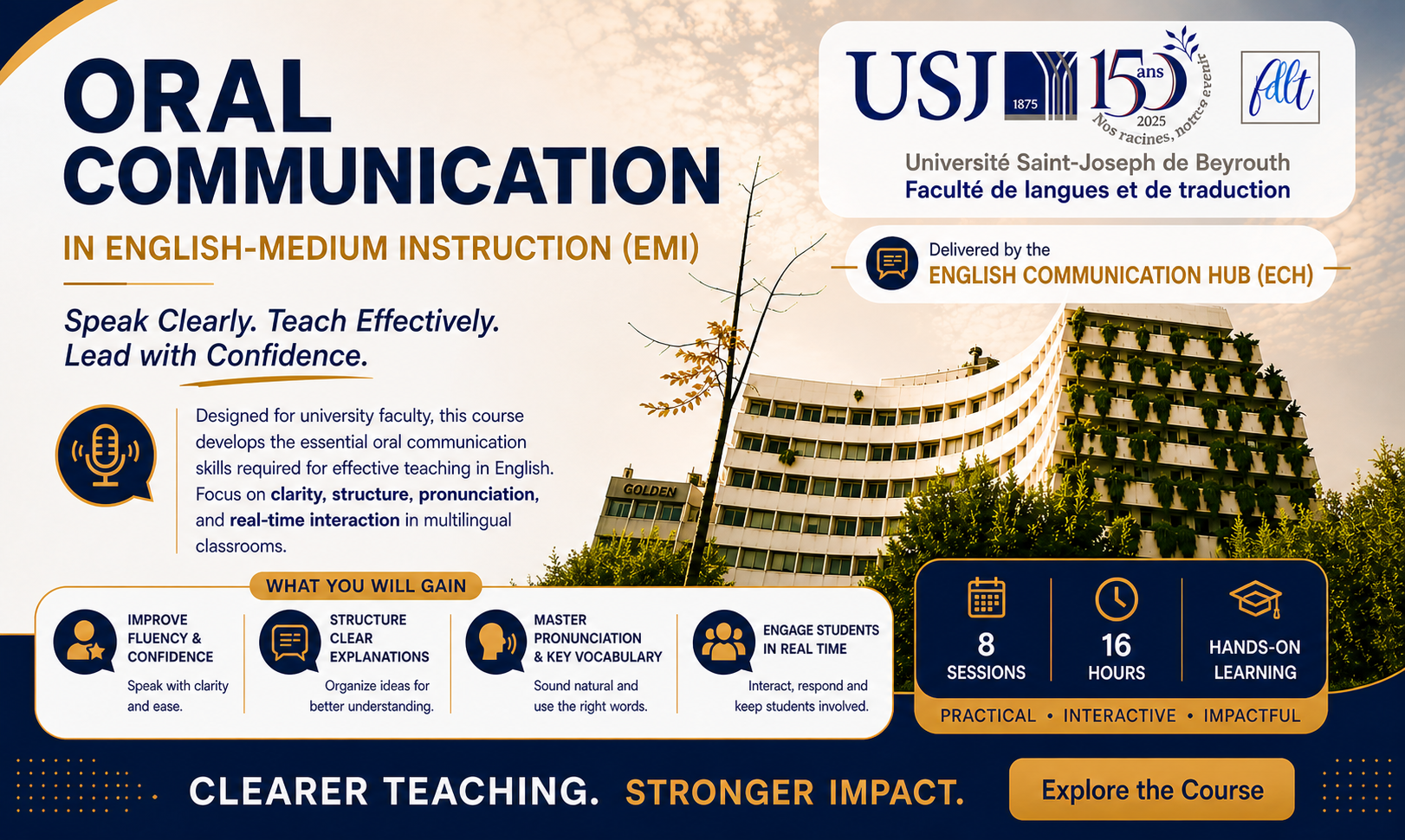
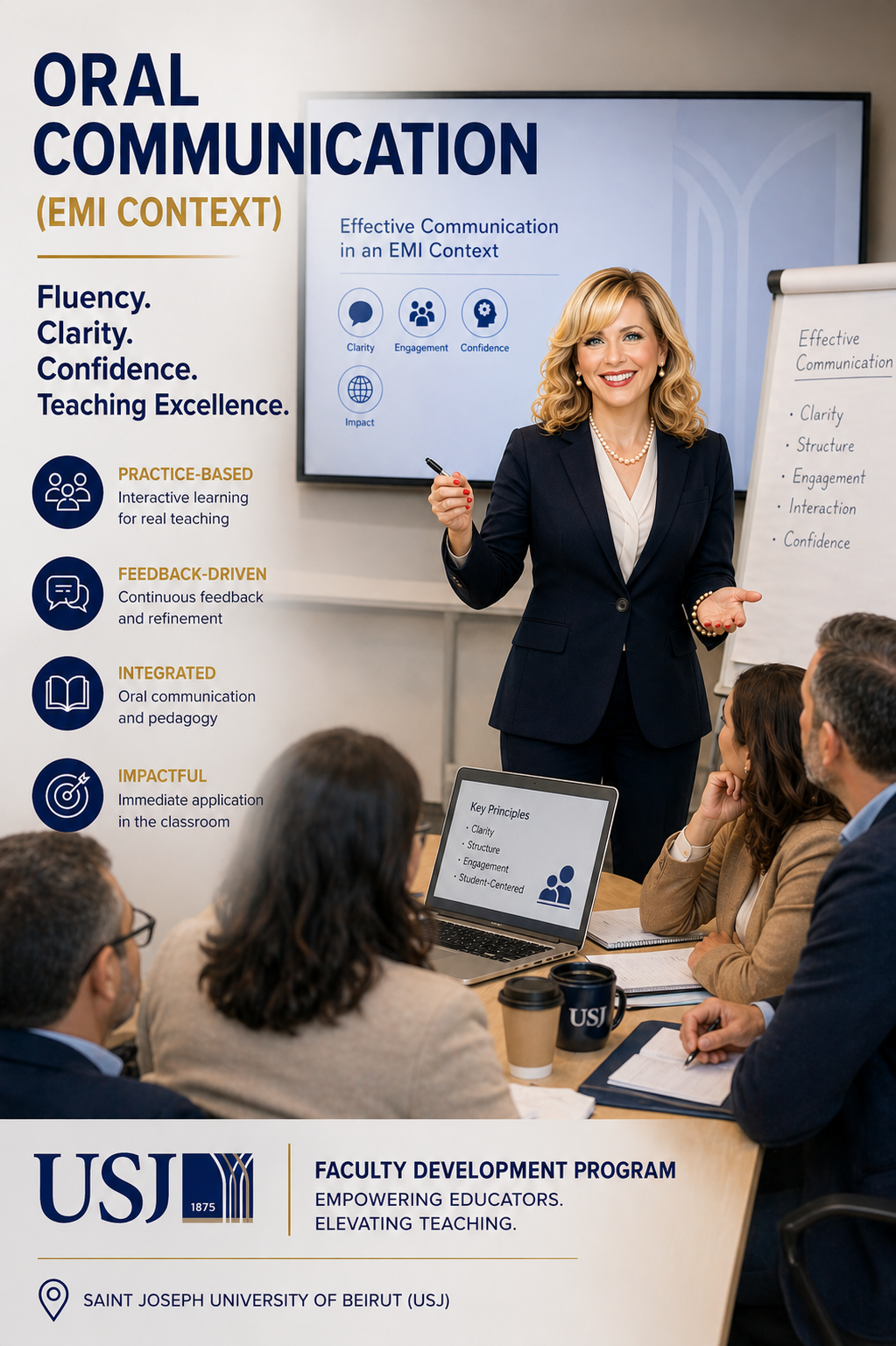
This program is aimed at educators who wish to hone their skills in oral communication in English-Medium Instruction (EMI) contexts.
It develops professors into clear and confident communicators in English, capable of teaching complex concepts using the structure, clarity, and engagement of the American teaching approach.
ORAL COMMUNICATION
English-Medium Instruction (EMI) Context
Clarity. Confidence. Teaching Excellence.
Saint Joseph University of Beirut (USJ)
OBJECTIVE
To empower faculty across disciplines to improve oral fluency, communicate clearly and confidently in English, and teach more effectively in an English-Medium Instruction (EMI) context.
CORE EMI PRINCIPLES
CORE EMI PRINCIPLES
Foundation of effective teaching in English.
Focus
-
- Communicating content clearly in English
- Supporting understanding in multilingual classrooms
- Creating structured and engaging learning experiences
Core Elements
-
- Clarity over complexity
- Structured delivery
- Scaffolding for understanding
- Comprehension checking
- Strategic use of language
- Student engagement
- Psychological safety
In Practice
-
- Use simple, direct language instead of complex or translated sentences
- Organize explanations using clear structure (e.g., What–Why–How)
- Break down complex ideas step by step
- Check understanding regularly through targeted questions
- Rephrase, repeat, and emphasize key concepts
- Encourage participation and interaction
- Create a safe environment where students feel comfortable speaking
Outcome
-
- Clearer and more effective communication in English
- Improved student understanding and participation
- More structured, engaging, and supportive teaching

🔵 SESSION 2 — FLUENCY & SPEAKING WITH EASE
From hesitation to flow
3.3. False Friends / Easily Confused Words (6–8 min)
👉 Focus (1 min)
Avoid common French–English confusion that reduces clarity and credibility.
Examples (1–2 min)
❌ “Actually, we are in the meeting now.” (actuellement)
✅ “We are currently in the meeting.”
❌ “I assisted the conference yesterday.”
✅ “I attended the conference yesterday.”
❌ “We need to control the results.” (vérifier)
✅ “We need to check the results.”
High-Frequency False Friends (1–2 min)
- Actually ≠ actuellement → in fact (not now)
- Assist ≠ assister → help (not attend)
- Control ≠ vérifier → check
- Eventually ≠ éventuellement → finally
- Sensible ≠ sensible → reasonable
- Fabric ≠ fabrique → material
- Library ≠ librairie → place to study
- Comprehensive ≠ compréhensif → complete / exhaustive (not understanding)
- Experience ≠ expérience scientifique → knowledge or skill from practice (not experiment)
- Support ≠ supporter → help (not stand)
- Demand ≠ demander → require (not ask)
- Resume ≠ résumer → continue (not summarize)
- Résumé ≠ résumer → CV
- Delay ≠ délai → postpone
- Sympathetic ≠ sympathique → compassionate, caring
- Deceived ≠ déçu → tricked (not disappointed)
- Ignore ≠ignorer → deliberately not to pay attention
Exercise 1 — Choose the Correct Meaning (Pairs) (2-4 min)
- Actually → (currently / in fact)
- Assist → (help / attend)
- Control → (check / manage)
- Eventually → (possibly / finally)
- Sensible → (sensitive / reasonable)
- Fabric → (factory / material)
- Library → (bookstore / place to study)
- Comprehensive → (complete / easy to understand)
- Experience → (experiment / knowledge)
- Support → (help / stand)
- Demand → (ask / require)
- Resume → (summarize / continue)
- Delay → (deadline / postpone)
- Sympathetic → (nice / compassionate)
- Deceived → (disappointed / tricked)
Exercise 2 — Correct the Sentence (Pairs) (2–4 min)
- Actually, we are studying this topic now.
- I assisted the seminar last week.
- We need to control the data carefully.
- Eventually, we can start the procedure.
- This is a very sensible issue for patients.
- The fabric produces medical tools.
- The explanation is very comprehensive to understand.
- I assisted the training session yesterday.
- He has a lot of experience in this experiment.
- The library sells scientific books.
- The doctor demanded the patient to return next week.
- We will resume the article before the exam.
- The teacher was sympathetic but not very understanding.
- The patient felt deceived after the results. He had expected to be cured, but he knew the doctor had tried his best.
✅ Answer Key
Exercise 1 — Answers
- in fact
- attend (important correction)
- check (in this context)
- finally
- reasonable
- material
- place to study
- complete
- knowledge
- help
- require
- continue
- postpone
- compassionate
- tricked
Exercise 2 — Suggested Corrections
- We are currently studying this topic.
- I attended the seminar last week.
- We need to check the data carefully.
- We can possibly start the procedure. (or: We may start…)
- This is a very sensitive issue for patients.
- The factory produces medical tools.
- The explanation is very clear / easy to understand.
- I attended the training session yesterday.
- He has a lot of experience in this field.
- The bookstore sells scientific books.
- The doctor asked the patient to return next week.
- We will summarize the article before the exam.
- The teacher was very nice / cute / friendly, but not very understanding.
- The patient felt disappointed after the results. He had expected to be cured, but he knew the doctor had tried his best.
Program FAQs
What is the course format?
The course is highly interactive, practice-based, and performance-driven.
Each session combines:
- Short, focused input
- Guided speaking practice
- Real teaching simulations (micro-teaching)
- Immediate feedback from the instructor and peers
Participants will:
- Record and analyze their own speaking
- Apply communication strategies to real teaching scenarios
- Engage in live activities using tools such as Poll Everywhere and Mentimeter
The course follows a progressive structure, allowing participants to build fluency, clarity, and confidence step by step.
Where will the sessions take place?
The sessions will take place at USJ (on campus), online, or hybrid.
What is the main objective of the course?
The Main Objective of the Course:
To transform how instructors teach in English by developing their ability to deliver clear, structured, and effective instruction in multilingual classrooms—moving beyond language fluency to achieve real student understanding and engagement in an English-Medium Instruction (EMI) context.
Who teaches the course?
The course is taught by Nada M. Salem, President/CEO of AFEE and IFWE.
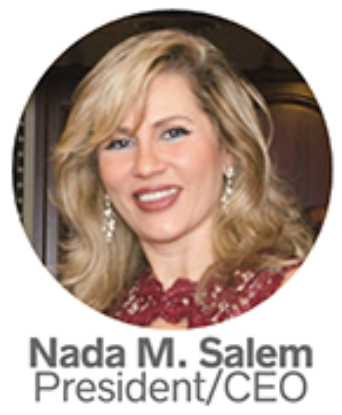 Nada M. Salem is a passionate educator with extensive experience in leading academic institutions in the United States and abroad. Over more than twenty years, she has taught school students, college students, student teachers, teachers, and leaders. She co-created and co- taught a methods course for teachers at The George Washington University Graduate School of Education. Nada is the Co-Editor in Chief of “Teaching World Languages: A Practical Guide- Arabic Edition” (The National Capital Language Resource Center, Washington, DC).
Mrs. Salem holds a teaching diploma, two master's degrees, one in translation and another in education, and has successfully completed most courses (40 credits) towards a doctorate (Ed.D.) in Curriculum and Instruction & Educational Technology Leadership at The George Washington University Graduate School of Education. Additionally, she holds an Executive Certificate in Public Leadership from Harvard University. Mrs. Salem formerly served as Administrative Director and Assessment of Learning Coordinator for AACSB Accreditation at the GWU School of Business’s Master of Science in Finance Program. In September 2019, Mrs. Salem was selected as a WOMAN LEADER by the University of Maryland‘s Kahlil Gibran Chair for Values and Peace. She is a member of the Marquis WHO'S WHO® list of Prominent Business Professionals, and she was featured among Marquis Who's Who's Top Executives in Education and Leadership.
Mrs. Salem is the Founding President/CEO of the American Foundation for Educational Excellence (AFEE), an organization whose mission is to help, on a worldwide basis, influencers, leaders, HR professionals, and managers of educational institutions, profit and non-profit organizations and corporations, to pursue excellence by improving leadership skills, managerial competencies and educational programs, namely through face-to-face and online trainings. AFEE is an Approved Provider for both HRCI & SHRM.
Mrs. Salem is also the Founding President/CEO of AFEE’s subsidiaries, the Center for Excellence in Languages: Teaching, Editing, Translating, and Interpreting, and the International Foundation for Women's Empowerment (IFWE) which seeks to empower all women and help them thrive on the personal and professional levels, regardless of nationality and religion.

TERMS OF SERVICE: We reserve the right, in our sole discretion, to reject or remove anyone who has registered or gained access under false pretenses, provided false information, or for any other action or behavior that we deem inappropriate, before, during or after the sessions, with or without prior notice or explanation, and without liability.
IMPORTANT DISCLAIMER: All rights reserved. The information on this page shall be considered proprietary information not to be used, copied or reproduced in any way. No part of our presentations / workshops / webinars may be reproduced, distributed, or transmitted in any form or by any means, including photocopying, recording, or other electronic or mechanical methods.