ECH Program on Oral Communication- EMI
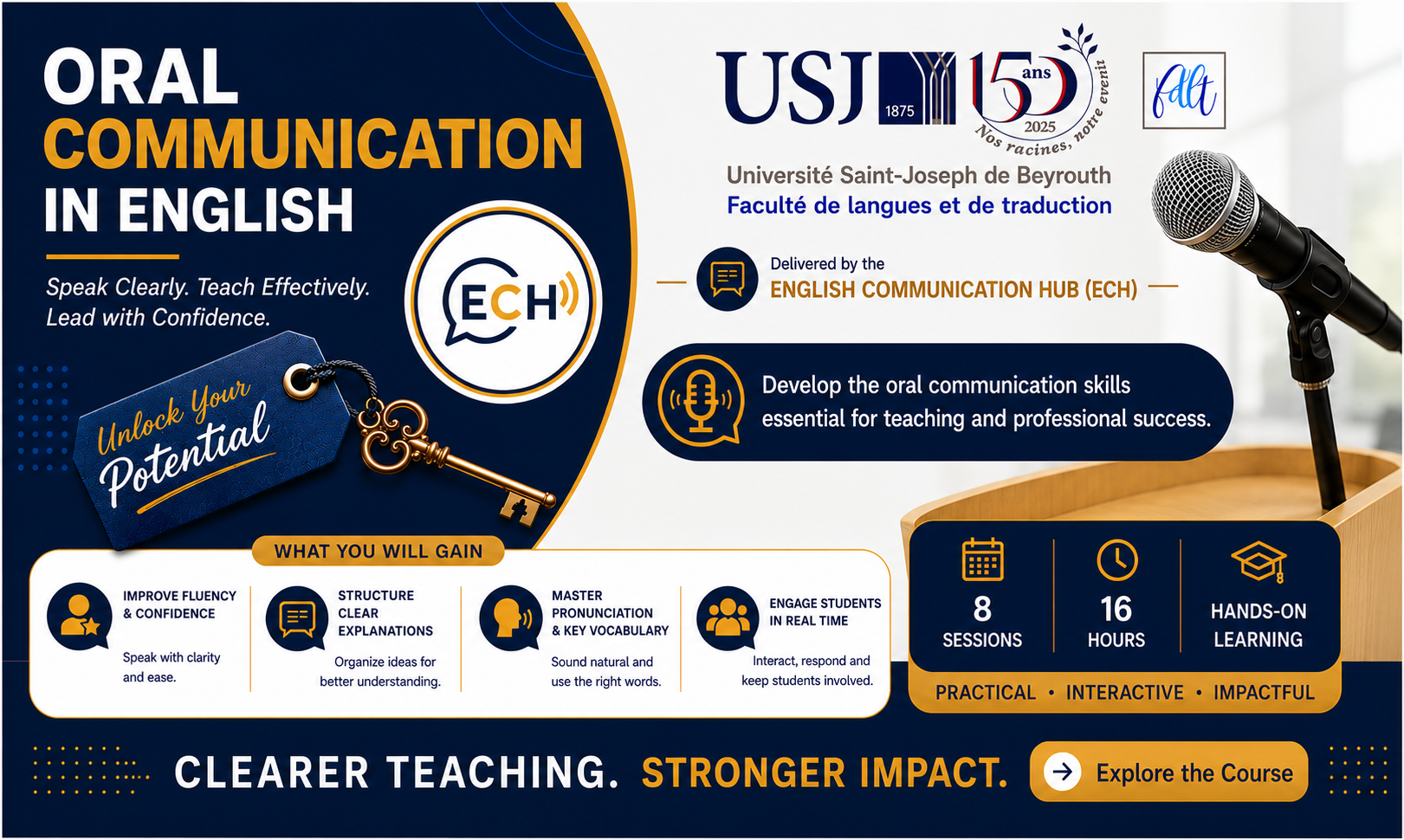
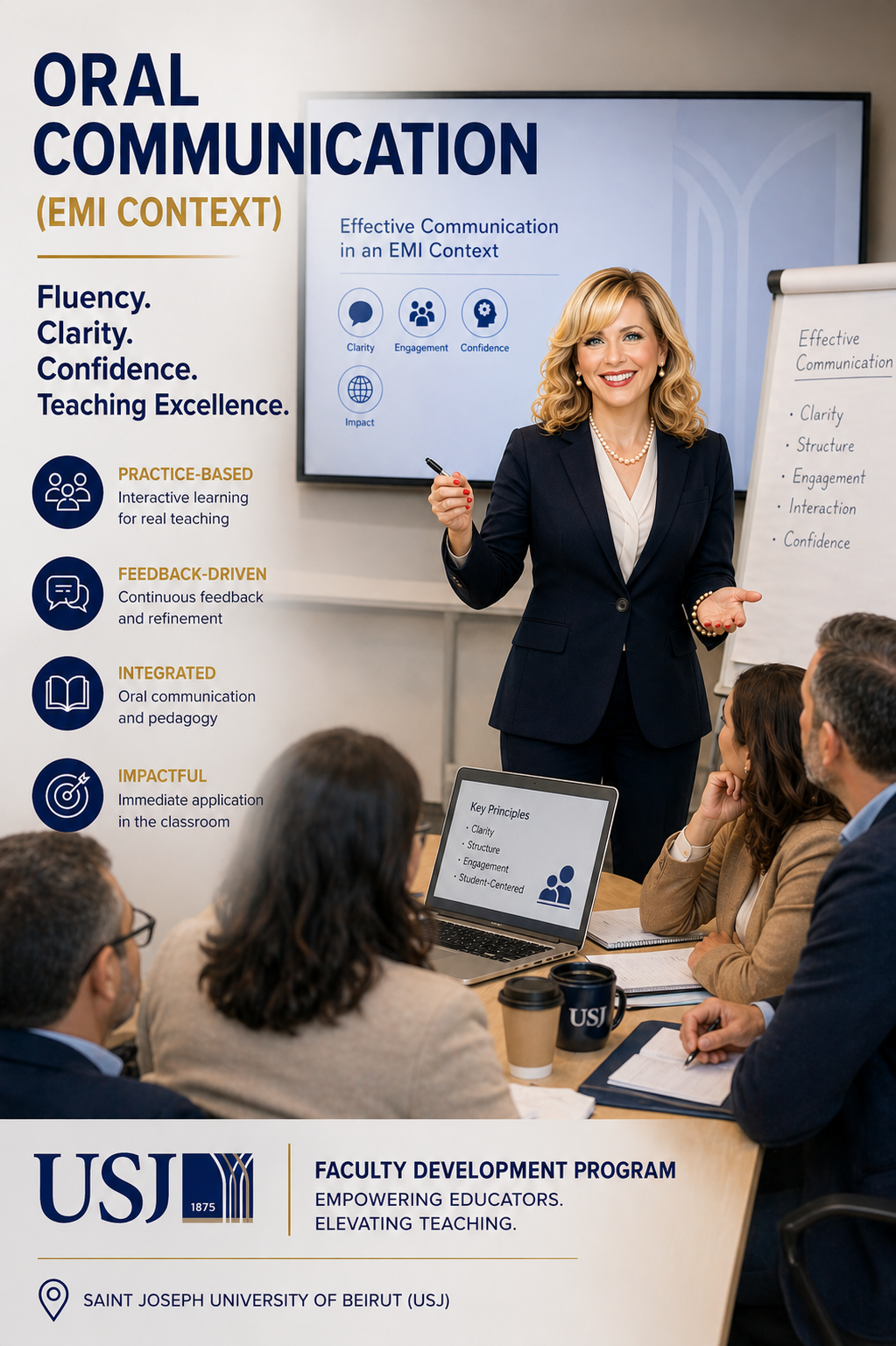
This program is aimed at educators who wish to hone their skills in oral communication in English-Medium Instruction (EMI) contexts.
It develops professors into clear and confident communicators in English, capable of teaching complex concepts using the structure, clarity, and engagement of the American teaching approach.
ORAL COMMUNICATION
English-Medium Instruction (EMI) Context
Clarity. Confidence. Teaching Excellence.
Saint Joseph University of Beirut (USJ)
OBJECTIVE
To empower faculty across disciplines to improve oral fluency, communicate clearly and confidently in English, and teach more effectively in an English-Medium Instruction (EMI) context.
CORE EMI PRINCIPLES
CORE EMI PRINCIPLES
Foundation of effective teaching in English.
Focus
-
- Communicating content clearly in English
- Supporting understanding in multilingual classrooms
- Creating structured and engaging learning experiences
Core Elements
-
- Clarity over complexity
- Structured delivery
- Scaffolding for understanding
- Comprehension checking
- Strategic use of language
- Student engagement
- Psychological safety
In Practice
-
- Use simple, direct language instead of complex or translated sentences
- Organize explanations using clear structure (e.g., What–Why–How)
- Break down complex ideas step by step
- Check understanding regularly through targeted questions
- Rephrase, repeat, and emphasize key concepts
- Encourage participation and interaction
- Create a safe environment where students feel comfortable speaking
Outcome
-
- Clearer and more effective communication in English
- Improved student understanding and participation
- More structured, engaging, and supportive teaching

Session Details
🔵 SESSION 2 — FLUENCY & SPEAKING WITH EASE
From hesitation to flow.
Focus
- Reducing hesitation
- Developing natural flow
- Speaking with confidence
Core Elements
- Speaking in chunks (not translating from French)
- Fluency strategies for real-time teaching
- Guided fluency drills using dental content
Language Integration
- Short, clear sentence patterns
- Functional spoken grammar (present, sequencing)
EMI Principles in Action
- Clarity over complexity
- Strategic use of language
Outcome
- Personal fluency strategy
- Increased ease in spontaneous explanation
🔵 SESSION 2 DETAILS — FLUENCY & SPEAKING WITH EASE
From hesitation to flow
A. Main Objective
By the end of this session, you will be able to manage hesitation, maintain flow using short and clear sentences, and respond clearly and confidently in real-time classroom situations—despite imperfection.
The goal is not to speak perfectly, but to speak clearly, confidently, and continuously—despite imperfection.
This session focuses on developing natural speaking flow by avoiding translation, simplifying sentence structure, practicing spontaneous interaction, and improving clarity through targeted grammar and vocabulary use.
B. Agenda
1. Advance Organizer — Bridging Old and New Knowledge (8-10 min)
1.1. Reviewing last session content
1.2. Exploring this session content
(+ Core EMI Principles)
2. Oral Practice (56-72 min)
2.1. Weekly speaking reflection
2.2. HW review
2.3. TED Talk reflection
2.4. Elevator pitch
2.5. Rapid-fire student questions
2.6. Video-based fluency practice
3. Sentence clarity, grammar, and false friends (exercises- 25-30 min)
3.1. Sentence clarity
3.2. Grammar
3.3. False friends / easily confused words
4. EMI Principles in Action (5 min)
5. Recap (2 min)
HW + TED Talk (1 min)
C. Core (Session Content & Activities)
1. Advance Organizer — Bridging Old and New Knowledge (8–10 min)
1.1. Reviewing Last Session (4–5 min)
Work with a partner.
👉 Briefly discuss:
-
- What were the main challenges you identified in Session 1?
- When you speak in English, what usually causes hesitation?
- What makes an explanation unclear?
👉 Key points: (Do you agree?)
-
- hesitation
- long, complex sentences
- lack of clear structure
1.2. Exploring This Session (4–5 min)
In this session, you will learn how to:
-
- manage hesitation and maintain flow
- speak in short, clear sentences
- respond more quickly and confidently
👉 Key shift: From awareness → to controlled, fluent speaking
(+ Core EMI Principles — 1 min):
-
- Clarity over complexity
- Structured delivery
- Scaffolding for understanding
- Comprehension checking
- Strategic use of language
- Student engagement
- Psychological safety
We will apply:
-
- Clarity over complexity
- Structured delivery
👉 Focus on making your message easy to understand
2. Oral Practice (56-72 min)
2.1. Weekly Speaking Reflection (12–15 minutes MAX)
Step 1 — Quick Individual Reflection (1–2 min)
Think about your week:
-
- Did you speak or teach in English?
- How did you feel?
- What was difficult?
- Did you use anything from last session?
👉 Keep it short — just identify ONE situation.
Step 2 — Pair Sharing (4–5 min)
Work with a partner.
Each person shares in 1 min only:
-
- One situation
- One difficulty
- One thing that worked (or could have worked)
⏱️ Keep it fast and focused.
Step 3 — Whole-Class Snapshot (5–6 min)
We will NOT share everything.
👉 Each pair shares ONLY ONE point:
-
- one common difficulty
OR - one useful strategy
- one common difficulty
Step 4 — Quick Coaching (2–3 min)
As a class, briefly identify key takeaways from the discussion.
👉 Share:
-
- one common difficulty
- one effective strategy
- one way to say something more clearly
👉 Keep answers short (1–2 sentences).
👉 No long explanations — focus on clarity and improvement.
2.2. Homework Review (10-12 min)
Work with a partner.
Step 1 — Listen (4 min)
-
- Listen to your partner’s 2-minute recording
- Focus on understanding the message
Step 2 — Reflection (3 min)
Briefly discuss:
-
- How did you feel recording yourself?
- What was easy or difficult?
Step 3 — Feedback (3-4 min)
Your partner gives:
-
- 1 strength (what worked well)
- 1 improvement (what to fix next time)
Step 4 — Focus
Pay attention to:
-
- hesitation
- clarity of ideas
- sentence length
👉 Keep feedback specific and useful
👉 Focus on improvement, not perfection
2.3. TED Talk Reflection (10-12 min)
10 ways to have a better conversation
Work with a partner.
Even if you did not watch the full video, you can fully participate using the key ideas below.
💡 Key Ideas from the Talk
Good communication means:
- being present when speaking
- using simple and clear language
- avoiding long and complicated sentences
- listening carefully
- focusing on what really matters
👉 Step 1 — Pair Discussion (5-6 min)
Discuss with your partner (choose 2–3 questions):
- Which of these ideas do you already use?
- Which one is most difficult for you? Why?
- How can simple language improve your teaching?
- What should you stop doing when speaking English?
- How can you reduce hesitation when answering students?
👉 Step 2 — Whole-Class Discussion (4-6 min)
We will now discuss together as a class.
Be ready to share:
- one key idea you found important
- one thing you would like to improve
👉 Optional (if you watched the video)
- What example or idea from the talk stood out to you?
- What did you learn that you can apply immediately?
2.4. Elevator Pitch — Communicate What You Believe (10–12 min total)
Step 1 — Preparation (1–2 min)
Think of one idea you strongly believe in.
👉 Quickly decide:
-
- What do you believe?
- Why does it matter?
(No writing — just thinking)
Step 2 — First Attempt (Pairs) (3–4 min)
-
- Partner A speaks (30–45 sec)
- Partner B listens
- Switch roles
Step 3 — Feedback (Pairs) (2–3 min)
Each partner gives:
-
- 1 strength
- 1 improvement
👉 Focus on:
-
- clarity
- conviction
- impact
Step 4 — Second Attempt (Improved) (3–4 min)
-
- Repeat the pitch (30–45 sec each)
- Apply feedback immediately
2.5. Rapid-Fire Student Questions — Real-Time Response (9-10 min)
Fast Q&A Practice
Work with the same partner.
Task
Ask and answer quick questions about your partner’s elevator pitch.
Respond immediately, as in a real classroom.
Round 1 (4–5 min)
Partner A asks — Partner B answers
Ask 4–5 questions:
-
- Why is this important in practice?
- Can you explain that again in a simpler way?
- Can you give a concrete example?
- What is the main point we should remember?
- How do we apply this in real situations?
👉 Partner B answers immediately, using short, clear sentences
Round 2 (4–5 min)
Switch roles
Partner B asks — Partner A answers
Quick Feedback (1–2 min)
Each partner gives:
-
- 1 strength
- 1 improvement
Rule
👉 Respond quickly.
👉 Keep answers short.
👉 Do not wait for perfect language.
2.6. Video-Based Fluency Practice — From Input to Explanation (12-15 min)
Work with a partner.
Task
After watching the video below (Vygotsky’s ZPD), you will:
-
- understand the key idea
- explain it clearly
- discuss and apply it
Step 1 — Quick Understanding (Individual- 2 min)
Take a moment to think:
-
- What is the main idea of the video?
Step 2 — Structured Explanation (Pairs- 5-6 min)
Explain the idea to your partner using:
-
- First… (introduce the concept)
- Then… (explain how it works)
- Finally… (give a simple example)
👉 Use short, clear sentences
Step 3 — Partner Questions (3-4 min)
Your partner asks 2–3 questions about your explanation:
-
- Can you simplify that?
- Can you give another example?
- Why is this important for learning?
👉 Respond immediately, using short answers
Step 4 — Discussion (Application- 2-3 min)
Discuss together (choose 2–3):
-
- What is the most important idea in this concept?
- What is one benefit for students?
- Do you agree with this approach? Why?
- How could you apply this in your teaching?
Focus
-
- clarity of explanation
- short sentences
- responding under pressure
- connecting ideas to practice
Videos: Lev Vygotsky's Zone of Proximal Development
3. Sentence Clarity, Grammar, and False Friends (25–30 min)
3.1. Sentence Clarity (8–10 min)
👉 Focus
- one idea per sentence
- avoid long, complex sentences
- speak directly
Examples (Model)
❌ “What we are going to do now is examine the data.”
✅ “Now, we examine the data.”
❌ “In order to understand this process, it is necessary to look at each step.”
✅ “To understand this, look at each step.”
❌ “It is important to note that this condition can become serious.”
✅ “This condition can become serious.”
COMMON SPEAKING PROBLEMS (EMI) — & HOW TO FIX THEM
Exercise — Simplify the Sentence (Work in pairs: 5–6 sentences each)
👉 Simplify and say out loud:
“What did you remove?”
“What did you simplify?”
- What we are going to do now is explain the treatment plan.
- In order to understand this condition, we need to analyze the symptoms carefully.
- Due to the fact that this disease progresses slowly, patients often ignore it.
- What we can observe here is a clear improvement in the patient’s condition.
- It is important to note that early diagnosis improves outcomes.
- There are several factors that need to be considered before making a decision.
- What we are trying to do here is reduce the risk of infection.
- The reason why this occurs is because bacteria accumulate over time.
- In order to be able to treat this effectively, we must act early.
- What I would like to explain now is the next step in the procedure.
- It is important to understand that this method requires precision.
- There are many different approaches that can be used in this case.
- Due to the fact that the patient did not follow the instructions, the condition worsened.
- What we are going to look at next is how the system responds to treatment.
- In order to improve results, we need to focus on patient compliance.
- What we can see in this example is a failure of the initial treatment.
- The reason why this is important is because it affects long-term outcomes.
- It is important to mention that this procedure is widely used in practice.
- There are several methods that can be applied depending on the case.
- What we are trying to achieve is a complete understanding of the process.
Which of these sentences do you actually use in your teaching?
KEY
3.2. Grammar (for Speaking) (10–12 min)
👉 Focus
- speak clearly using correct structures
- avoid common French–English interference
- use accurate tense and verb forms in real time
Examples (Model)
❌ “I recommend that she studies this topic.”
✅ “I recommend that she study this topic.”
❌ “If you will follow this method, you will succeed.”
✅ “If you follow this method, you will succeed.”
❌ “He suggested to analyze the results.”
✅ “He suggested analyzing the results.”
❌ “This depends of the situation.”
✅ “This depends on the situation.”
Exercise 1 — Correct and Say (Pairs)
👉 Correct the sentence and say it out loud:
- I recommend that he goes to the next step.
- It is important that she understands the process.
- If you will apply this method, you get better results.
- He suggested to change the approach.
- When you will correct the exercise, I will give you an extra point.
- If we would follow this protocol, the outcome improves.
- I advise that he prepares more carefully.
- It is essential that the student follows all instructions.
- If the system would fail, we take action.
- She insisted that the doctor explains the procedure again.
Exercise 2 — Reformulate for Correct Speaking (Pairs)
👉 Reformulate and say clearly:
- I recommend that she studies more before the exam.
- If you will not treat this early, it becomes worse.
- He suggested to use another method.
- This depends of many external factors.
- If we would analyze this differently, we get better results.
- I propose that he takes this approach.
- It is important that the patient understands clearly. (check form)
- If the symptoms would appear, we react immediately.
- She recommended to review the results again.
- This solution allows to improve performance.
Exercise 3 — Controlled Speaking (Pairs)
Partner A explains a short idea using:
- one recommendation (I recommend that…)
- one conditional (If…, we…)
Partner B listens and says:
- “Form” (if structure is incorrect)
- “Clearer” (if message is unclear)
👉 Switch roles
EXTRAS:
3.3. False Friends / Easily Confused Words (10-14 min)
👉 Focus
Avoid common French–English confusion that reduces clarity and credibility.
Examples (1–2 min)
❌ “Actually, we are in the meeting now.” (actuellement)
✅ “We are currently in the meeting.”
❌ “I assisted the conference yesterday.”
✅ “I attended the conference yesterday.”
❌ “We need to control the results.” (vérifier)
✅ “We need to check the results.”
High-Frequency False Friends (1–2 min)
- Actually ≠ actuellement → in fact (not now)
- Assist ≠ assister → help (not attend)
- Control ≠ vérifier → check
- Eventually ≠ éventuellement → finally
- Sensible ≠ sensible → reasonable
- Fabric ≠ fabrique → material
- Library ≠ librairie → place to study
- Comprehensive ≠ compréhensif → complete / exhaustive (not understanding)
- Experience ≠ expérience scientifique → knowledge or skill from practice (not experiment)
- Support ≠ supporter → help (not stand)
- Demand ≠ demander → require (not ask)
- Resume ≠ résumer → continue (not summarize)
- Résumé ≠ résumer → CV
- Delay ≠ délai → postpone
- Sympathetic ≠ sympathique → compassionate, caring
- Deceived ≠ déçu → tricked (not disappointed)
- Ignore ≠ignorer → deliberately not to pay attention
Exercise 1 — Choose the Correct Meaning (Pairs) (2-4 min)
- Actually → (currently / in fact)
- Assist → (help / attend)
- Control → (check / manage)
- Eventually → (possibly / finally)
- Sensible → (sensitive / reasonable)
- Fabric → (factory / material)
- Library → (bookstore / place to study)
- Comprehensive → (complete / easy to understand)
- Experience → (experiment / knowledge)
- Support → (help / stand)
- Demand → (ask / require)
- Resume → (summarize / continue)
- Delay → (deadline / postpone)
- Sympathetic → (nice / compassionate)
- Deceived → (disappointed / tricked)
Exercise 2 — Correct the Sentence (Pairs) (2–4 min)
- Actually, we are studying this topic now.
- I assisted the seminar last week.
- We need to control the data carefully.
- Eventually, we can start the procedure.
- This is a very sensible issue for patients.
- The fabric produces medical tools.
- The explanation is very comprehensive to understand.
- I assisted the training session yesterday.
- He has a lot of experience in this experiment.
- The library sells scientific books.
- The doctor demanded the patient to return next week.
- We will resume the article before the exam.
- The teacher was sympathetic but not very understanding.
- The patient felt deceived after the results. He had expected to be cured. But he knew the doctor had tried his best.
Exercise 3 — Speaking Practice (Pairs) (1–2 min)
Partner A creates a sentence using one word
Partner B confirms or corrects
👉 Words to use:
- actually
- assist
- eventually
- sensible
- support
- demand
- resume
- comprehensive
- sympathetic
- deceive
- ignore
Quick Correction Practice (throughout)
👉 Correct your partner immediately when needed
👉 Focus on clarity and accuracy in speaking
EXTRAS:
4. EMI Principles in Action (5 min)
4.1. Clarity over complexity (2 min)
- short sentences
- simple ideas
4.2. Strategic use of language (3 min)
Use patterns:
- “The main idea is…”
- “This means…”
- “For example…”
5. Recap (2 min)
✔ Speak in short sentences
✔ Do not translate — simplify
✔ Respond immediately
✔ Use structure to support fluency
HW
2-minute recording
Choose ONE:
-
- Answer a student question
- Present your course
- Explain a concept simply
Requirements
-
- short sentences
- clear structure
- one example
Reflection
-
- Did I hesitate?
- Did I simplify my speech?
- Was I clear?
🎥 TED Talk (Homework)
How to speak so that people want to listen
Watch the talk by Julian Treasure.
🎯 Focus while watching
Pay attention to:
- how the speaker uses simple and clear language
- how he engages the audience
- how he makes his message easy to follow
✍️ Reflection (prepare for next session)
Be ready to discuss:
- What makes the speaker effective?
- What should you start doing when you speak?
- What should you stop doing?
- What can you apply immediately in your teaching?
💡 Optional (for deeper thinking)
- How does the speaker use his voice (tone, pace, emphasis)?
- How does this affect understanding?
🔚 Final Reflection & Closing (3-4 min || If time permits)
Before we finish, try one more time:
👉 Answer a question or explain a concept in 20–30 seconds.
Was it easier than at the beginning? What changed in your speaking?
👉 Key idea: Fluency comes from simplifying, not from overthinking.
Next session, we will focus on pronunciation — so that your message is not only clear, but immediately understood.
Program FAQs
What is the course format?
The course is highly interactive, practice-based, and performance-driven.
Each session combines:
- Short, focused input
- Guided speaking practice
- Real teaching simulations (micro-teaching)
- Immediate feedback from the instructor and peers
Participants will:
- Record and analyze their own speaking
- Apply communication strategies to real teaching scenarios
- Engage in live activities using tools such as Poll Everywhere and Mentimeter
The course follows a progressive structure, allowing participants to build fluency, clarity, and confidence step by step.
Where will the sessions take place?
The sessions will take place at USJ (on campus), online, or hybrid.
What is the main objective of the course?
The Main Objective of the Course:
To transform how instructors teach in English by developing their ability to deliver clear, structured, and effective instruction in multilingual classrooms—moving beyond language fluency to achieve real student understanding and engagement in an English-Medium Instruction (EMI) context.
Who teaches the course?
The course is taught by Nada M. Salem, President/CEO of AFEE and IFWE.
 Nada M. Salem is a passionate educator with extensive experience in leading academic institutions in the United States and abroad. Over more than twenty years, she has taught school students, college students, student teachers, teachers, and leaders. She co-created and co- taught a methods course for teachers at The George Washington University Graduate School of Education. Nada is the Co-Editor in Chief of “Teaching World Languages: A Practical Guide- Arabic Edition” (The National Capital Language Resource Center, Washington, DC).
Mrs. Salem holds a teaching diploma, two master's degrees, one in translation and another in education, and has successfully completed most courses (40 credits) towards a doctorate (Ed.D.) in Curriculum and Instruction & Educational Technology Leadership at The George Washington University Graduate School of Education. Additionally, she holds an Executive Certificate in Public Leadership from Harvard University. Mrs. Salem formerly served as Administrative Director and Assessment of Learning Coordinator for AACSB Accreditation at the GWU School of Business’s Master of Science in Finance Program. In September 2019, Mrs. Salem was selected as a WOMAN LEADER by the University of Maryland‘s Kahlil Gibran Chair for Values and Peace. She is a member of the Marquis WHO'S WHO® list of Prominent Business Professionals, and she was featured among Marquis Who's Who's Top Executives in Education and Leadership.
Mrs. Salem is the Founding President/CEO of the American Foundation for Educational Excellence (AFEE), an organization whose mission is to help, on a worldwide basis, influencers, leaders, HR professionals, and managers of educational institutions, profit and non-profit organizations and corporations, to pursue excellence by improving leadership skills, managerial competencies and educational programs, namely through face-to-face and online trainings. AFEE is an Approved Provider for both HRCI & SHRM.
Mrs. Salem is also the Founding President/CEO of AFEE’s subsidiaries, the Center for Excellence in Languages: Teaching, Editing, Translating, and Interpreting, and the International Foundation for Women's Empowerment (IFWE) which seeks to empower all women and help them thrive on the personal and professional levels, regardless of nationality and religion.

TERMS OF SERVICE: We reserve the right, in our sole discretion, to reject or remove anyone who has registered or gained access under false pretenses, provided false information, or for any other action or behavior that we deem inappropriate, before, during or after the sessions, with or without prior notice or explanation, and without liability.
IMPORTANT DISCLAIMER: All rights reserved. The information on this page shall be considered proprietary information not to be used, copied or reproduced in any way. No part of our presentations / workshops / webinars may be reproduced, distributed, or transmitted in any form or by any means, including photocopying, recording, or other electronic or mechanical methods.