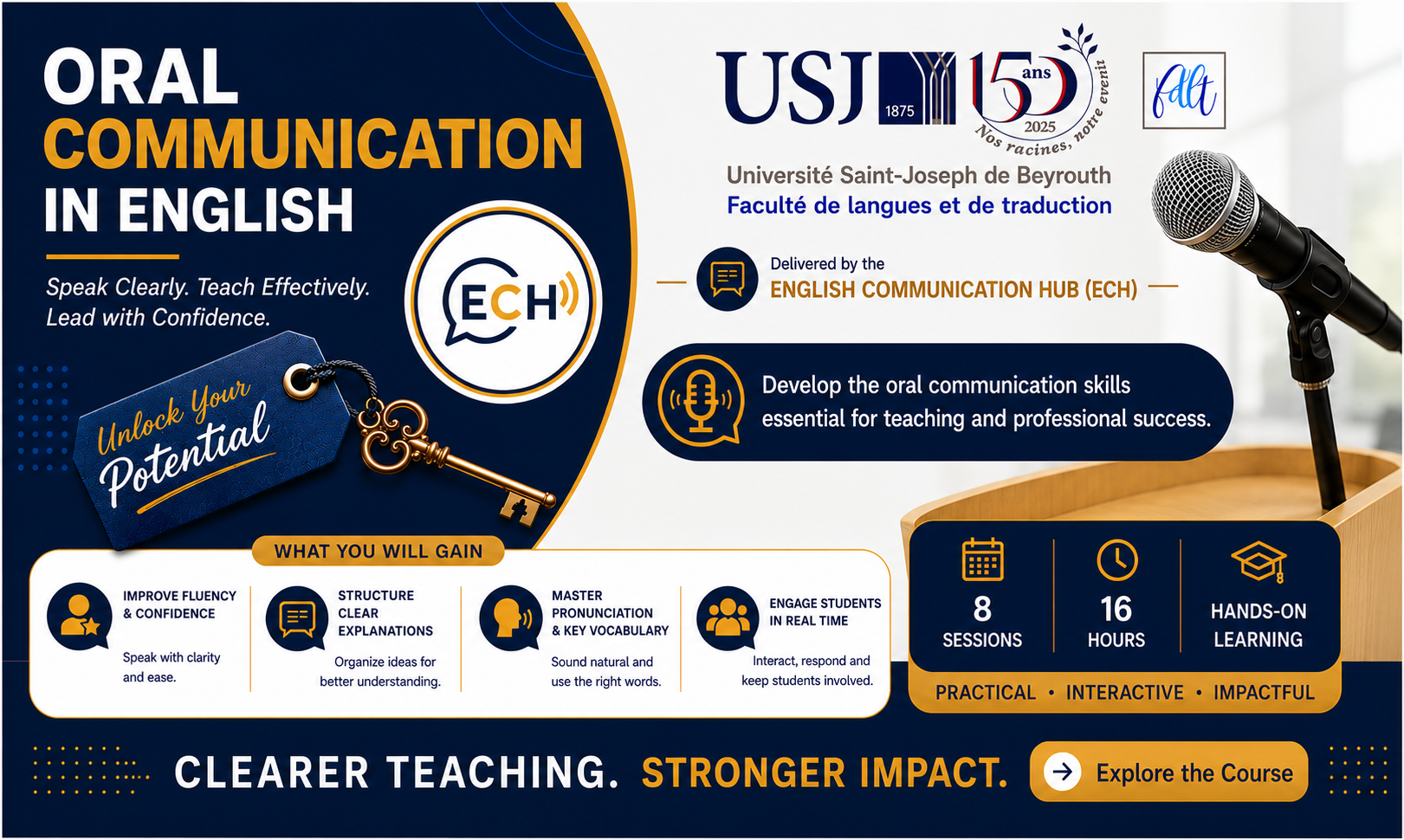
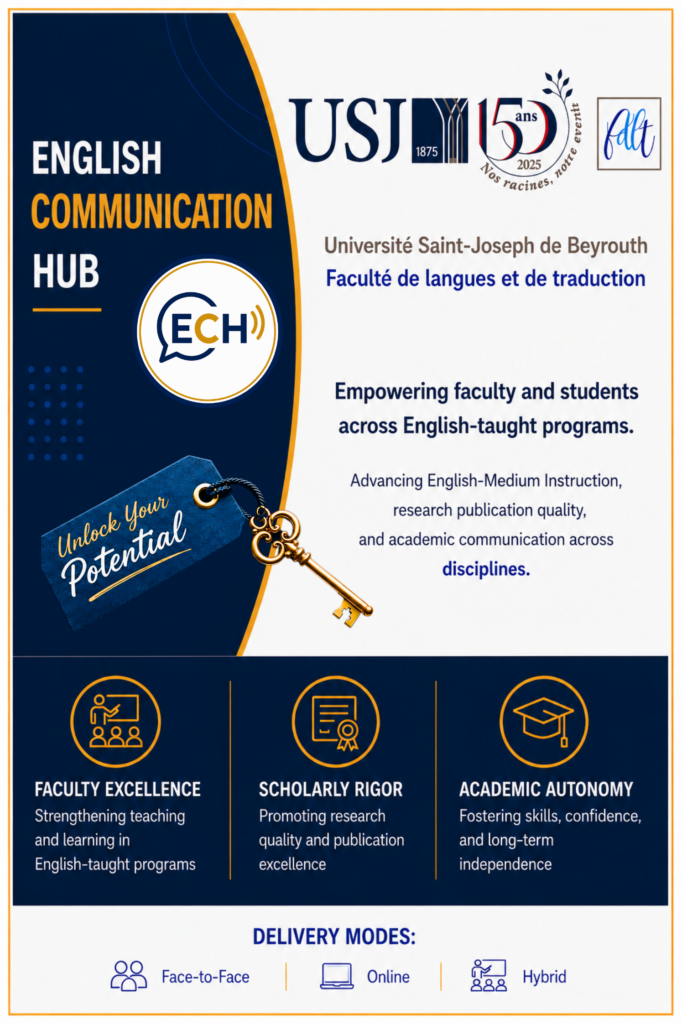
ECH Program on Oral Communication- EMI
This program is aimed at educators who wish to hone their skills in oral communication in English-Medium Instruction (EMI) contexts.
It develops professors into clear and confident communicators in English, capable of teaching complex concepts using the structure, clarity, and engagement of the American teaching approach.
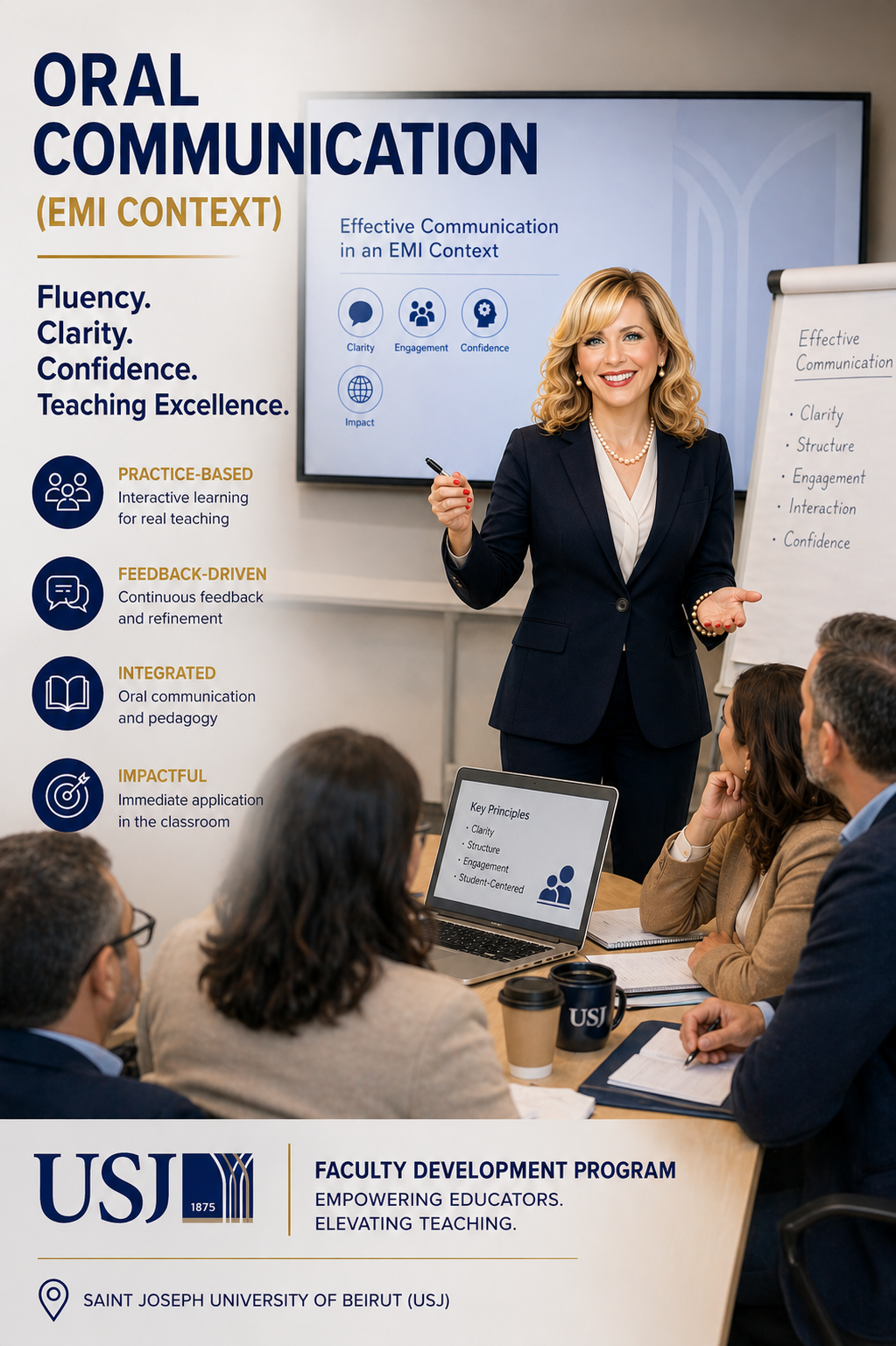
ORAL COMMUNICATION
English-Medium Instruction (EMI) Context
Clarity. Confidence. Teaching Excellence.
Saint Joseph University of Beirut (USJ)
OBJECTIVE
To empower faculty across disciplines to improve oral fluency, communicate clearly and confidently in English, and teach more effectively in an English-Medium Instruction (EMI) context.
CORE EMI PRINCIPLES
CORE EMI PRINCIPLES
Foundation of effective teaching in English.
Focus
-
- Communicating content clearly in English
- Supporting understanding in multilingual classrooms
- Creating structured and engaging learning experiences
Core Elements
-
- Clarity over complexity
- Structured delivery
- Scaffolding for understanding
- Comprehension checking
- Strategic use of language
- Student engagement
- Psychological safety
In Practice
-
- Use simple, direct language instead of complex or translated sentences
- Organize explanations using clear structure (e.g., Why - How - What)
- Break down complex ideas step by step
- Check understanding regularly through targeted questions
- Rephrase, repeat, and emphasize key concepts
- Encourage participation and interaction
- Create a safe environment where students feel comfortable speaking
Outcome
-
- Clearer and more effective communication in English
- Improved student understanding and participation
- More structured, engaging, and supportive teaching

Session Details
🔷 SESSION 7 — TEACHING PRESENCE & PSYCHOLOGICAL SAFETY
Instructional confidence shapes participation.
Focus
- Instructor confidence
- Creating a supportive classroom environment
- Developing strong instructional presence in EMI contexts
Core Elements
- Encouraging student participation
- Managing hesitation and mistakes positively
- Building inclusive communication
- Managing multilingual classroom interaction confidently
- Encouraging participation despite language hesitation
Language Integration
- Supportive phrases:
- “That’s a good attempt…”
- “Let’s try again…”
- Reformulation strategies
- Supportive feedback and clarification techniques
- Language for encouragement, redirection, and constructive correction
EMI Principles in Action
- Psychological safety
- Student engagement
- Strategic use of language
Outcome
- Personal communication style framework
- Stronger teaching presence and student comfort
- Increased instructional confidence and classroom participation
🔷 SESSION 7 DETAILS — TEACHING PRESENCE & PSYCHOLOGICAL SAFETY
Instructional confidence shapes participation.
Goal
Develop a confident, supportive, and learner-centered teaching presence that encourages multilingual students to participate, ask questions, make mistakes, and learn actively in English-Medium Instruction (EMI) classrooms.
Focus
- Developing strong instructional presence in EMI
- Building confidence through effective communication
- Creating psychologically safe learning environments
- Encouraging participation despite language barriers
- Managing multilingual classroom interaction confidently
- Responding to mistakes in ways that promote learning
Core Elements
1. What Is Teaching Presence?
Teaching presence is the instructor's ability to communicate confidence, clarity, approachability, and credibility while guiding learning.
Students participate more when instructors appear:
- calm
- organized
- encouraging
- attentive
- supportive
Instructional presence is communicated through both language and behavior.
2. Psychological Safety in EMI
Students in EMI classrooms often hesitate because they fear:
- making language mistakes
- asking "stupid" questions
- misunderstanding instructions
- speaking with an accent
- being judged by classmates
Psychological safety reduces these barriers.
Students participate when they believe:
- mistakes are accepted
- questions are welcomed
- learning is collaborative
- improvement is valued over perfection
3. Encouraging Student Participation
Strategies include:
- inviting multiple viewpoints
- waiting after asking questions
- acknowledging every contribution
- praising effort before accuracy
- using names positively
- encouraging quieter students
- normalizing mistakes as part of learning
4. Responding to Errors Constructively
Instead of highlighting mistakes:
- acknowledge the contribution
- reformulate when necessary
- guide students toward the answer
- reinforce successful thinking
The goal is to preserve confidence while improving understanding.
5. Managing Multilingual Interaction
Students may:
- hesitate
- search for words
- mix languages
- answer incompletely
Effective EMI instructors:
- remain patient
- simplify language
- rephrase questions
- scaffold responses
- maintain the flow of communication
6. Building Instructor Confidence
Confidence comes from preparation rather than personality.
[The 5 Ps: Proper Preparation Prevents Poor Performance]
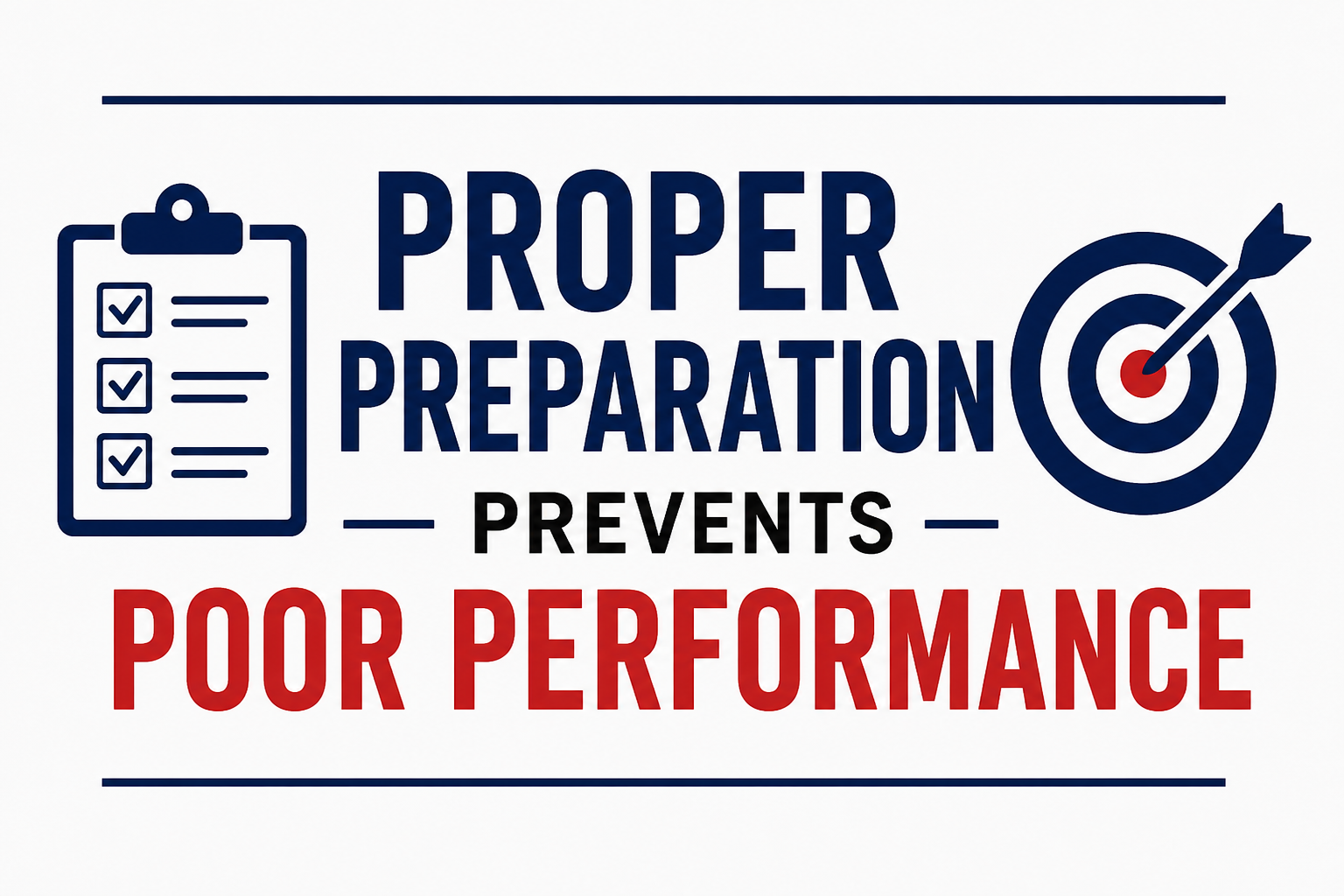
Practice includes:
- using consistent lesson structures
- planning transition language
- anticipating student questions
- using supportive classroom language
- speaking deliberately rather than quickly
Language Integration
Encouraging Participation
- "That's a good question."
- "Thank you for sharing."
- "Let's think about this together."
- "Take your time."
- "Would anyone like to add to that?"
- "There are several possible answers."
Supportive Feedback
- "That's a good start."
- "You're on the right track."
- "Let's refine that idea."
- "Exactly."
- "Almost."
- "Let's say it another way."
- "Can you explain your thinking?"
Clarification Language
- "Could you explain that differently?"
- "What makes you think that?"
- "Can someone build on this answer?"
- "Let's look at another example."
- "Let's revisit the key idea."
Reformulation Strategies
Instead of:
"No, that's wrong."
Try:
"That's an interesting idea. Let's look at it another way."
Instead of:
"Incorrect."
Try:
"You're very close. Let's refine the explanation."
Instead of:
"You don't understand."
Try:
"Let's break it down step by step."
EMI Principles in Action
- Psychological safety
- Student engagement
- Strategic use of language
- Clarity over complexity
- Scaffolding for understanding
- Comprehension checking
Practice Activities [If Time Permits]
Activity 1 — Rewriting Teacher Responses
Participants transform discouraging teacher comments into supportive EMI language.
Activity 2 — Responding to Student Errors
Participants practice responding to authentic student misunderstandings while maintaining psychological safety.
Activity 3 — Classroom Scenarios
Participants respond to situations such as:
- no one answers a question
- students answer in French
- incorrect answers
- hesitant participation
- dominant students
- silent students
Activity 4 — Supportive Language Role Play
Participants practice giving encouragement, clarification, and constructive feedback using authentic teaching situations from dentistry.
Activity 5 — Teaching Presence Reflection
Participants identify:
- strengths in their teaching presence
- habits that encourage participation
- language they want to use more intentionally
- behaviors that build trust in multilingual classrooms
Key Takeaways
Effective EMI instructors do more than explain clearly.
They create learning environments where students feel comfortable thinking, questioning, and communicating in English.
Teaching presence is not about authority alone.
It is about combining clarity, empathy, structure, and supportive communication to make learning accessible for every student.
Outcome
Participants will leave with:
- A personal teaching presence framework
- A repertoire of supportive classroom language
- Strategies for fostering psychological safety
- Greater confidence managing multilingual interaction
- Increased ability to encourage participation while maintaining instructional clarity
Example: Personal Teaching Presence Framework
My Teaching Presence
1. I create a welcoming learning environment.
- I greet students warmly.
- I learn and use their names.
- I encourage questions and different viewpoints.
2. I communicate with clarity.
- I speak at a moderate pace.
- I use short, well-structured sentences.
- I signpost my explanations.
- I pause to allow students time to process information.
3. I encourage participation.
- I wait at least five seconds after asking a question.
- I invite multiple students to contribute.
- I acknowledge every response respectfully.
4. I respond to mistakes positively.
Instead of saying:
"That's wrong."
I say:
"That's a good start."
"Let's think about it another way."
"You're very close."
"Let's build on your idea."
5. I support multilingual learners.
- I simplify difficult terminology.
- I rephrase complex explanations.
- I give examples before asking students to respond.
- I check understanding regularly.
6. I project confidence.
- I maintain eye contact.
- I speak calmly and deliberately.
- I avoid rushing.
- I use positive body language and purposeful movement.
7. I finish every lesson with encouragement.
- I summarize the key ideas.
- I invite final questions.
- I reinforce students' progress.
- I end with a positive message that motivates continued learning.
My Personal Teaching Commitment
I will create a classroom where every student feels respected, supported, and confident to participate. I will communicate clearly, respond to mistakes constructively, and encourage learning through patience, structure, and positive interaction.
Session Handout
Click on the + below
Session 7 Handout
ECH ORAL COMMUNICATION COURSE
Session 7 Handout
TEACHING PRESENCE & PSYCHOLOGICAL SAFETY
Instructional confidence shapes participation.
Learning Goals
By the end of this session, you will be able to:
✓ Develop a confident and supportive instructional presence.
✓ Foster psychological safety in multilingual classrooms.
✓ Encourage active student participation despite language barriers.
✓ Respond to student mistakes in ways that promote learning.
✓ Manage multilingual classroom interaction with confidence.
✓ Build your own Teaching Presence Framework for future teaching.
1. Teaching Presence: More Than Confidence
Many instructors believe that teaching presence is simply confidence.
It is not.
Teaching presence is the combination of your communication, organization, language, attitude, and classroom behaviors that helps students trust you and engage with learning.
Students quickly form impressions about whether a classroom feels safe.
A strong teaching presence communicates:
✓ Confidence
✓ Competence
✓ Clarity
✓ Warmth
✓ Respect
✓ Approachability
Teaching presence is communicated through both what you say and how you say it.
Reflect
Think about one teacher you remember positively.
What behaviors made you feel comfortable learning?
2. Psychological Safety in EMI
What is Psychological Safety?
Psychological safety is the belief that students can:
• ask questions
• express uncertainty
• make mistakes
• participate
without fear of embarrassment or ridicule.
Learning cannot flourish if students are afraid to speak.
Why Does It Matter in EMI?
Students learning through English often hesitate because they worry about:
✓ making language mistakes
✓ speaking with an accent
✓ misunderstanding instructions
✓ asking questions in English
✓ being judged by classmates
✓ appearing less knowledgeable because of language limitations
Your response determines whether they participate again.
Students Participate More When They Believe...
✓ Mistakes are accepted.
✓ Questions are encouraged.
✓ Everyone is still learning.
✓ Improvement matters more than perfection.
3. Teaching Behaviors That Encourage Participation
Small teaching behaviors have a big impact.
Instead of trying to "motivate students," create conditions that make participation easier.
Effective Strategies
✓ Learn students' names.
✓ Smile and maintain positive eye contact.
✓ Wait at least five seconds after asking questions.
✓ Accept different viewpoints.
✓ Praise effort before accuracy.
✓ Invite quieter students into the discussion.
✓ Normalize mistakes as part of learning.
Wait Time Matters
Many instructors answer their own questions after only one or two seconds.
Research consistently shows that increasing wait time leads to:
• longer student responses
• greater participation
• deeper thinking
• improved confidence
Sometimes the best teaching strategy is simply to wait.
4. Responding to Mistakes Constructively
Students learn more when mistakes become opportunities rather than failures.
Avoid shutting down participation.
Instead:
Acknowledge
"Thank you for sharing."
Encourage
"That's a good start."
Reformulate
"Let's think about it another way."
Guide
"What evidence supports your answer?"
Reinforce
"You're very close."
Instead of This...
| Avoid | Try Instead |
|---|---|
| That's wrong. | That's an interesting idea. Let's look at it another way. |
| Incorrect. | You're very close. Let's refine the explanation. |
| No. | Let's think through it together. |
| You don't understand. | Let's break it down step by step. |
| Anyone else? | Let's build on this answer together. |
5. Managing Multilingual Classrooms
In EMI classrooms, students may:
✓ hesitate
✓ search for vocabulary
✓ mix languages
✓ answer incompletely
✓ remain silent
This is normal.
Effective EMI instructors remain patient and keep communication moving.
Practical Strategies
✓ Simplify your language.
✓ Rephrase difficult questions.
✓ Scaffold responses.
✓ Encourage partial answers.
✓ Clarify key terminology.
✓ Check understanding frequently.
Remember:
Communication is more important than linguistic perfection.
6. Building Instructor Confidence
Confidence is rarely a personality trait.
It is usually the result of preparation.
The Five Ps
Proper Preparation Prevents Poor Performance
Preparation reduces anxiety because it reduces uncertainty.
Before every lesson, prepare:
✓ Lesson structure
✓ Key explanations
✓ Transition language
✓ Examples
✓ Questions students may ask
✓ Clarification strategies
✓ Closing summary
The better prepared you are, the more naturally confidence will emerge.
7. Language That Builds Psychological Safety
Encouraging Participation
- "That's a good question."
- "Thank you for sharing."
- "Take your time."
- "Let's think about this together."
- "Would anyone like to add to that?"
- "There are several possible answers."
Supportive Feedback
- "That's a good start."
- "You're on the right track."
- "Let's refine that idea."
- "Exactly."
- "Almost."
- "Can you explain your thinking?"
Clarification Language
- "Could you explain that differently?"
- "Let's revisit the key idea."
- "Can someone build on this answer?"
- "Let's look at another example."
8. EMI Principles in Action
This session integrates six key EMI principles.
| EMI Principle | Classroom Practice |
|---|---|
| Psychological Safety | Students feel safe participating. |
| Student Engagement | Encourage active participation. |
| Strategic Language | Choose language intentionally. |
| Clarity over Complexity | Keep explanations accessible. |
| Scaffolding | Support students progressively. |
| Comprehension Checking | Confirm understanding regularly. |
9. My Personal Teaching Presence Framework
My Teaching Presence
I create a welcoming classroom by:
I communicate clearly by:
I encourage participation by:
I respond to mistakes by:
I support multilingual learners by:
I project confidence by:
I end each lesson by:
My Personal Teaching Commitment
Complete the statement below.
I will create a classroom where every student feels respected, supported, and confident to participate. I will communicate clearly, respond to mistakes constructively, and encourage learning through patience, structure, and positive interaction.
Additional commitments:
Key Takeaways
✓ Teaching presence is a skill that can be developed.
✓ Students participate when they feel psychologically safe.
✓ Supportive language encourages confidence and engagement.
✓ Mistakes should be treated as opportunities for learning.
✓ Preparation is one of the strongest sources of instructional confidence.
✓ Effective EMI teaching combines clarity, empathy, structure, and intentional communication.
The EMI Mastery Review
ECH EMI Communication Framework
Final Review (Sessions 1–7)
SESSION 1
Awareness Before Improvement
The Big Idea
You cannot improve what you cannot see.
We began by analyzing our own teaching and identifying communication habits that reduce clarity.
Remember
✓ Speak naturally—not by translating from French.
✓ Focus on communication, not perfection.
✓ Clarity matters more than sounding sophisticated.
Key EMI Principles
• Clarity over complexity
• Structured delivery
SESSION 2
Fluency
The Big Idea
Good teachers think about ideas—not grammar.
Students understand teachers who speak smoothly and confidently.
Remember
✓ Speak in chunks.
✓ Pause naturally.
✓ Don't mentally translate.
✓ Keep sentences manageable.
Ask Yourself
Am I speaking naturally or constructing every sentence?
SESSION 3
Intelligibility
The Big Idea
Students cannot learn if they cannot understand the words.
Accent is acceptable.
Being understandable is essential.
Remember to focus on:
• word stress
• rhythm
• pacing
• emphasis
• key terminology
Ask Yourself
Would every student understand me the first time?
SESSION 4
Clear Teaching Language
The Big Idea
Many communication problems come from language interference—not lack of knowledge.
Remember
Avoid
• French sentence structure
• false friends
• overloaded sentences
Instead
✓ simplify
✓ shorten
✓ reformulate
✓ explain naturally
Ask Yourself
Am I speaking English—or translating French?
SESSION 5
Structure
The Big Idea
Students remember organized explanations.
They forget disorganized explanations.
Always Use
Beginning
Today we will...
Middle
First...
Next...
Now let's examine...
Finally...
Conclusion
The main idea is...
Remember
Structure reduces cognitive load.
SESSION 6
Scaffolding
The Big Idea
Teaching is helping students understand—not simply delivering information.
Remember
Good teachers constantly ask
Do students understand?
Can they follow?
What support do they need?
Use
✓ examples
✓ comparisons
✓ analogies
✓ chunking
✓ questions
✓ comprehension checks
Ask Yourself
Have I made learning easier to understand?
SESSION 7
Teaching Presence
The Big Idea
Students participate when they feel safe.
Confidence creates participation.
Remember
Be
✓ calm
✓ organized
✓ encouraging
✓ approachable
✓ supportive
Mistakes are opportunities for learning.
Ask Yourself
Would I enjoy being a student in my own classroom?
The Seven Habits of an Excellent EMI Teacher
Excellent EMI teachers:
✓ explain clearly
✓ speak fluently
✓ are easy to understand
✓ use natural English
✓ organize information logically
✓ scaffold learning
✓ create psychologically safe classrooms
The Final Question
When students leave your classroom, they should never say:
"I know my professor is intelligent…
…but I didn't understand."
Instead, they should say:
"My professor explained difficult ideas clearly."
That is successful EMI.
Program FAQs
What is the course format?
The course is highly interactive, practice-based, and performance-driven.
Each session combines:
- Short, focused input
- Guided speaking practice
- Real teaching simulations (micro-teaching)
- Immediate feedback from the instructor and peers
Participants will:
- Record and analyze their own speaking
- Apply communication strategies to real teaching scenarios
- Engage in live activities using tools such as Poll Everywhere and Mentimeter
The course follows a progressive structure, allowing participants to build fluency, clarity, and confidence step by step.
Where will the sessions take place?
The sessions will take place at USJ (on campus), online, or hybrid.
What is the main objective of the course?
The Main Objective of the Course:
To transform how instructors teach in English by developing their ability to deliver clear, structured, and effective instruction in multilingual classrooms—moving beyond language fluency to achieve real student understanding and engagement in an English-Medium Instruction (EMI) context.
Who teaches the course?
The course is taught by Nada M. Salem, President/CEO of AFEE and IFWE.
 Nada M. Salem is a passionate educator with extensive experience in leading academic institutions in the United States and abroad. Over more than twenty years, she has taught school students, college students, student teachers, teachers, and leaders. She co-created and co- taught a methods course for teachers at The George Washington University Graduate School of Education. Nada is the Co-Editor in Chief of “Teaching World Languages: A Practical Guide- Arabic Edition” (The National Capital Language Resource Center, Washington, DC).
Mrs. Salem holds a teaching diploma, two master's degrees, one in translation and another in education, and has successfully completed most courses (40 credits) towards a doctorate (Ed.D.) in Curriculum and Instruction & Educational Technology Leadership at The George Washington University Graduate School of Education. Additionally, she holds an Executive Certificate in Public Leadership from Harvard University. Mrs. Salem formerly served as Administrative Director and Assessment of Learning Coordinator for AACSB Accreditation at the GWU School of Business’s Master of Science in Finance Program. In September 2019, Mrs. Salem was selected as a WOMAN LEADER by the University of Maryland‘s Kahlil Gibran Chair for Values and Peace. She is a member of the Marquis WHO'S WHO® list of Prominent Business Professionals, and she was featured among Marquis Who's Who's Top Executives in Education and Leadership.
Mrs. Salem is the Founding President/CEO of the American Foundation for Educational Excellence (AFEE), an organization whose mission is to help, on a worldwide basis, influencers, leaders, HR professionals, and managers of educational institutions, profit and non-profit organizations and corporations, to pursue excellence by improving leadership skills, managerial competencies and educational programs, namely through face-to-face and online trainings. AFEE is an Approved Provider for both HRCI & SHRM.
Mrs. Salem is also the Founding President/CEO of AFEE’s subsidiaries, the Center for Excellence in Languages: Teaching, Editing, Translating, and Interpreting, and the International Foundation for Women's Empowerment (IFWE) which seeks to empower all women and help them thrive on the personal and professional levels, regardless of nationality and religion.

TERMS OF SERVICE: We reserve the right, in our sole discretion, to reject or remove anyone who has registered or gained access under false pretenses, provided false information, or for any other action or behavior that we deem inappropriate, before, during or after the sessions, with or without prior notice or explanation, and without liability.
IMPORTANT DISCLAIMER: All rights reserved. The information on this page shall be considered proprietary information not to be used, copied or reproduced in any way. No part of our presentations / workshops / webinars may be reproduced, distributed, or transmitted in any form or by any means, including photocopying, recording, or other electronic or mechanical methods.