ECH Program on Oral Communication- EMI
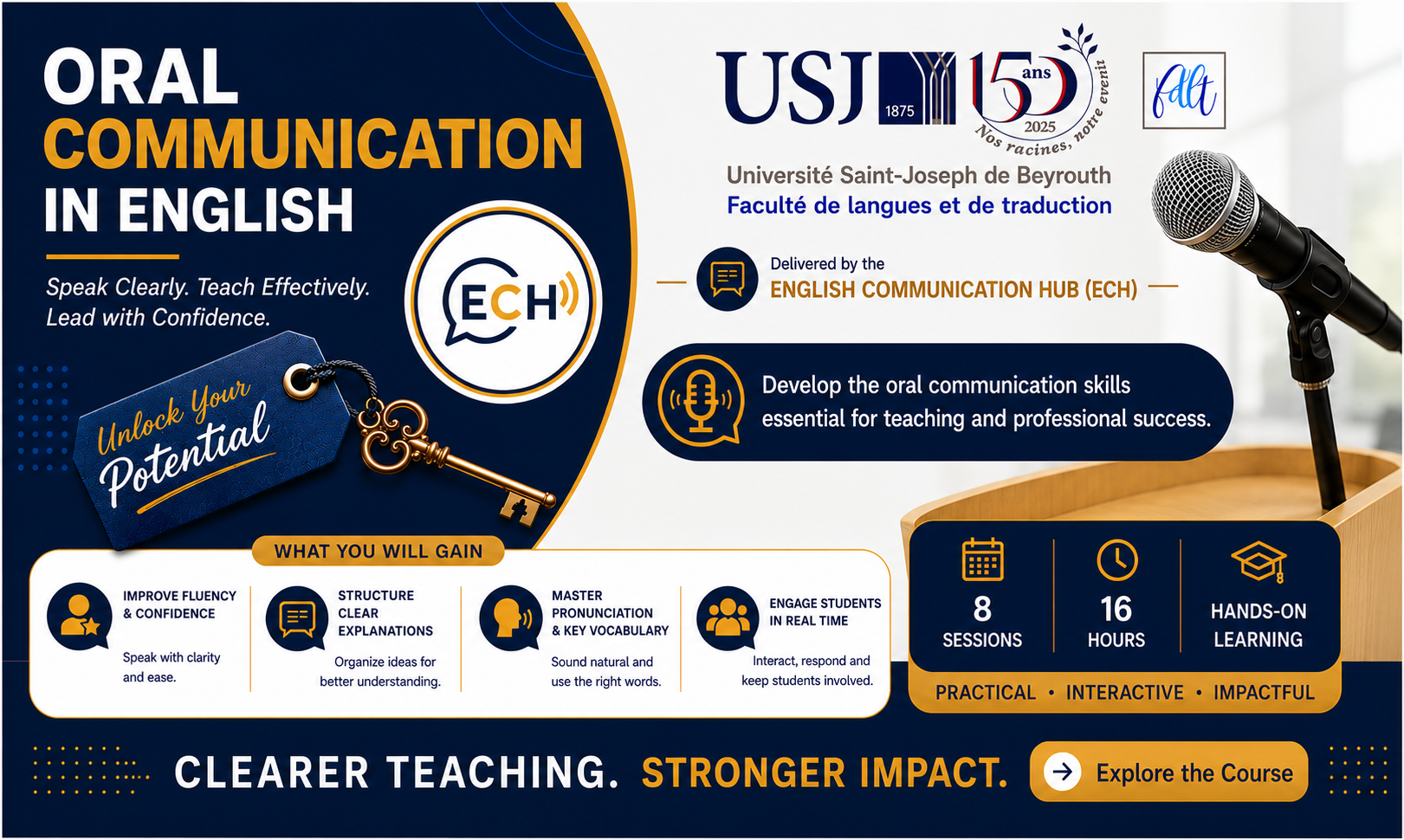
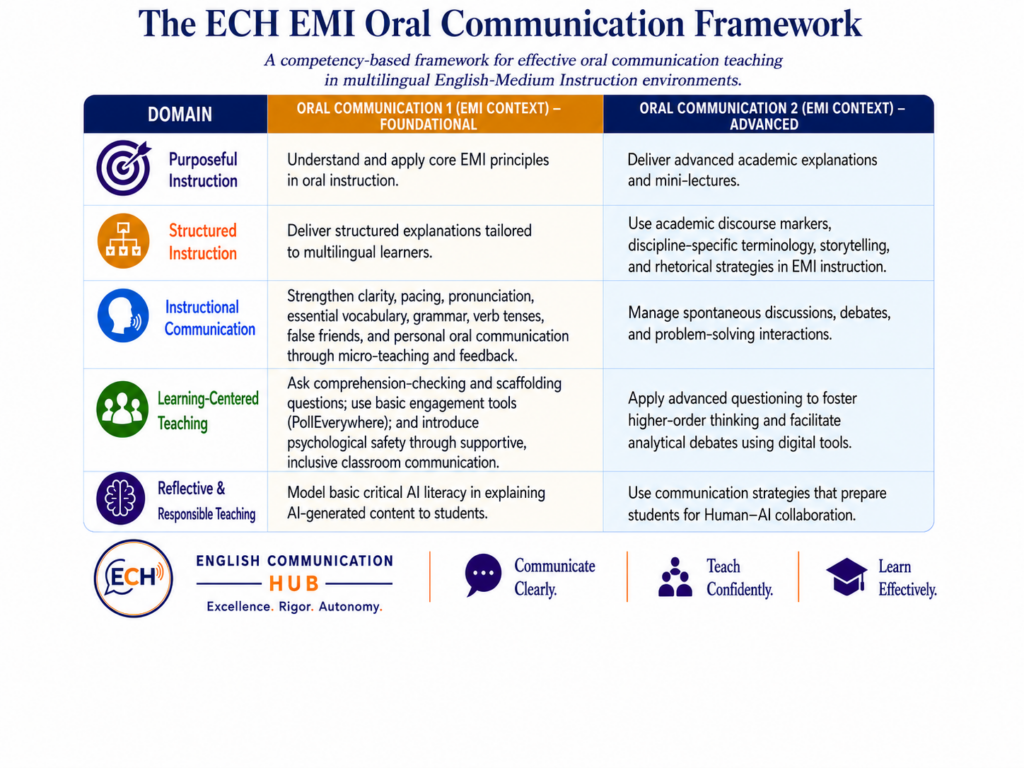
This program is aimed at educators who wish to hone their skills in oral communication in English-Medium Instruction (EMI) contexts.
It develops professors into clear and confident communicators in English, capable of teaching complex concepts using the structure, clarity, and engagement of the American teaching approach.
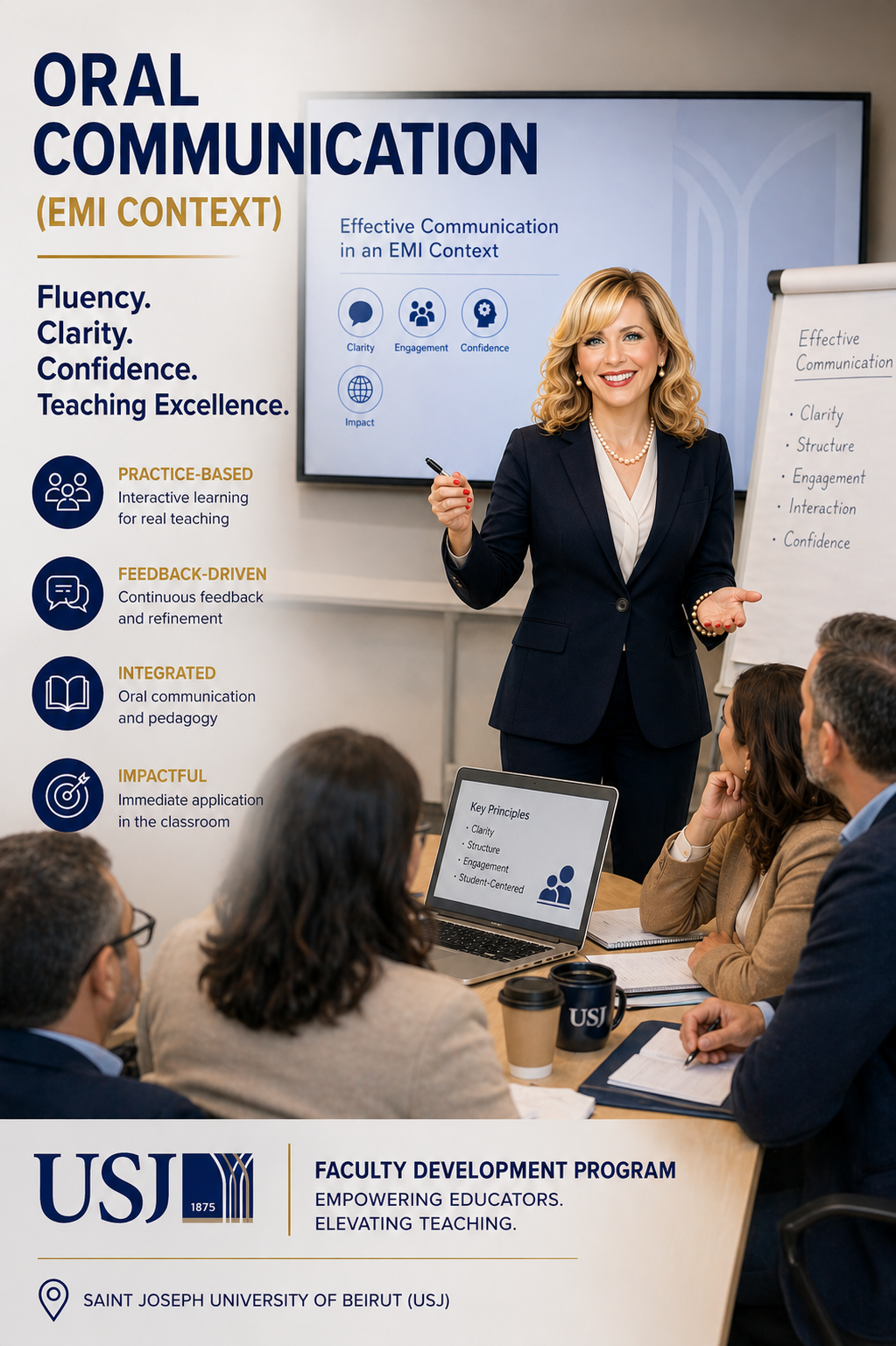
ORAL COMMUNICATION
English-Medium Instruction (EMI) Context
Clarity. Confidence. Teaching Excellence.
Saint Joseph University of Beirut (USJ)
OBJECTIVE
To empower faculty across disciplines to improve oral fluency, communicate clearly and confidently in English, and teach more effectively in an English-Medium Instruction (EMI) context.
CORE EMI PRINCIPLES
CORE EMI PRINCIPLES
Foundation of effective teaching in English.
Focus
-
- Communicating content clearly in English
- Supporting understanding in multilingual classrooms
- Creating structured and engaging learning experiences
Core Elements
-
- Clarity over complexity
- Structured delivery
- Scaffolding for understanding
- Comprehension checking
- Strategic use of language
- Student engagement
- Psychological safety
In Practice
-
- Use simple, direct language instead of complex or translated sentences
- Organize explanations using clear structure (e.g., Why - How - What)
- Break down complex ideas step by step
- Check understanding regularly through targeted questions
- Rephrase, repeat, and emphasize key concepts
- Encourage participation and interaction
- Create a safe environment where students feel comfortable speaking
Outcome
-
- Clearer and more effective communication in English
- Improved student understanding and participation
- More structured, engaging, and supportive teaching

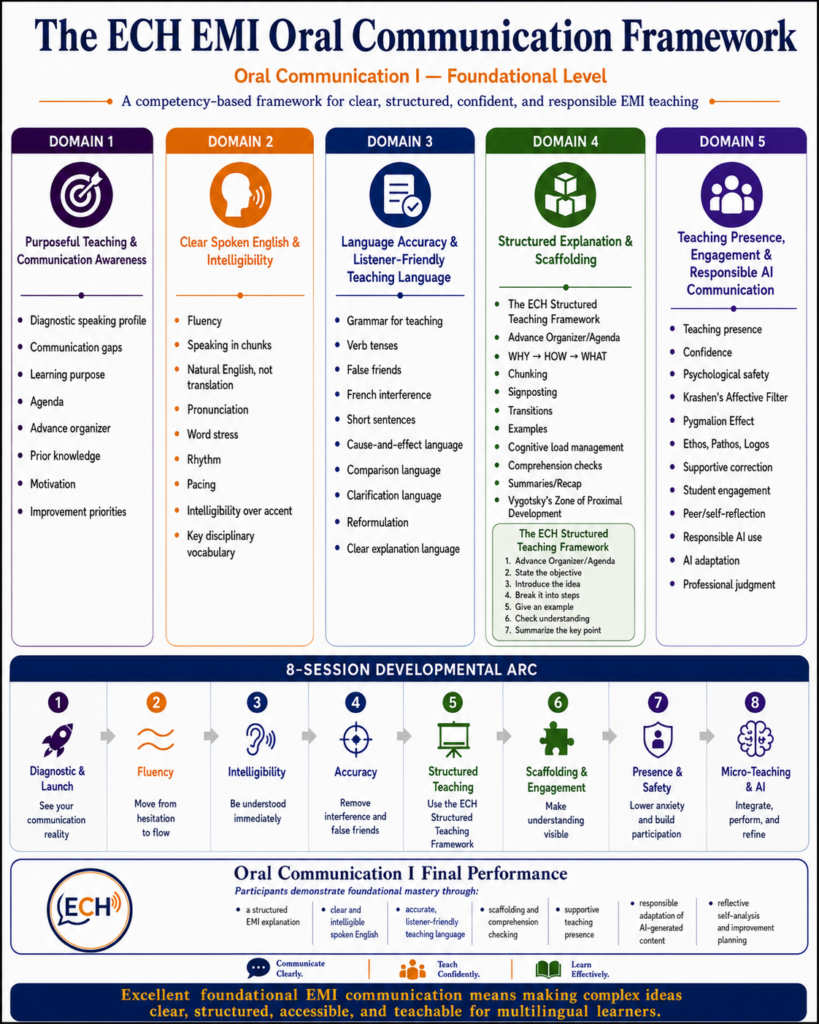
Session Details
🟡 SESSION 8 — MICRO-TEACHING & INTEGRATION (WITH AI- AWARE COMMUNICATION)
Integrate. Perform. Refine.
Focus
- Full integration of skills
- Performance and refinement
- Applying EMI communication principles in authentic teaching performance
- Responsible and effective use of AI-supported teaching communication
Core Elements
- 5–7 minute micro-teaching (recorded)
- Feedback using diagnostic rubric
- Structured self-analysis and peer feedback
- Explaining AI-generated content clearly (limits, risks, appropriate use)
- Adapting AI-generated content into clear, teachable explanations
- Clarifying uncertainty, limitations, and reliability of AI outputs
Language Integration
- Clear explanation and justification language
- Responsible framing of AI outputs
- Language for clarification, contextualization, and instructional mediation
- Communicating AI-generated information with clarity and cognitive responsibility
EMI Principles in Action
- All EMI principles integrated
Outcome
- Final performance evaluation
- Individual improvement roadmap
- Increased confidence and teaching effectiveness
- Integrated EMI communication performance framework
- Stronger instructional clarity, confidence, and cognitive agency in AI-mediated teaching contexts
🟡 SESSION 8 DETAILS — MICRO-TEACHING & INTEGRATION (WITH AI- AWARE COMMUNICATION)
Integrate. Perform. Refine.
The rubric below is your roadmap to success. In mastery-oriented learning, assessment criteria are transparent from the beginning. You know exactly what excellence looks like, so you can prepare intentionally rather than guess what will be evaluated.
This rubric does not assess your English alone. It assesses your ability to think and communicate as an effective university teacher in an English-Medium Instruction classroom.
Throughout this course, we have learned that excellent teaching is not measured by how much you know, but by how well your students understand, engage, and learn.
Adapted Rubric
POLL
ECH ORAL COMMUNICATION 1 (EMI)
Final Micro-Teaching Assessment Rubric
Foundational Level | 100 Points
| Criterion | A – Excellent | B – Very Good | C – Satisfactory | D – Developing | F – Unsatisfactory |
|---|---|---|---|---|---|
| 1. Instructional Clarity 15 pts | 14–15 pts Explanations are consistently clear, concise, and immediately understandable. Complex ideas are made accessible without being oversimplified. The instructor uses short, listener-friendly sentences and highlights the key message clearly. | 12–13 pts Explanations are generally clear, with only minor moments of ambiguity. Most ideas are easy to follow. | 10–11 pts Main ideas are understandable, but some explanations lack clarity, precision, or simplicity. | 8–9 pts Explanations are frequently unclear, overloaded, or too complex for learners to follow easily. | 0–7 pts Students would struggle to understand the explanation. |
| 2. Purpose, Structure & Cognitive Organization 15 pts (Agenda • Advance Organizer • Why–How–What • Chunking • Signposting) | 14–15 pts The lesson begins with clear learning outcomes, an agenda or advance organizer, and a strong sense of purpose. The instructor explains why the topic matters, organizes ideas logically, breaks content into manageable chunks, uses transitions and signposting, and concludes with a clear summary or recap. The ECH Structured Teaching Framework is clearly visible: Advance Organizer/Agenda → State the Objective → Introduce the Idea → Break It into Steps → Give an Example → Check Understanding → Summarize the Key Point. | 12–13 pts The lesson is well organized and easy to follow, with clear progression and only minor weaknesses in transitions, chunking, or final summary. | 10–11 pts Basic structure is present, but the roadmap, transitions, or sequencing are inconsistent. Some sections may feel underdeveloped. | 8–9 pts Organization is weak. Ideas jump too quickly, and students may struggle to see how the explanation is developing. | 0–7 pts No clear structure is evident. The explanation feels disorganized and difficult to follow. |
| 3. Fluency & Natural Delivery 10 pts | 9–10 pts The instructor speaks fluently and confidently, with natural pacing and minimal hesitation. Speech is delivered in meaningful chunks rather than word-by-word translation. The instructor sounds natural, not memorized or overly translated from French. | 8 pts Delivery is mostly smooth, with minor hesitation that does not interfere with comprehension. | 7 pts Hesitation is noticeable and occasionally interrupts communication. | 6 pts Frequent pauses, fillers, or sentence breakdowns reduce effectiveness. | 0–5 pts Delivery is fragmented, hesitant, and difficult to follow. |
| 4. Intelligibility: Pronunciation, Word Stress, Rhythm & Pacing 10 pts | 9–10 pts Speech is consistently easy to understand. Pronunciation, word stress, rhythm, emphasis, and pacing support comprehension. The instructor demonstrates the principle: intelligibility over accent. Key disciplinary vocabulary is pronounced clearly. | 8 pts Minor pronunciation, stress, or pacing issues occur but do not interfere with understanding. | 7 pts Occasional pronunciation, stress, or pacing issues slightly affect comprehension. | 6 pts Frequent pronunciation, rhythm, stress, or pacing problems interfere with understanding. | 0–5 pts Speech is often difficult to understand. |
| 5. Language Accuracy & Listener-Friendly Teaching Language 10 pts (Grammar • Tenses • False Friends • Reformulation) | 9–10 pts The instructor uses accurate grammar and verb tenses, avoids false friends and French interference, and communicates in natural instructional English. Sentences are manageable and listener-friendly. The instructor uses cause-and-effect language, comparison language, clarification language, and reformulation effectively. | 8 pts Minor grammatical or lexical errors occur but have little impact on clarity. | 7 pts Several language errors or interference patterns are noticeable and occasionally affect clarity. | 6 pts Frequent grammar, tense, false-friend, or French-influenced structures reduce instructional clarity. | 0–5 pts Persistent language errors significantly interfere with communication. |
| 6. Student Engagement & Learning Support 15 pts (Scaffolding • ZPD • Guided Questioning • Comprehension Checking) | 14–15 pts The instructor builds on prior knowledge, asks guiding questions, uses examples, reformulates difficult ideas, checks comprehension continuously, and adjusts explanations when learners appear confused. Scaffolding is visible and purposeful. The instructor supports learners within Vygotsky’s Zone of Proximal Development by making difficult ideas accessible without removing intellectual challenge. | 12–13 pts The instructor uses several effective scaffolding and engagement techniques appropriately. | 10–11 pts Some learner support is present, but scaffolding and comprehension checking are inconsistent. | 8–9 pts Limited support is provided. The instructor explains but does not sufficiently guide understanding. | 0–7 pts Little or no evidence of scaffolding, questioning, or comprehension monitoring. |
| 7. Comprehension Checking & Interaction 10 pts | 9–10 pts The instructor actively monitors understanding through purposeful questions, comprehension checks, wait time, and interaction. Students are invited to participate, explain, predict, compare, or apply ideas. Understanding is made visible. | 8 pts Good interaction is present, with occasional comprehension checks. | 7 pts Some attempts are made to involve students, but interaction remains limited. | 6 pts Minimal questioning or comprehension checking is used. | 0–5 pts No meaningful interaction or monitoring of understanding is evident. |
| 8. Teaching Presence, Credibility & Learner Trust 5 pts (Ethos • Pathos • Logos • Psychological Safety) | 5 pts The instructor demonstrates confidence, calmness, credibility, and professionalism. The instructor establishes Ethos through expertise, Logos through clear reasoning, and Pathos through connection with learners. The teaching style creates psychological safety, lowers Krashen’s affective filter, communicates high expectations through the Pygmalion Effect, responds positively to mistakes, and encourages participation. | 4 pts The instructor is generally confident, credible, and supportive, with minor areas for refinement. | 3 pts Teaching presence is adequate but confidence, rapport, or learner trust is inconsistent. | 2 pts Limited confidence or approachability affects the classroom climate. | 0–1 pt The teaching style discourages participation or creates discomfort. |
| 9. AI-Mediated Teaching & Professional Judgment 10 pts | 9–10 pts The instructor evaluates AI-generated content critically, verifies information, identifies limitations, explains uncertainty, contextualizes AI output, adapts it for multilingual learners, and uses AI to enhance—not replace—professional expertise. AI content is transformed into a clear, teachable explanation. | 8 pts AI is used responsibly, with only minor omissions in evaluation, adaptation, or explanation. | 7 pts The instructor shows basic awareness of AI limitations but relies too heavily on AI output. | 6 pts Limited critical evaluation of AI-generated information is evident. | 0–5 pts AI-generated content is accepted or presented uncritically, inaccurately, or without appropriate adaptation. |
Overall Performance Levels
| Final Score | Grade | Performance Level |
|---|---|---|
| 90–100 | A | Excellent – Demonstrates mastery of EMI communication and teaching practices. |
| 80–89 | B | Very Good – Demonstrates strong EMI teaching skills with minor areas for refinement. |
| 70–79 | C | Satisfactory – Meets essential expectations but requires further development. |
| 60–69 | D | Developing – Demonstrates emerging skills but significant improvement is needed. |
| Below 60 | F | Unsatisfactory – Does not yet meet the expected standards for effective EMI teaching. |
An A-level performance should naturally include phrases such as:
- Agenda / Advance Organizer: "Today we will...", "Our objectives are..."
- Signposting: "First...", "Next...", "Now let's move to...", "Finally..."
- Chunking: "Let's break this down into three parts."
- Emphasis: "The key idea is...", "This is important because..."
- Checking Understanding: "Does that make sense?", "Can someone explain this in their own words?"
- Reformulation: "Another way to think about this is..."
Developmental Feedback:
| Strengths to Build On | |
|---|---|
| Priority Areas for Improvement | |
| Personal Action Plan Before the Next Teaching Session |
Across the entire course
The ultimate question is not:
"Did the professor speak good English?"
It is:
"Could multilingual students understand, follow, trust, and learn from this professor?"
Program FAQs
What is the course format?
The course is highly interactive, practice-based, and performance-driven.
Each session combines:
- Short, focused input
- Guided speaking practice
- Real teaching simulations (micro-teaching)
- Immediate feedback from the instructor and peers
Participants will:
- Record and analyze their own speaking
- Apply communication strategies to real teaching scenarios
- Engage in live activities using tools such as Poll Everywhere and Mentimeter
The course follows a progressive structure, allowing participants to build fluency, clarity, and confidence step by step.
Where will the sessions take place?
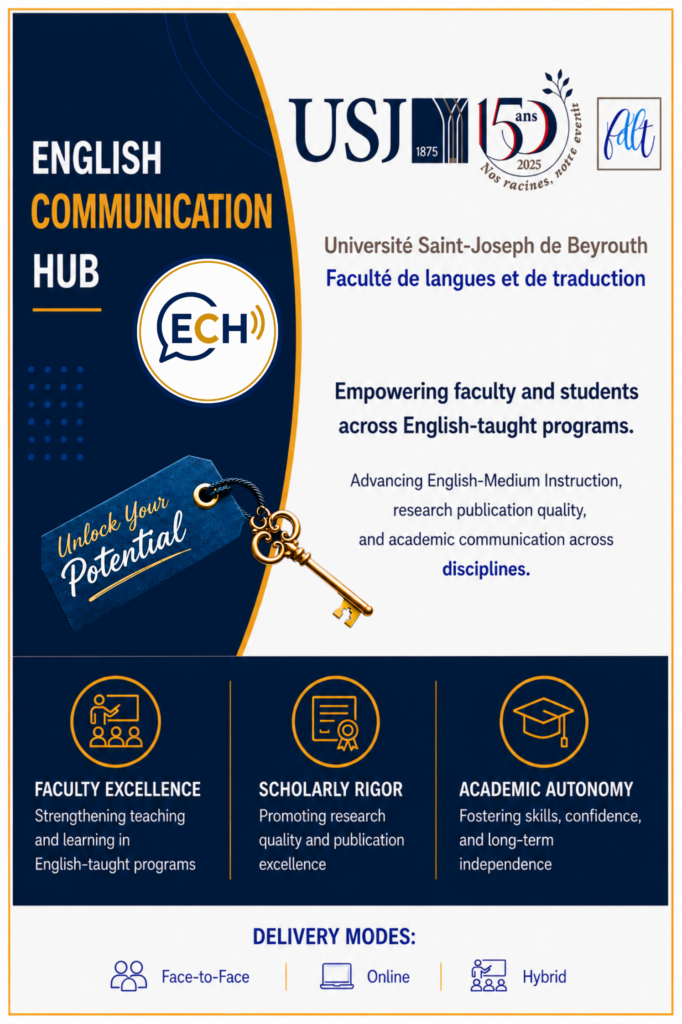
The sessions will take place at USJ (on campus), online, or hybrid.
What is the main objective of the course?
The Main Objective of the Course:
To transform how instructors teach in English by developing their ability to deliver clear, structured, and effective instruction in multilingual classrooms—moving beyond language fluency to achieve real student understanding and engagement in an English-Medium Instruction (EMI) context.
Who teaches the course?
The course is taught by Nada M. Salem, President/CEO of AFEE and IFWE.
 Nada M. Salem is a passionate educator with extensive experience in leading academic institutions in the United States and abroad. Over more than twenty years, she has taught school students, college students, student teachers, teachers, and leaders. She co-created and co- taught a methods course for teachers at The George Washington University Graduate School of Education. Nada is the Co-Editor in Chief of “Teaching World Languages: A Practical Guide- Arabic Edition” (The National Capital Language Resource Center, Washington, DC).
Mrs. Salem holds a teaching diploma, two master's degrees, one in translation and another in education, and has successfully completed most courses (40 credits) towards a doctorate (Ed.D.) in Curriculum and Instruction & Educational Technology Leadership at The George Washington University Graduate School of Education. Additionally, she holds an Executive Certificate in Public Leadership from Harvard University. Mrs. Salem formerly served as Administrative Director and Assessment of Learning Coordinator for AACSB Accreditation at the GWU School of Business’s Master of Science in Finance Program. In September 2019, Mrs. Salem was selected as a WOMAN LEADER by the University of Maryland‘s Kahlil Gibran Chair for Values and Peace. She is a member of the Marquis WHO'S WHO® list of Prominent Business Professionals, and she was featured among Marquis Who's Who's Top Executives in Education and Leadership.
Mrs. Salem is the Founding President/CEO of the American Foundation for Educational Excellence (AFEE), an organization whose mission is to help, on a worldwide basis, influencers, leaders, HR professionals, and managers of educational institutions, profit and non-profit organizations and corporations, to pursue excellence by improving leadership skills, managerial competencies and educational programs, namely through face-to-face and online trainings. AFEE is an Approved Provider for both HRCI & SHRM.
Mrs. Salem is also the Founding President/CEO of AFEE’s subsidiaries, the Center for Excellence in Languages: Teaching, Editing, Translating, and Interpreting, and the International Foundation for Women's Empowerment (IFWE) which seeks to empower all women and help them thrive on the personal and professional levels, regardless of nationality and religion.

TERMS OF SERVICE: We reserve the right, in our sole discretion, to reject or remove anyone who has registered or gained access under false pretenses, provided false information, or for any other action or behavior that we deem inappropriate, before, during or after the sessions, with or without prior notice or explanation, and without liability.
IMPORTANT DISCLAIMER: All rights reserved. The information on this page shall be considered proprietary information not to be used, copied or reproduced in any way. No part of our presentations / workshops / webinars may be reproduced, distributed, or transmitted in any form or by any means, including photocopying, recording, or other electronic or mechanical methods.