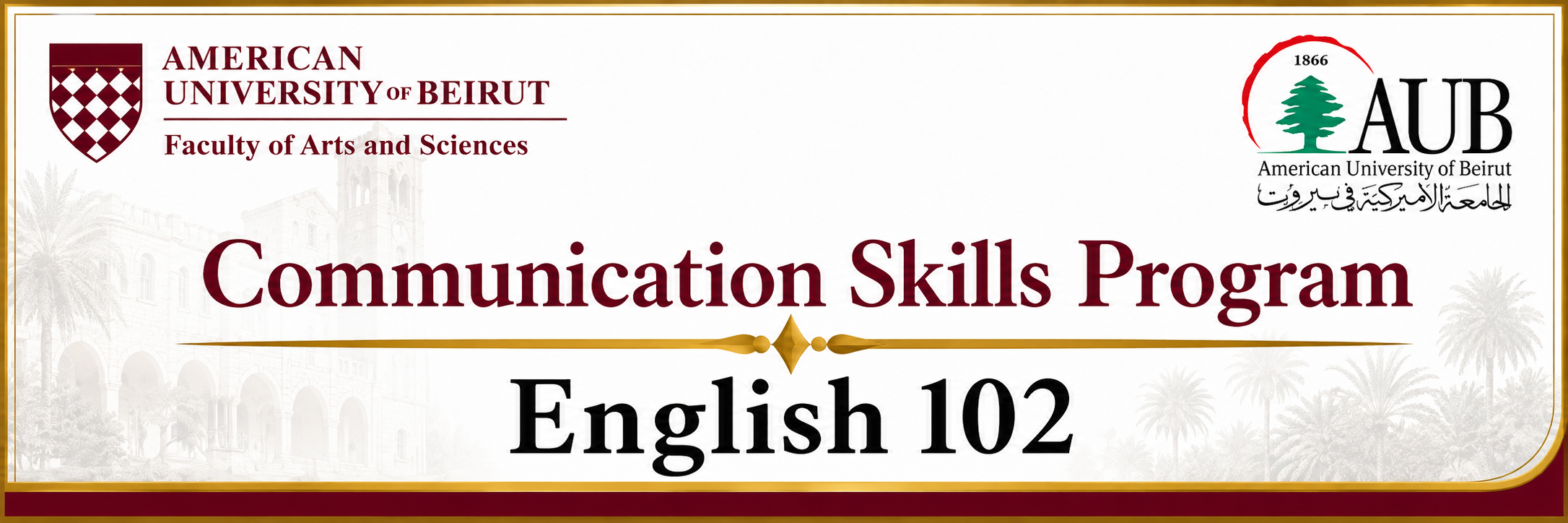
"The Communication Skills Program at AUB adheres to the philosophy that learning to write is a dynamic process, both social and individual, that takes place over time with continual guidance and practice.
The program comprises courses designed to satisfy university requirements and to meet the diverse literacy needs of AUB students. It aims to educate students to use writing and reading for learning, critical thinking, and communication in academic and other social contexts. It seeks to foster a collaborative environment within the program and across the university." Source
COMMUNICATION SKILLS PROGRAM
English 102:
Enrichment Course in English
American University of Beirut (AUB)
WHY ENGLISH 102 MATTERS IN THE AI ERA
English 102 develops the human capabilities students need to succeed in an AI-enabled university and workplace.
AI can already generate text, summarize information, create presentations, and draft essays. What will increasingly distinguish students is their ability to understand complex information, think critically, evaluate ideas, construct sound arguments, communicate clearly, and remain intellectually responsible for their work.
English 102 helps students build these capabilities through critical reading, rhetorical analysis, academic writing, revision, reflection, and ethical use of sources—so that they can become masters of AI, rather than be mastered by it.
For my students:
Your advantage in the AI era will not come from competing with AI at producing words. It will come from learning to think, judge, communicate, and remain in control of the tools.
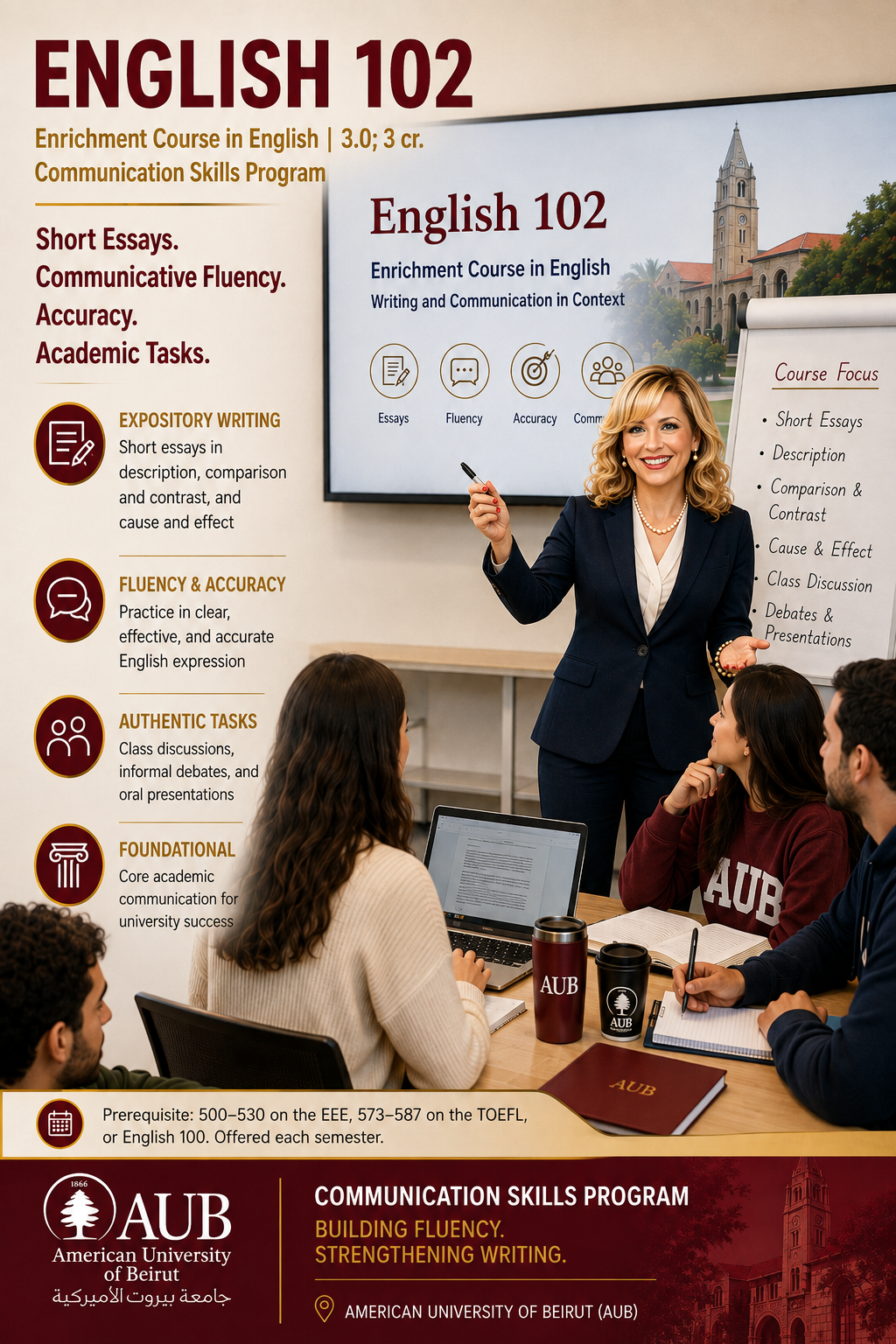

This instructor-created resource supplements the official AUB Moodle course site. Moodle remains the official platform for course materials, submissions, grades, and announcements.
OBJECTIVE
To help students develop the critical reading, analytical writing, rhetorical awareness, and academic communication skills needed to succeed in university and beyond.
COURSE APPROACH
- Close reading and analysis of academic and argumentative texts
- Process-based writing through drafting, feedback, revision, and reflection
- Student-centered learning through discussion, collaboration, and peer review
- Emphasis on clarity, fluency, accuracy, and ethical use of sources
- Progressive preparation for formal analytical responses and the final writing exam
FINAL IMPACT
By the end of the course, students will:
- Read academic texts more critically and strategically
- Analyze arguments and rhetorical choices more effectively
- Write more clear, structured, and analytical academic responses
- Revise their writing more purposefully and independently
- Communicate with greater fluency and accuracy
- Use sources more ethically and responsibly
- Build stronger foundational skills for future university courses and professional communication
THE GOAL
Think critically. Read deeply. Write clearly. Communicate powerfully.
And ultimately:
Master AI—rather than be mastered by it.
[Password Protected]
Course FAQs
What is the course format?
The course is highly interactive, student-centered, and writing-intensive.
Each session combines:
- Short, focused instruction on reading, writing, and rhetorical analysis
- Guided close reading and discussion of academic texts
- Individual, pair, and small-group activities
- Scaffolded analytical writing practice
- Peer review, revision, and reflection
- Instructor feedback and conferencing
Students will:
- Analyze arguments, purpose, audience, tone, and rhetorical strategies
- Practice summarizing, paraphrasing, and responding to academic texts
- Draft and revise analytical responses through a recursive writing process
- Give and receive constructive feedback
- Reflect on their own writing and learning
- Participate in collaborative written and oral activities
- Use Moodle, Turnitin, library resources, and other course tools as required
The course follows a progressive structure, moving from comprehension and active reading to rhetorical analysis, formal academic writing, revision, and increasingly independent performance.
The goal is to help students strengthen their critical thinking, academic writing, fluency, accuracy, and intellectual ownership step by step.
Where will the sessions take place?
The sessions will take place at AUB (on campus).
What is the main objective of the course?
The Main Objective of the Course:
To transform how students read, think, and write in academic contexts by developing their ability to critically analyze texts, construct clear and well-supported arguments, and communicate ideas effectively—moving beyond basic language proficiency to achieve independent thinking, academic mastery, and intellectual ownership in an AI-enabled university and workplace.
Who teaches the course?
The course is taught by Nada M. Salem, President/CEO of AFEE and IFWE.

Nada M. Salem is an academic leader, institutional strategist, and educator working at the intersection of educational excellence, leadership development, and transformation in the AI era.
She is the Founding President and CEO of the American Foundation for Educational Excellence (AFEE) and the International Foundation for Women’s Empowerment (IFWE), through which she designs and leads high-impact initiatives, builds institutional partnerships, and advances leadership and education across the United States, Lebanon, and internationally.
She is also the Founding Director of the Center for Excellence in Languages (CEL), a subsidiary of AFEE specializing in teaching, editing, translation, and interpreting, further strengthening her work in language education and academic communication.
She serves as Adjunct Professor at The George Washington University, where she teaches academic writing, instructional course design, educational technology, and English communication, and mentors international scholars and faculty.
At Saint Joseph University of Beirut, she is Director of the English Communication Hub (ECH), leading university-wide efforts to elevate English-Medium Instruction (EMI), strengthen research publication, and advance academic communication to international standards. She previously served as Representative of the Rector for Educational Excellence and Philanthropy in the United States, contributing to strategic partnerships and institutional outreach.
Her doctoral work advances a framework for learning in the AI era centered on transferable mastery and cognitive agency, examining how universities can redesign curricula, assessment, and teaching practices in AI-mediated environments.
Across her career, she has designed and led academic and leadership programs, trained faculty, and supported institutional development across universities, foundations, and international organizations, bridging pedagogy, communication, and strategy in diverse educational contexts.
She holds a degree in languages and a Master’s in Translation from Saint Joseph University of Beirut, as well as a Teaching Diploma and a Master’s in TEFL from the American University of Beirut. She completed 40 credit hours toward a Doctorate (Ed.D.) in Curriculum & Instruction and Educational Technology Leadership at The George Washington University, and holds an Executive Certificate in Public Leadership from Harvard Kennedy School of Government.
She was selected as a Woman Leader by the University of Maryland’s Kahlil Gibran Chair for Values and Peace and recognized among Marquis Who’s Who Top Executives in Education and Leadership.
Her work is dedicated to advancing mastery-based, AI-ready education systems and developing leaders capable of shaping institutions in an era of profound technological and societal transformation.

TERMS OF SERVICE: We reserve the right, in our sole discretion, to reject or remove anyone who has registered or gained access under false pretenses, provided false information, or for any other action or behavior that we deem inappropriate, before, during or after the sessions, with or without prior notice or explanation, and without liability.
IMPORTANT DISCLAIMER: All rights reserved. The information on this page shall be considered proprietary information not to be used, copied or reproduced in any way. No part of our presentations / workshops / webinars may be reproduced, distributed, or transmitted in any form or by any means, including photocopying, recording, or other electronic or mechanical methods.