
Using Military Strategies to Combat Challenges in Today’s Business World…
APRIL SESSION: SPEAKER BIOGRAPHIES
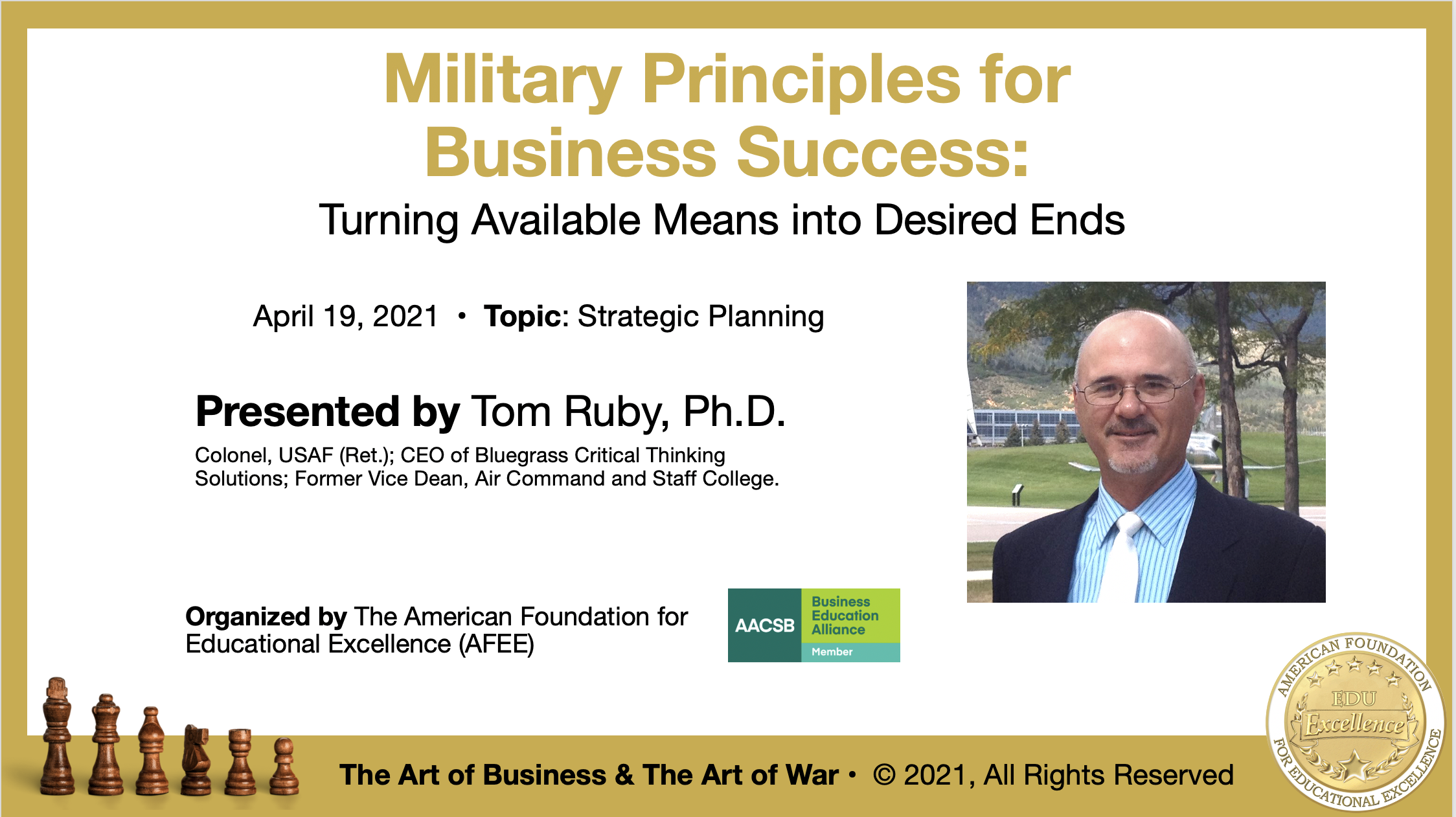
Biography: Tom Ruby is a retired Air Force Colonel who served 26 years on active duty in positions from Squadron Intelligence Officer, to Chief of Doctrine for the AF ISR Enterprise, to Chief of Special Programs for the Air Force Materiel Command. He was Associate Dean of the Air Command and Staff College where he developed exchange programs with the NATO School, the French École Militaire, the German General Staff College and Poland’s National Defense University. He served on General Petraeus’ Joint Strategic Assessment Team as well as in three combat deployments. He holds a PhD in Political Science from the University of Kentucky, and actively mentors graduate students through the American Political Science Association. He is widely published and speaks globally on topics from critical thinking, to leadership, to strategy, to morality in warfare. He is currently CEO of Bluegrass Critical Thinking Solutions, a business and Defense consulting firm.
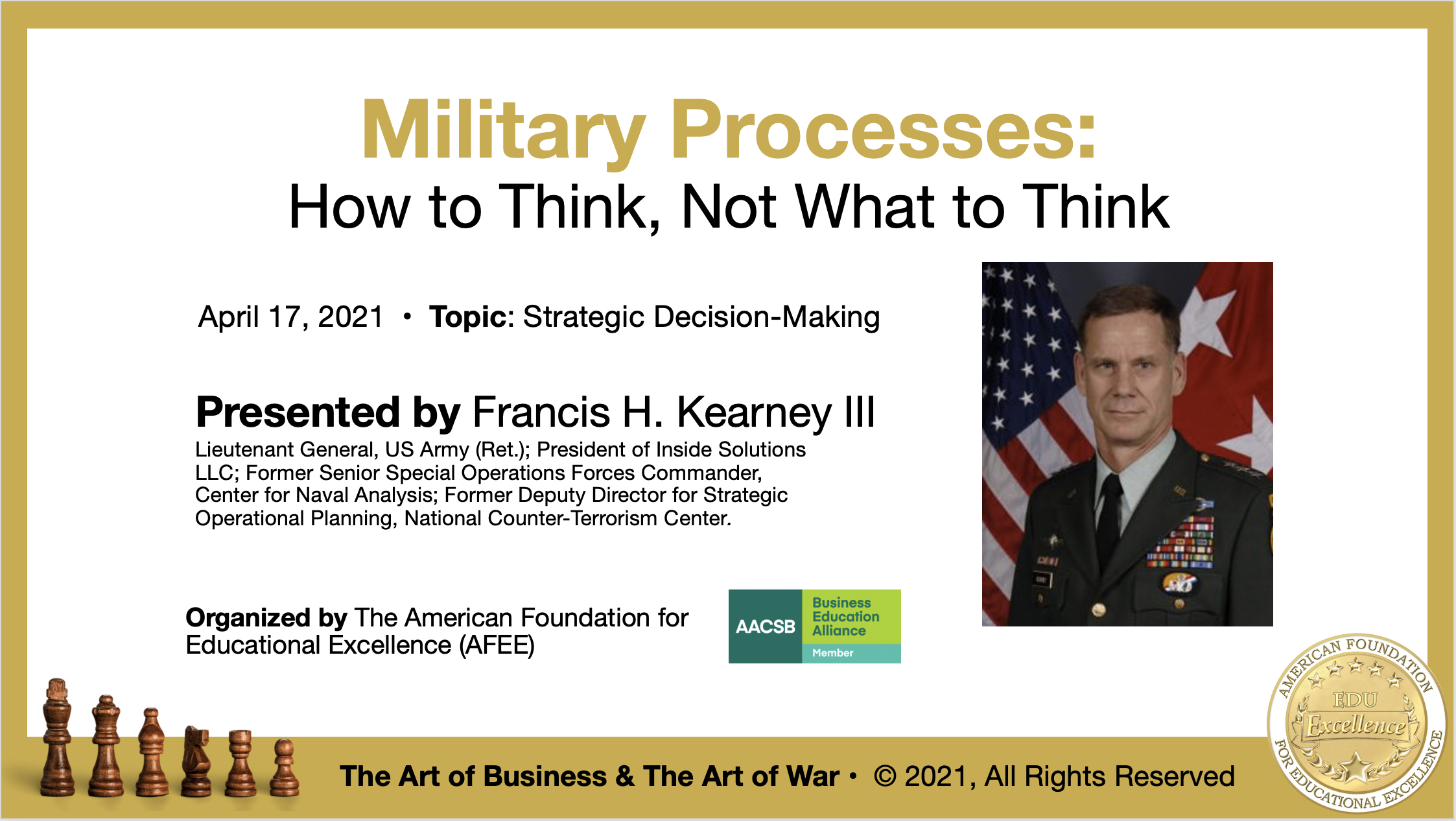
Biography: Lieutenant General Frank Kearney retired on 1 January 2012 from the United States Army after more than 35 years of service. His final active duty assignment was Deputy Director for Strategic Operational Planning at the National Counter-Terrorism Center in Washington DC. General Kearney now serves as the President of his own consulting company, Inside-Solutions-LLC, focusing on leader development in organizations. Most recently he served as the Interim CEO and President of Draper Laboratories in Cambridge, MA from March to mid October 2020.
He works routinely with Thayer Leadership at the Thayer Hotel at West Point, NY and with military and corporate groups to assist in improving organizational performance through leader development. In this capacity, he has worked with leaders in 7-11, Deloitte, Mercedes-Benz USA, General Electric, USAA, Morgan Stanley, and many others.
General Kearney serves as a Distinguished Faculty Member of the Joint Special Operations University and as a mentor to the Department of State Foreign Service Institute in Washington DC. He is a Senior Special Operations Fellow at the Center for Naval Analysis in Washington DC.
General Kearney's most recent assignments at the strategic and operational levels focused on Special Operations and Counter-Terrorism. He planned and participated in the opening campaigns of Operation Enduring Freedom in Afghanistan and Operation Iraqi Freedom in Iraq and commanded all Theater Special Operations forces in the middle-east from March 2005 to June 2007. General Kearney also served as the Deputy Combatant Commander for United States Special Operations Command (SOCOM) from 2007-2010 and insured that the 62,000 operators of this command were properly trained and equipped for their global special operations' missions. General Kearney oversaw the SOCOM requirements process, the execution of a 10 billion dollar budget and led the SOCOM Quadrennial Defense Review (QDR) team.
General Kearney also sat on the DOD Ballistic Missile Defense Review Committee and the Deputy Secretary of Defense’s Advisory Working Group managing the Defense Department’s annual budget approval and execution. Finally, at the National Counter-Terrorism Center, General Kearney worked with 16-29 different cabinet level agencies in the US government to plan and coordinate the whole of government efforts to achieve the goals of the Obama Administration’s Counter-Terrorism strategy.
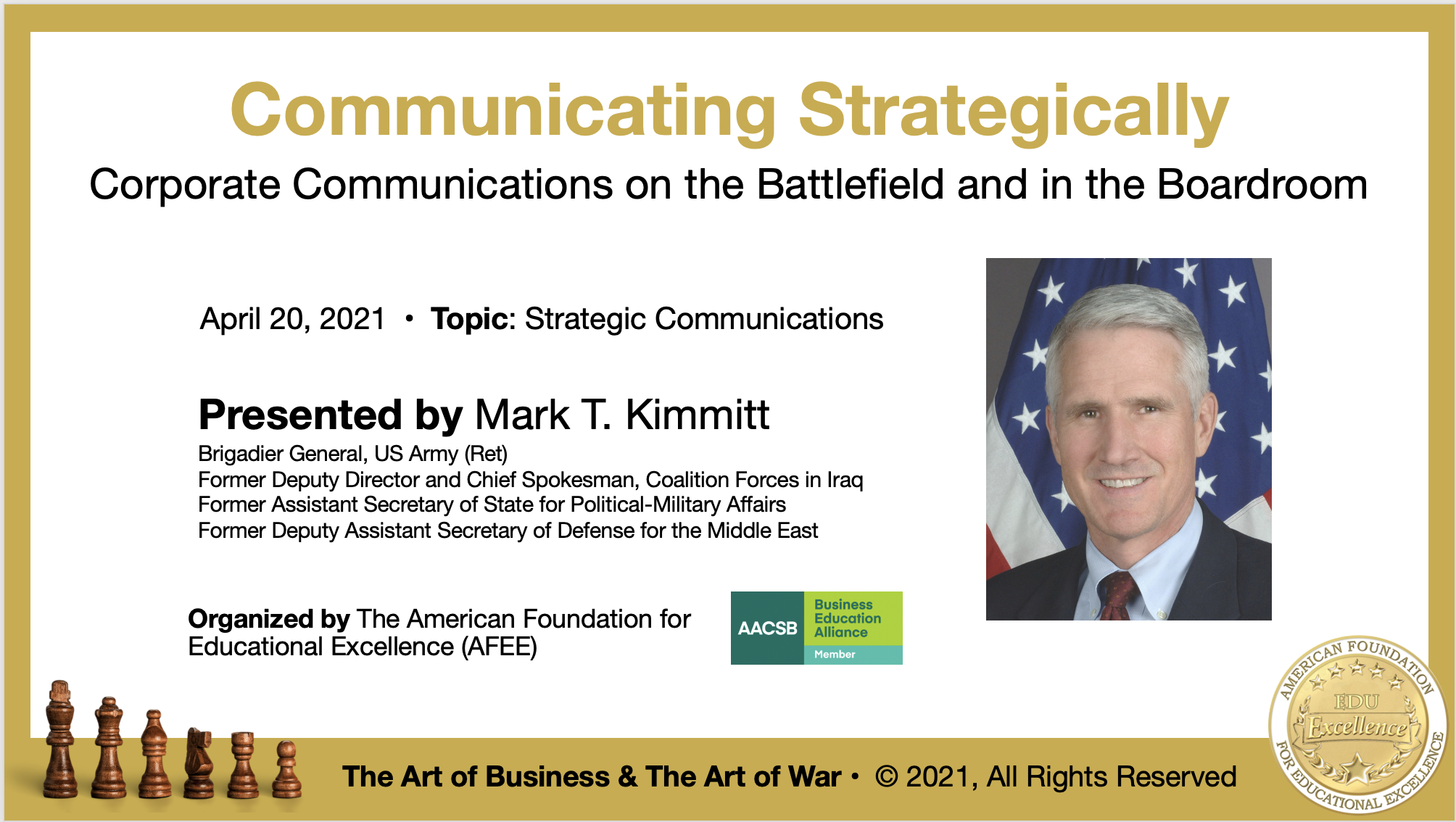
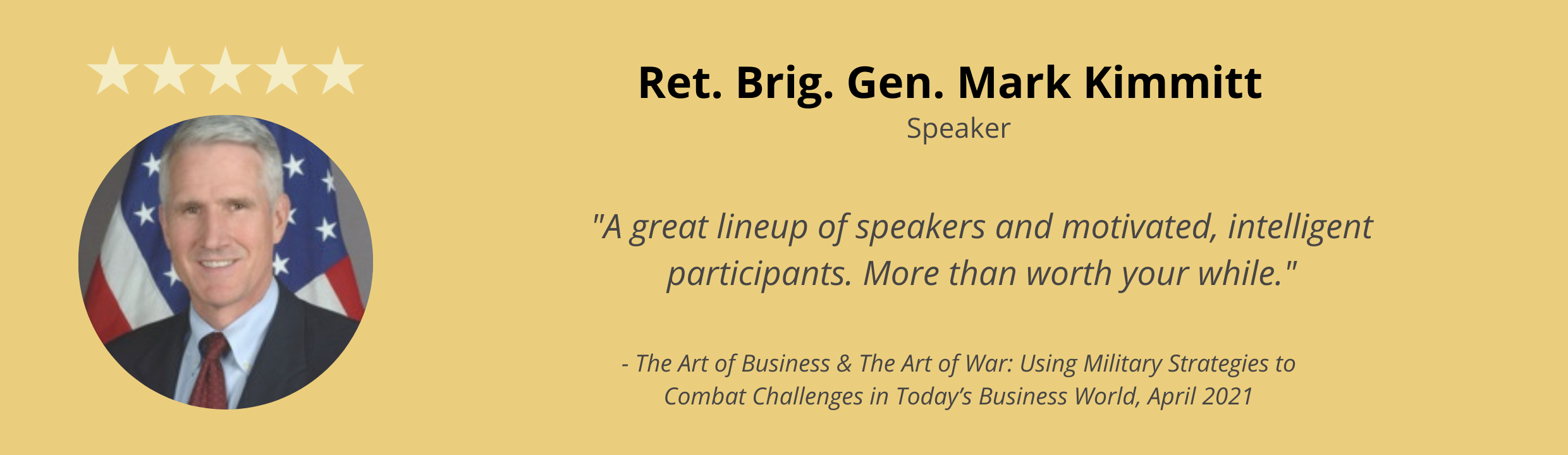
Biography: Brigadier General Mark T. Kimmitt, USA (Ret.) served as Assistant Secretary of State for Political-Military Affairs from 2008 to 2009. In that capacity, he was responsible for State Department political-military policy, with particular emphasis on security assistance and sales of arms around the world, as well as serving as the primary liaison between the Departments of State and Defense. He was also instrumental in recent counter-piracy operations off the coast of Somalia, and negotiated the groundbreaking arrangements for the prosecution of pirates abroad.
From 2006 to 2008, Kimmitt served as the Deputy Assistant Secretary of Defense for Middle East Policy, responsible for defense policy development, planning, guidance and oversight for the region. He was involved in every key defense deliberation during that period, to include the change in U.S. strategy for Iraq in 2006, participating in the Status of Forces negotiations with Iraq and leading DOD efforts to enhance security in the Middle East through the Gulf Security Dialogue.
Kimmitt served for over 30 years as an officer in the United States Army in a wide variety of command, operational, and policy positions with extensive operational experience abroad before retiring with the rank of Brigadier General in 2006. His assignments included Deputy Director of Strategy and Plans at United States Central Command from 2004 to 2006 and Deputy Director of Operations and Chief Military Spokesman for Coalition Forces in Iraq in 2003 and 2004. He has led soldiers and paratroopers at every level of command in the artillery.
Kimmitt is a graduate of the United States Military Academy. He holds a Masters Degree (with Distinction) from Harvard Business School. He also earned Masters from the School of Advanced Military Studies and the National Defense University, and a professional certification as a Chartered Financial Analyst (CFA). He also served as Assistant Professor of Finance and Economics in the Department of Social Sciences at the United States Military Academy.
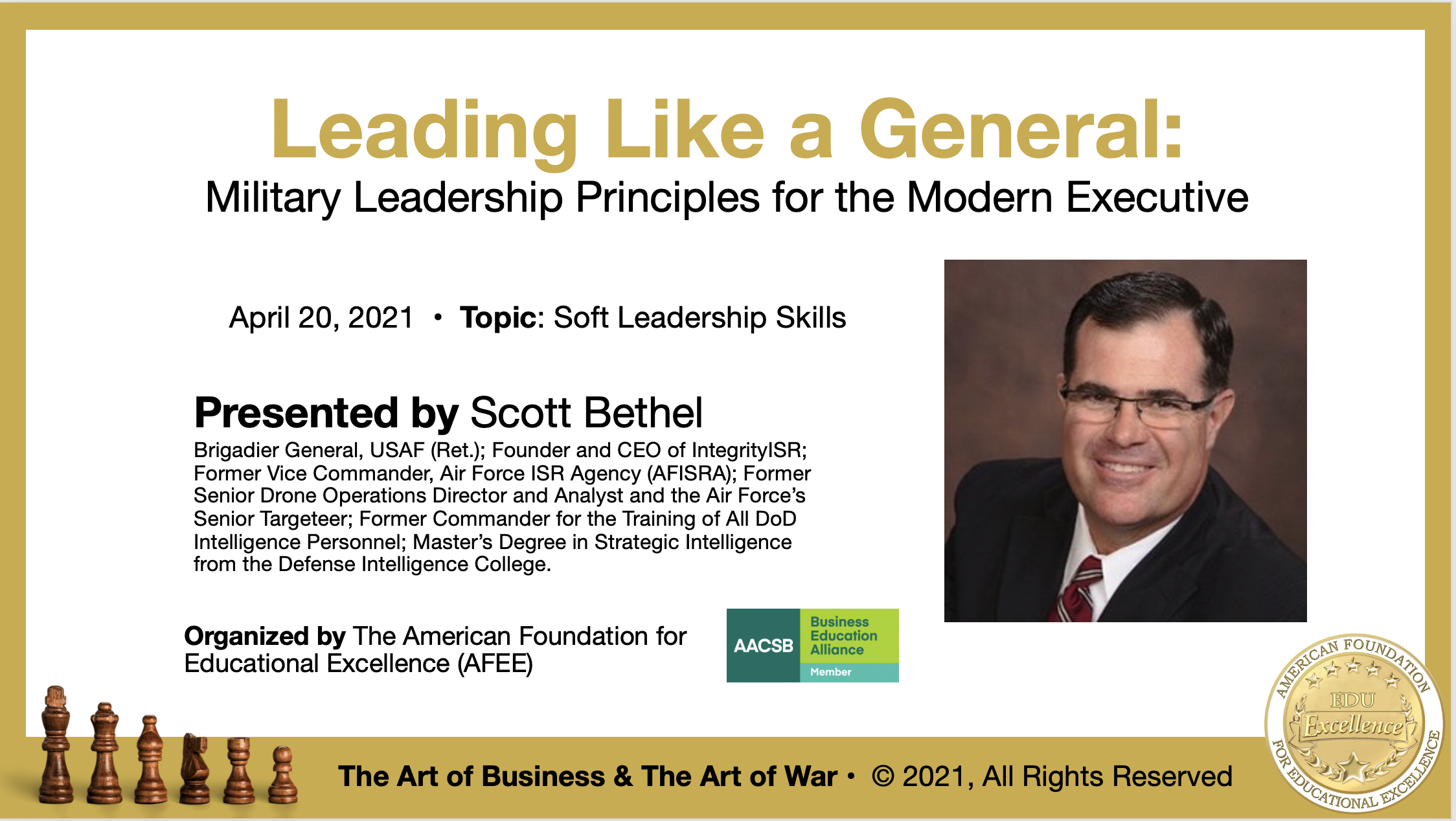
Biography: Scott Bethel is the Founder and CEO of IntegrityISR. He is a retired Air Force brigadier general with 33 years of senior leadership experience in small business development, business intelligence, strategic planning, organizational design, intelligence, information technologies and security, cyber, and education. His current focus areas are Cyber Operations, Strategy, Policy, Education and Training. In addition, he’s working on developing and mentoring small business through associations with accelerators in the US and Europe. He’s worked in both an advisory and training role with US and coalition partners including Saudi Arabia, UAE, Thailand, Poland, Pakistan, the Netherlands, Finland, and Mexico. As a consultant he has provided senior advice to a wide variety of government and commercial clients on Cyber, Data Management, Artificial Intelligence, Machine Learning, Electronic Warfare, ISR, Targeting and Operations. He’s also an Adjunct Professor at Angelo State University and serves on numerous Academic and Professional Boards. On active duty, he served as vice commander, Air Force ISR Agency (AFISRA), where he oversaw the organization, strategic planning, training and equipping of assigned forces to conduct ISR for the nation. He was the senior Drone Operations Director and Analyst as well as the Air Force’s senior targeteer. He has also served as a commander with responsibility for the initial training of all DoD intelligence personnel. In addition, he had various command and staff positions, including at Air Education and Training Command, as well as multiple deployments to combat areas. He has spoken and published extensively on business startups, ISR and cyber strategy and policy, future ISR systems, and modernization of processing, exploitation, and dissemination efforts.
General Bethel has a master’s degree in strategic intelligence from the Defense Intelligence College and a bachelor’s degree in political science and history from Northern Illinois University. He was a national security fellow at Boston University. He is the author of numerous articles and is author of the book “Vladmir Vladmirovich Putin and Russian Foreign Policy for a New Millennium: A New Approach.”
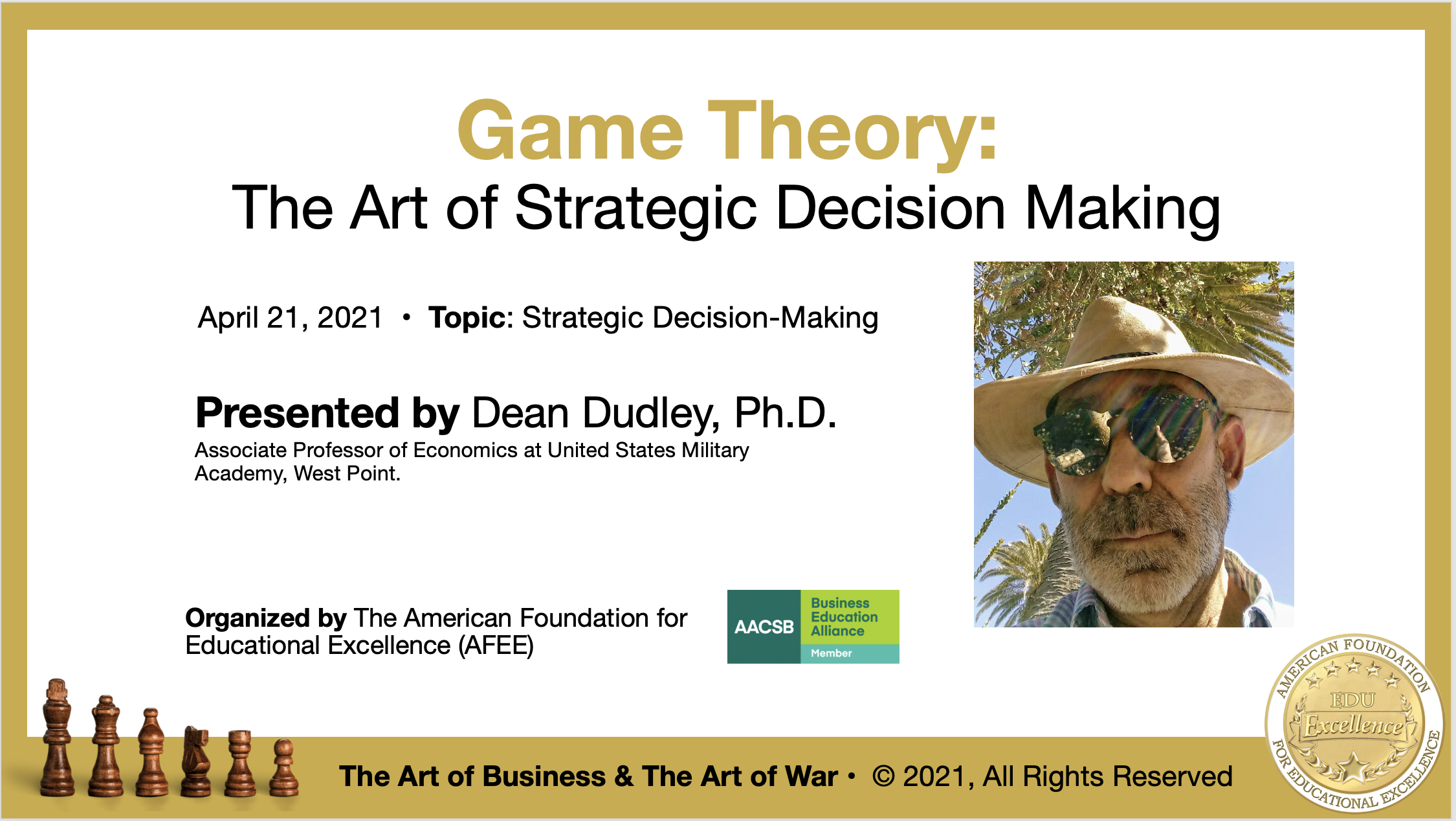
Biography: Dr. Dean Dudley is a Senior Civilian Economist specializing in Game Theory, Microeconomic Theory and Non-linear Optimization. Finishing a book titled “Game Theory and the Art of War” and actively pursuing research in Military Manpower Issues.
His current research focuses on military applications of game theory. Of particular interest is a theory of rational political extremism. The question then arises as to whether there can be rational explanations to extreme acts. From an economics perspective, can political extremism be the result of constrained optimization on well behaved preference sets?
Dean Dudley holds a Ph.D in Economics from Indiana University, Bloomington, IN.
He has been an Assistant Professor at the Department of Social Sciences, at the United States Military Academy, West Point, NY since Aug. 1993.
He has also been Adjunct Faculty at the Graduate School of Business Administration at Mount St. Mary’s College in NY since Oct. 1997.
Dr. Dudley has a large number of publications among which is “Planning, Budgeting, and management” in American National Security, 7th edition, 2015.
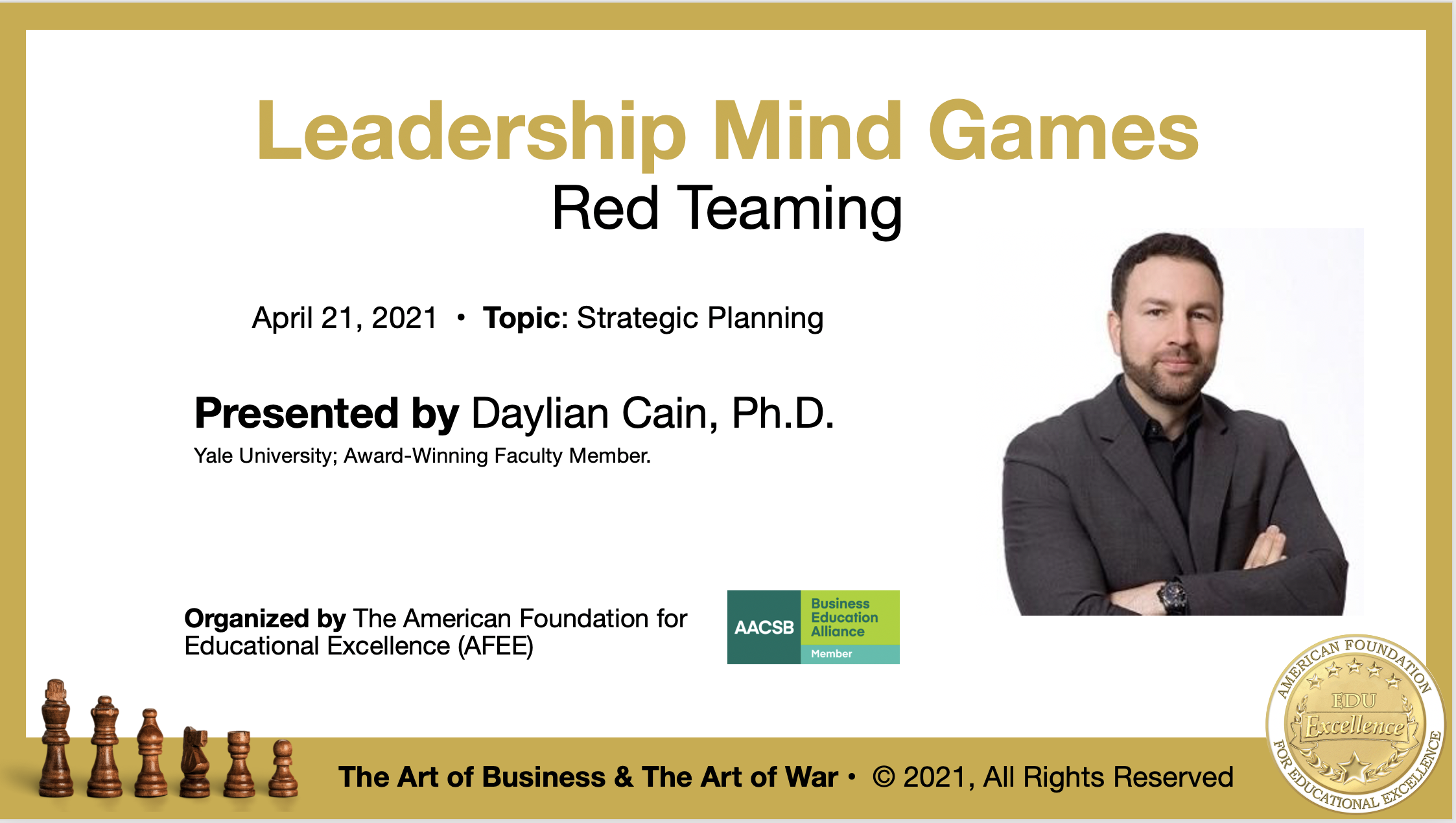
Biography: Daylian M. Cain, Ph.D., is an award-winning Yale faculty member who studies why smart people do dumb things. He is a Senior Lecturer of Negotiations, Leadership, & Ethics at the Yale School of Management. Hailing from Nova Scotia, Canada, Cain has a Ph.D. in Management from Carnegie Mellon. Prior to joining Yale, Cain was the Russell Sage Fellow of Behavioral Economics at Harvard University.
Cain is often one of the highest-rated professors in Yale’s executive education. For multiple years, he had the highest yearly-average rating and lowest variance in ratings. Cain is lead faculty on a new sales and leadership training program for Volvo America, lead instructor for the “Yale Negotiation Strategies” online program, and co-instructs Yale’s “Leading Effective Decision-Making” program, which earned the highest-ever rating of an inaugural program on Yale’s platform.
Fun Fact: Dr. Cain has appeared as a special guest on National Geographic’s TV show Brain Games (Season 2, “You Decide”).
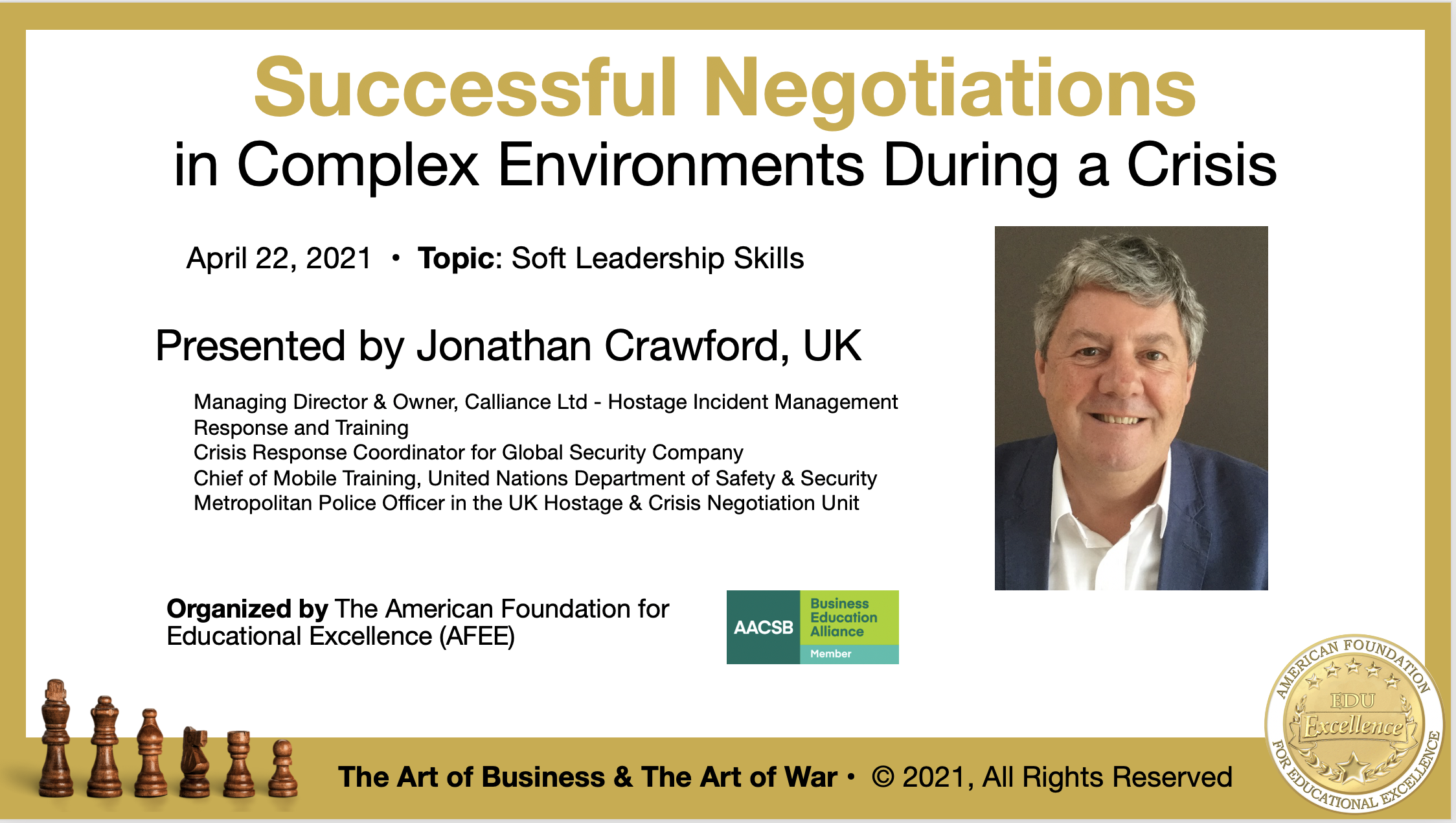
Biography: Jonathan Crawford is a proven professional working within the specialist area of hostage and crisis negotiation for the last twenty six years for the UK authorities, the United Nations (UN), a Private Security Company and also for his own company registered in Northern Ireland where he lives.
He brings us his experience as both a responder, a security advisor and a learning manager. Jon has a wide and varied global network of contacts having been part of government, organisation and corporate crisis management teams.
Jon’s company Calliance has developed an online training programme for managing International Kidnap & Hostage incidents which covers 16 different modules. It is in-depth, self-paced, continuous professional development.
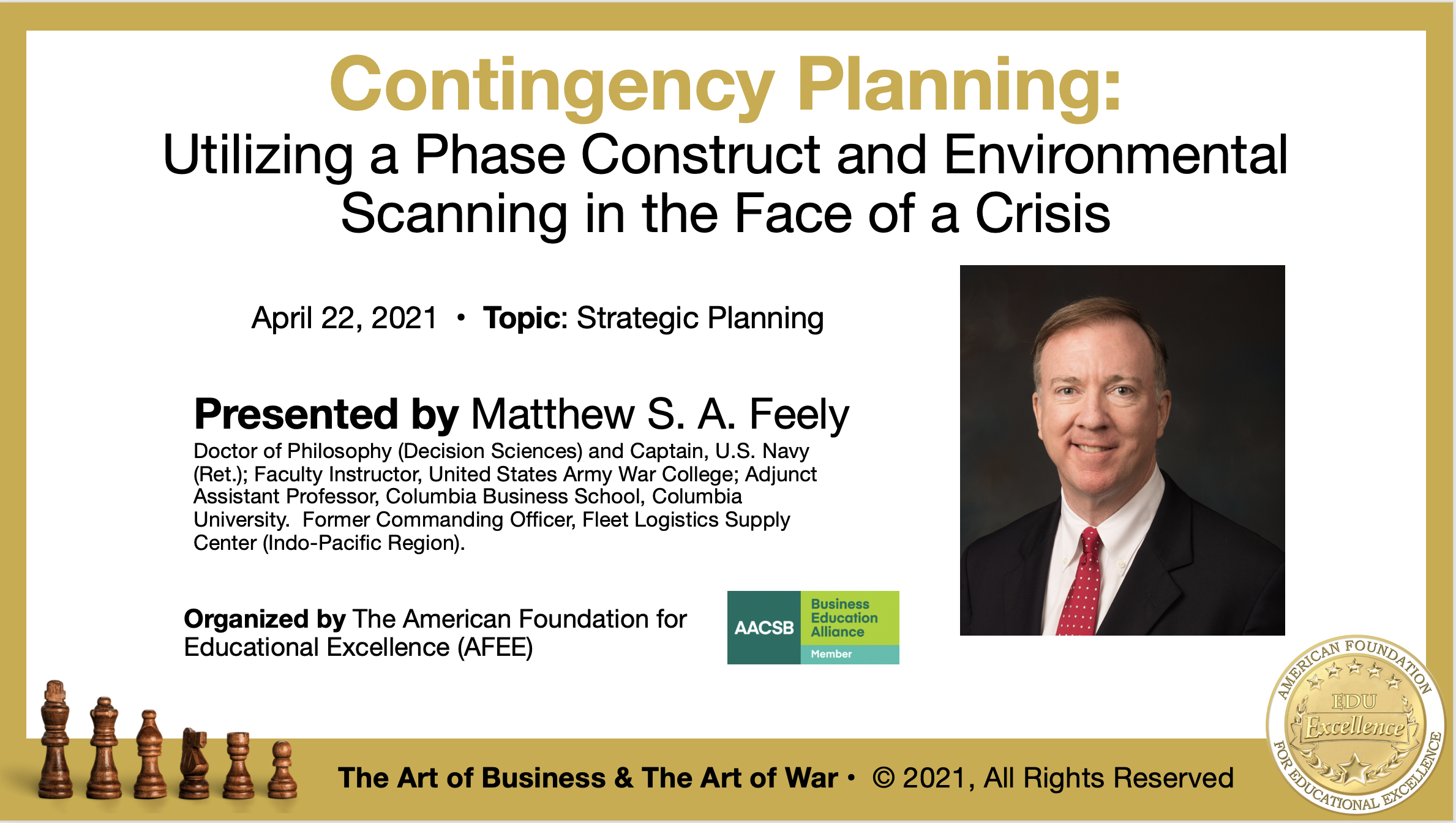
Biography: Matthew S. A. Feely joined the faculty at the Columbia Business School in May 2013, teaching strategic leadership and leadership decision-making to emerging leaders in the MBA and Executive MBA programs as well as to senior executives in the Crisis Leadership Executive Program and Advanced Management Program. Matt is also a faculty instructor at the United States Army War College where he leads two, year-long seminars of senior military officers in graduate studies to help them emerge as the next generation of strategic thinkers and leaders, applying their craft in a volatile, uncertain, complex and ambiguous world. His work in the classroom and lecture halls exemplifies a fusion of theoretical knowledge with practical experience gained from a robust scholarship coupled with a three decade-long navy career and recent problem solving work he has done on behalf of the private sector, the United States defense establishment and political campaigns. Matt’s case study about his experiences leading relief operations after the Great East Japan Earthquake earned the distinction of being the first Columbia University case study ever to be published as a paper case and as a multi-media case study.
Matt earned a B.S. at the U.S. Naval Academy, an MBA at the Wharton School and a Ph.D. in Decision Sciences at the Wharton School’s Center for Risk Management and Decision Processes and the Center for Energy and the Environment, University of Pennsylvania. He is also a distinguished graduate of the National Defense University.
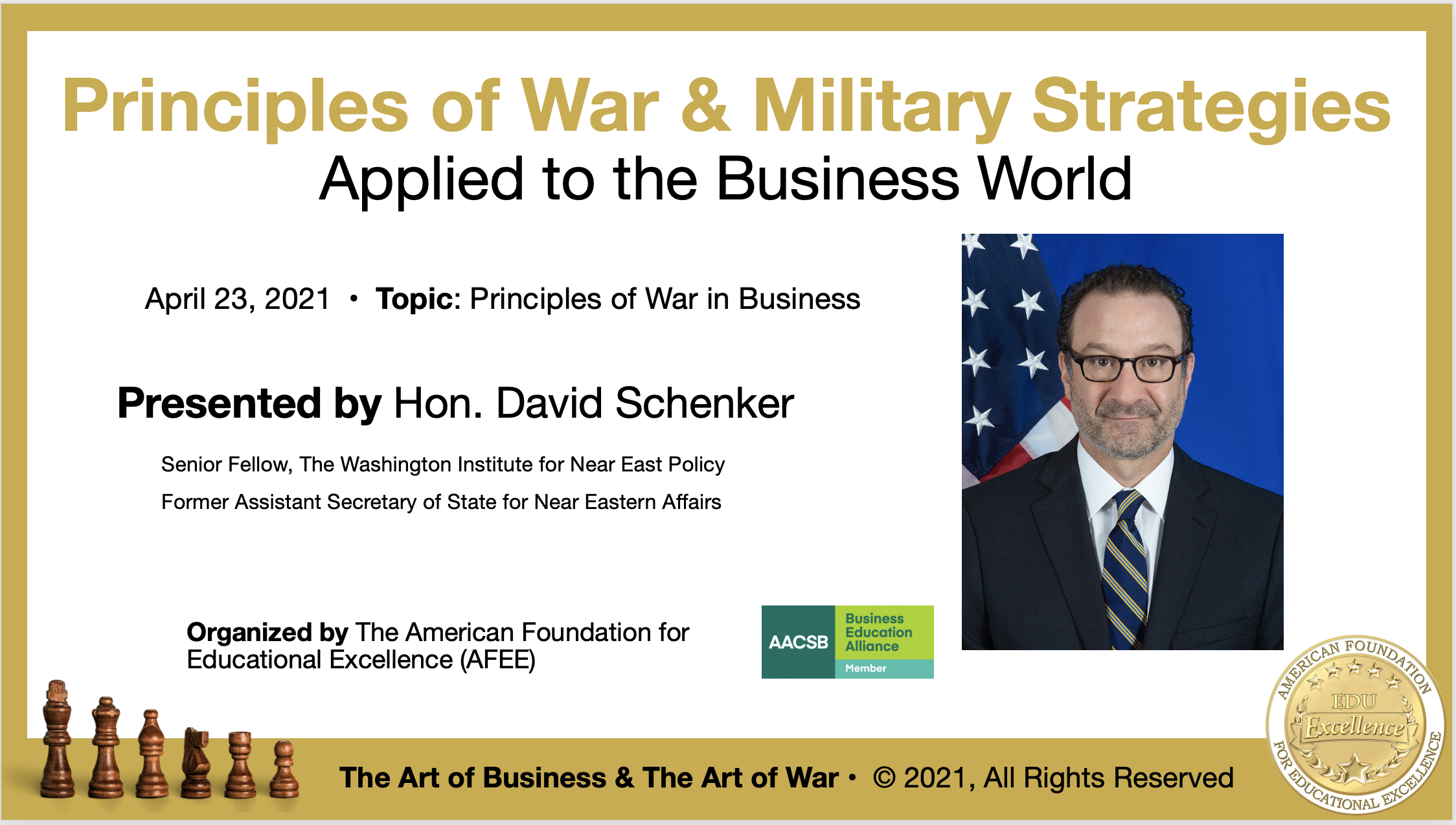
Biography: David Schenker is a Senior Fellow at The Washington Institute. Confirmed by the Senate on June 5, 2019, he served as Assistant Secretary of State for Near Eastern Affairs through January 2021. In that capacity, he was the principal Middle East advisor to the secretary of state and the senior official overseeing the conduct of U.S. policy and diplomacy in a region stretching from Morocco to Iran to Yemen, with responsibility for eighteen countries, the Palestinian Authority, and Western Sahara. He also supervised more than 9,000 staff and administered an annual budget in excess of $7 billion.
In policy terms, he led the bureau’s efforts to advance American interests abroad and strengthen U.S. partnerships and alliances across the region. Via diplomacy and the effective allocation of resources and assistance—as well as through imposition of sanctions—he worked to promote human rights, deter terrorism, fight corruption, and push back against regional adversaries. In addition to developing and implementing the U.S. strategy on China in the region, he worked to heal the Gulf rift between Qatar and neighboring states, resolve intractable conflicts in Libya and Yemen, consolidate the Abraham Accords, and counter malign Iranian influence in the Middle East.
Prior to joining the State Department, Schenker worked as a Fellow and director of the Program on Arab Politics at The Washington Institute from 2006 to 2019. During that period, he authored dozens of op-eds, journal articles, and PolicyWatches about Jordan, Lebanon, Hezbollah, and Egypt, among other topics, and contributed chapters to Institute monographs.
Previously, from 2002 to 2006, Schenker served in the Office of the Secretary of Defense as Levant country director, the Pentagon’s top policy aide on the Arab nations of the Levant. In that capacity, he advised the secretary and other senior Pentagon leadership on the military and political affairs of Syria, Lebanon, Jordan, and the Palestinian territories. He was awarded the Office of the Secretary of Defense Medal for Exceptional Civilian Service in 2005.
M.A., University of Michigan; Certificate, Center for Arabic Study Abroad (CASA), American University in Cairo;
B.A., University of Vermont
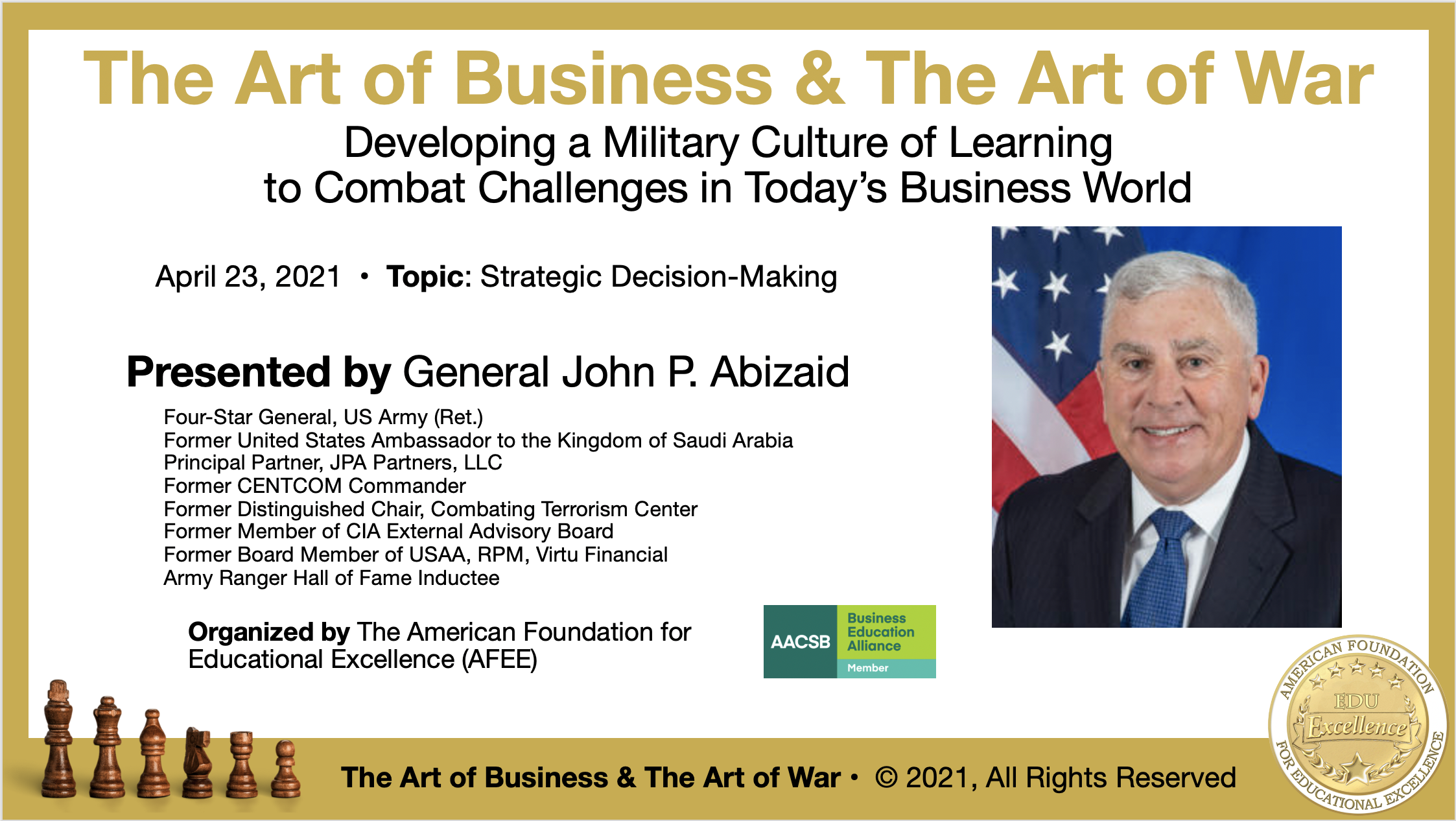
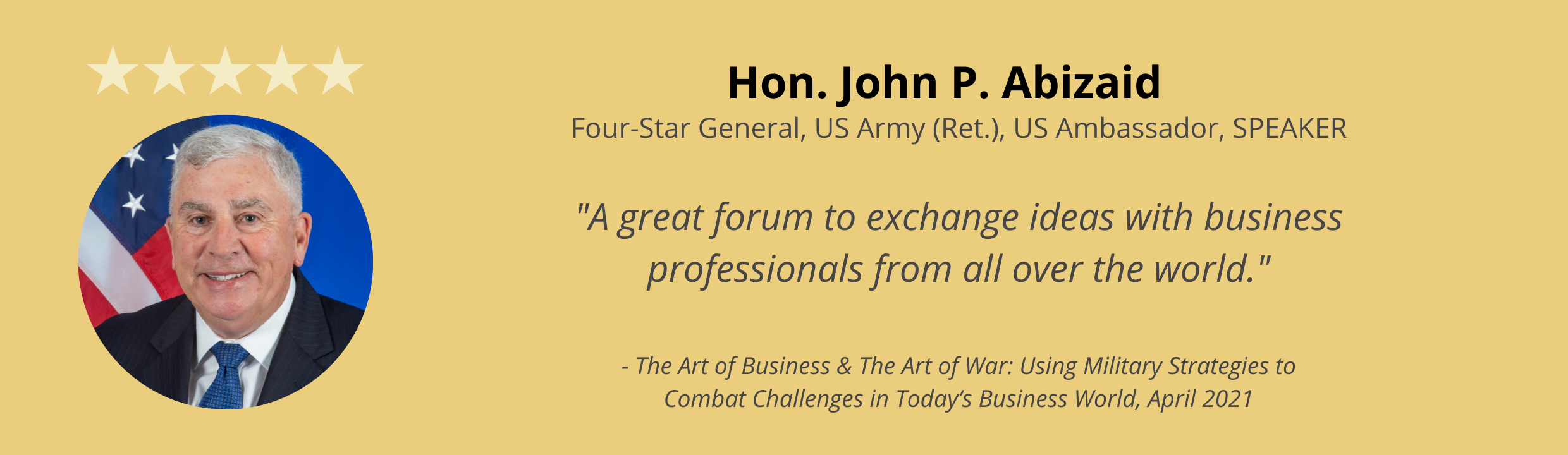
Biography: John P. Abizaid is a retired US Army four-star General, who most recently served as the United States Ambassador to the Kingdom of Saudi Arabia.
He served as the Distinguished Chair (Emeritus) of the Combating Terrorism Center at the United States Military Academy at West Point and was the first Annenberg Distinguished Visiting Fellow at the Hoover Institution, Stanford University. He was awarded Honorary Degrees from Dartmouth College and Norwich University. He has worked with the Preventative Defense Project at Stanford University and Harvard’s Kennedy School of Government and served on the CIA’s External Advisory Board. He is a Director of the Council on Foreign Relations and a member of the International Institute for Strategic Studies.
In 2015 he was inducted into the US Army Ranger Hall of Fame. General Abizaid retired from the United States Army in May 2007 as Commander of US Central Command, after thirty-four years of active service. A graduate of the United States Military Academy at West Point, he commanded units at every level, serving in Grenada, Lebanon, Kurdistan, Bosnia, Kosovo, Afghanistan and Iraq. He holds a master’s degree in Middle Eastern Studies from Harvard University and has deep expertise in regional as well as international strategy.
He is the Principal Partner of JPA Partners, LLC, a firm advising private business, government, and academic clients on leadership, national and international strategy, business, security, and military affairs.