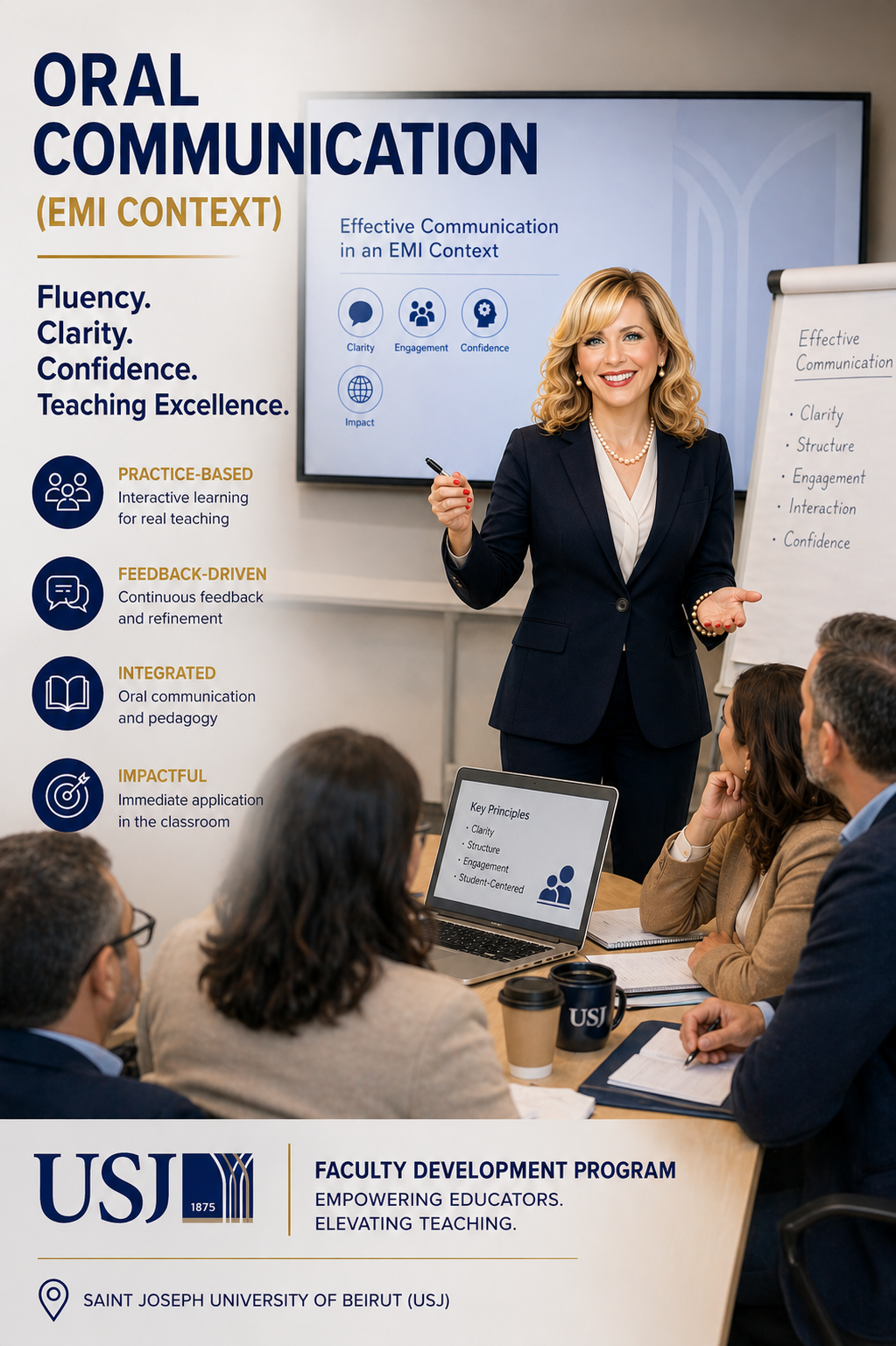
ECH Program on Oral Communication- EMI
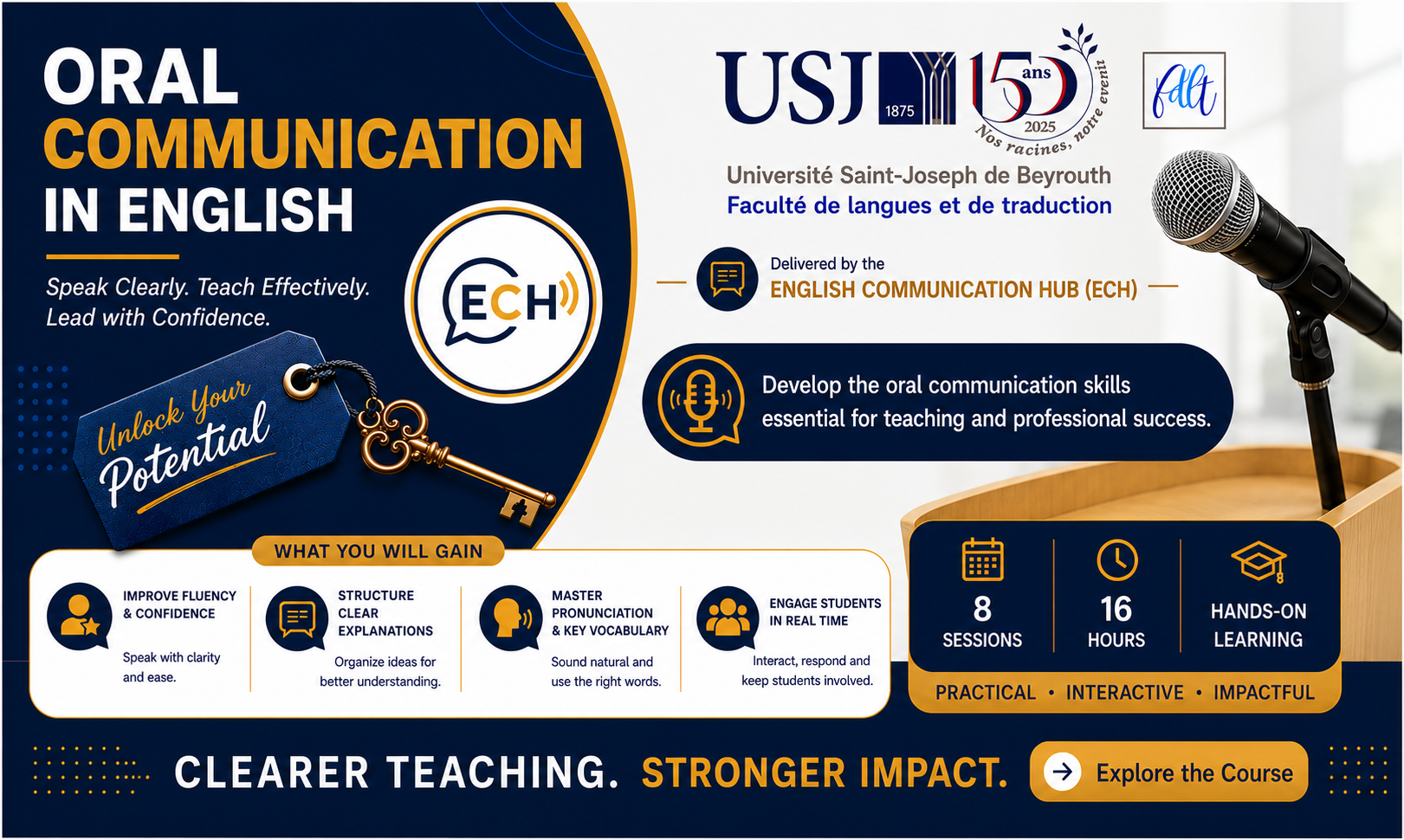
This program is aimed at educators who wish to hone their skills in oral communication in English-Medium Instruction (EMI) contexts.
It develops professors into clear and confident communicators in English, capable of teaching complex concepts using the structure, clarity, and engagement of the American teaching approach.
ORAL COMMUNICATION
English-Medium Instruction (EMI) Context
Clarity. Confidence. Teaching Excellence.
Saint Joseph University of Beirut (USJ)
OBJECTIVE
To empower faculty across disciplines to improve oral fluency, communicate clearly and confidently in English, and teach more effectively in an English-Medium Instruction (EMI) context.

PROGRAM STRUCTURE
Each session follows a structured approach combining reflection, guided practice, language control, and real-time interaction to develop effective English-Medium Instruction (EMI) communication.
Awareness → Fluency → Pronunciation/Intelligibility → Accuracy → Structure → Scaffolding/Engagement → Presence → Performance
- Session 1 → Awareness
- Session 2 → Fluency
- Session 3 → Pronunciation/Intelligibility
- Session 4 → Accuracy
- Session 5 → Structure
- Session 6 → Scaffolding/Engagement
- Session 7 → Presence
- Session 8 → Performance
From awareness to performance, this program equips you to transform the way you communicate, teach, and engage in English-Medium Instruction (EMI).
Clear thinking. Clear language. Effective teaching.
PROGRAM DETAILS
Program FAQs
What is the course format?
The course is highly interactive, practice-based, and performance-driven.
Each session combines:
- Short, focused input
- Guided speaking practice
- Real teaching simulations (micro-teaching)
- Immediate feedback from the instructor and peers
Participants will:
- Record and analyze their own speaking
- Apply communication strategies to real teaching scenarios
- Engage in live activities using tools such as Poll Everywhere and Mentimeter
The course follows a progressive structure, allowing participants to build fluency, clarity, and confidence step by step.
Where will the sessions take place?
The sessions will take place at USJ (on campus), online, or hybrid.
What is the main objective of the course?
The Main Objective of the Course:
To transform how instructors teach in English by developing their ability to deliver clear, structured, and effective instruction in multilingual classrooms—moving beyond language fluency to achieve real student understanding and engagement in an English-Medium Instruction (EMI) context.
Who teaches the course?
The course is taught by Nada M. Salem, President/CEO of AFEE and IFWE.
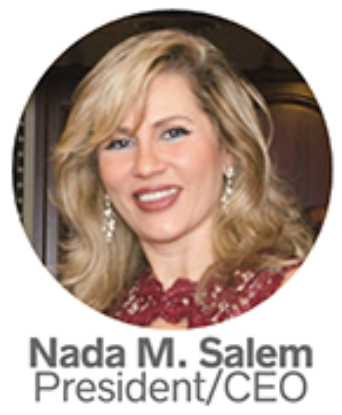
Nada M. Salem is an academic leader, institutional strategist, and educator working at the intersection of educational excellence, leadership development, and transformation in the AI era.
She is the Founding President and CEO of the American Foundation for Educational Excellence (AFEE) and the International Foundation for Women’s Empowerment (IFWE), through which she designs and leads high-impact initiatives, builds institutional partnerships, and advances leadership and education across the United States, Lebanon, and internationally.
She is also the Founding Director of the Center for Excellence in Languages (CEL), a subsidiary of AFEE specializing in teaching, editing, translation, and interpreting, further strengthening her work in language education and academic communication.
She serves as Adjunct Professor at The George Washington University, where she teaches academic writing, instructional course design, educational technology, and English communication, and mentors international scholars and faculty.
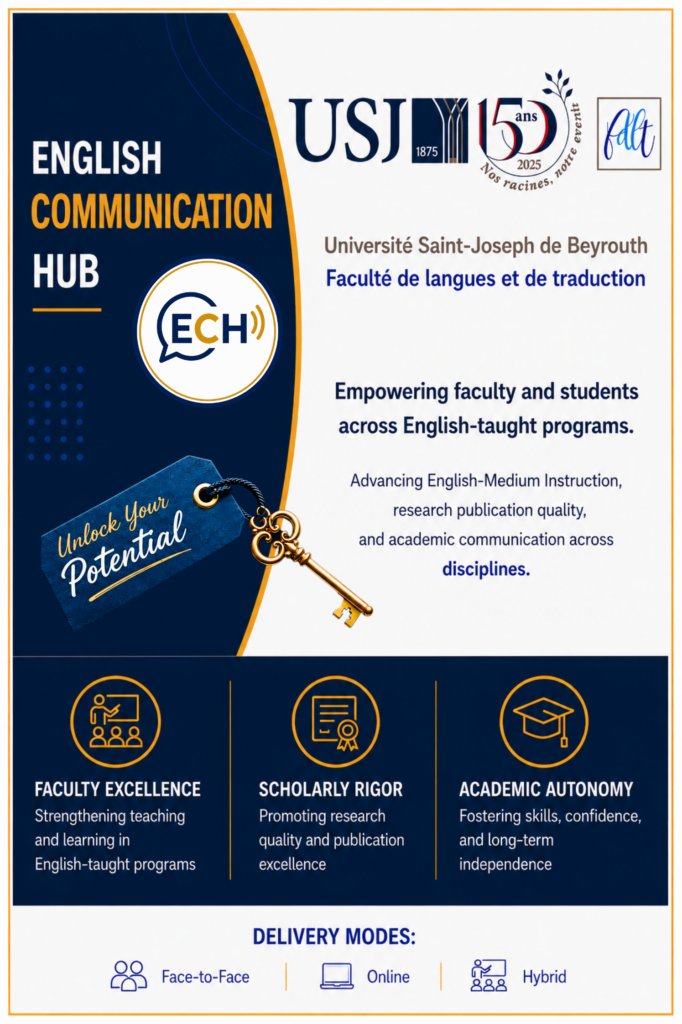
At Saint Joseph University of Beirut, she is Director of the English Communication Hub (ECH), leading university-wide efforts to elevate English-Medium Instruction (EMI), strengthen research publication, and advance academic communication to international standards. She previously served as Representative of the Rector for Educational Excellence and Philanthropy in the United States, contributing to strategic partnerships and institutional outreach.
Her doctoral work advances a framework for learning in the AI era centered on transferable mastery and cognitive agency, examining how universities can redesign curricula, assessment, and teaching practices in AI-mediated environments.
Across her career, she has designed and led academic and leadership programs, trained faculty, and supported institutional development across universities, foundations, and international organizations, bridging pedagogy, communication, and strategy in diverse educational contexts.
She holds a degree in languages and a Master’s in Translation from Saint Joseph University of Beirut, as well as a Teaching Diploma and a Master’s in TEFL from the American University of Beirut. She completed 40 credit hours toward a Doctorate (Ed.D.) in Curriculum & Instruction and Educational Technology Leadership at The George Washington University, and holds an Executive Certificate in Public Leadership from Harvard Kennedy School of Government.
She was selected as a Woman Leader by the University of Maryland’s Kahlil Gibran Chair for Values and Peace and recognized among Marquis Who’s Who Top Executives in Education and Leadership.
Her work is dedicated to advancing mastery-based, AI-ready education systems and developing leaders capable of shaping institutions in an era of profound technological and societal transformation.

TERMS OF SERVICE: We reserve the right, in our sole discretion, to reject or remove anyone who has registered or gained access under false pretenses, provided false information, or for any other action or behavior that we deem inappropriate, before, during or after the sessions, with or without prior notice or explanation, and without liability.
IMPORTANT DISCLAIMER: All rights reserved. The information on this page shall be considered proprietary information not to be used, copied or reproduced in any way. No part of our presentations / workshops / webinars may be reproduced, distributed, or transmitted in any form or by any means, including photocopying, recording, or other electronic or mechanical methods.