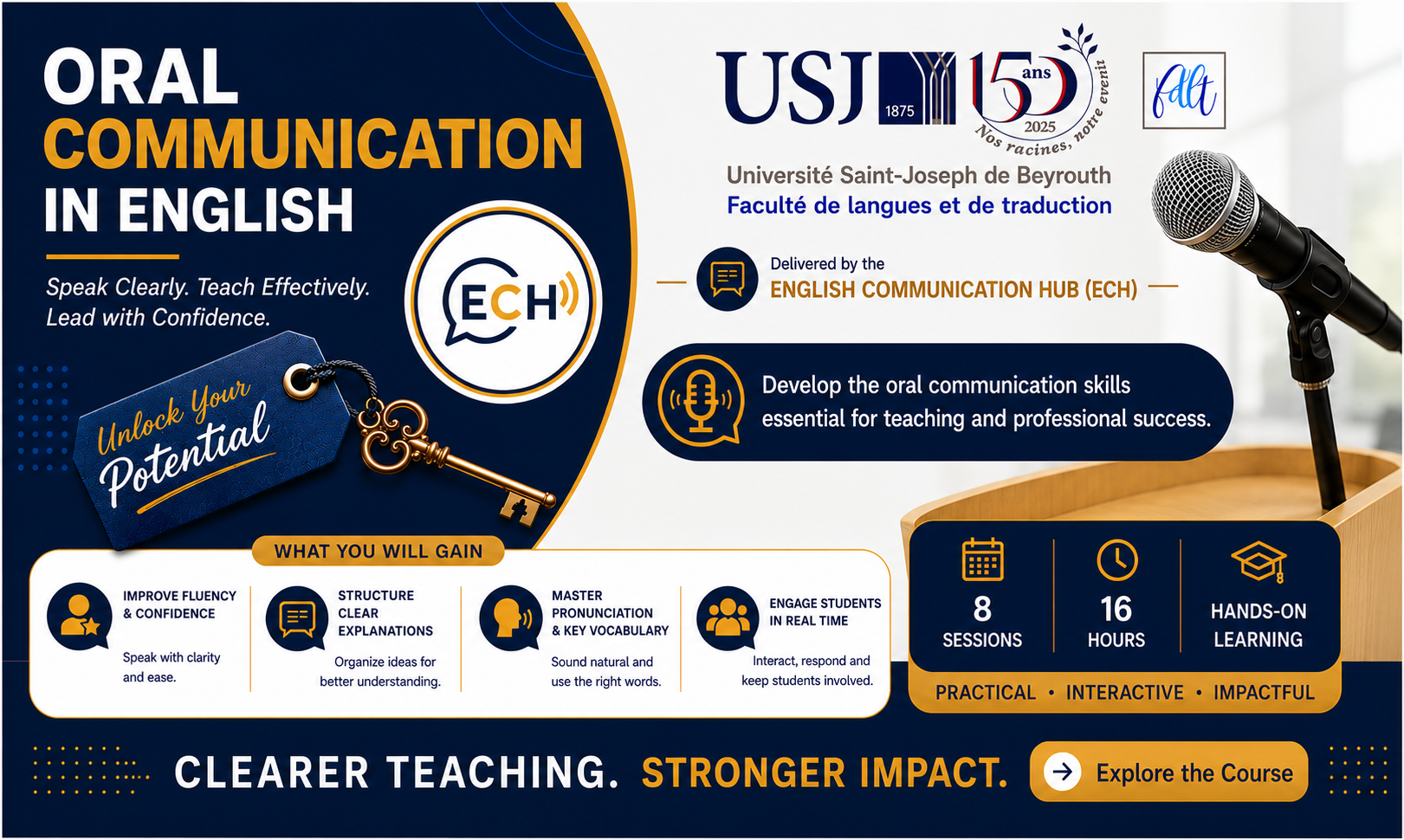
ECH Program on Oral Communication- EMI
This program is aimed at educators who wish to hone their skills in oral communication in English-Medium Instruction (EMI) contexts.
It develops professors into clear and confident communicators in English, capable of teaching complex concepts using the structure, clarity, and engagement of the American teaching approach.
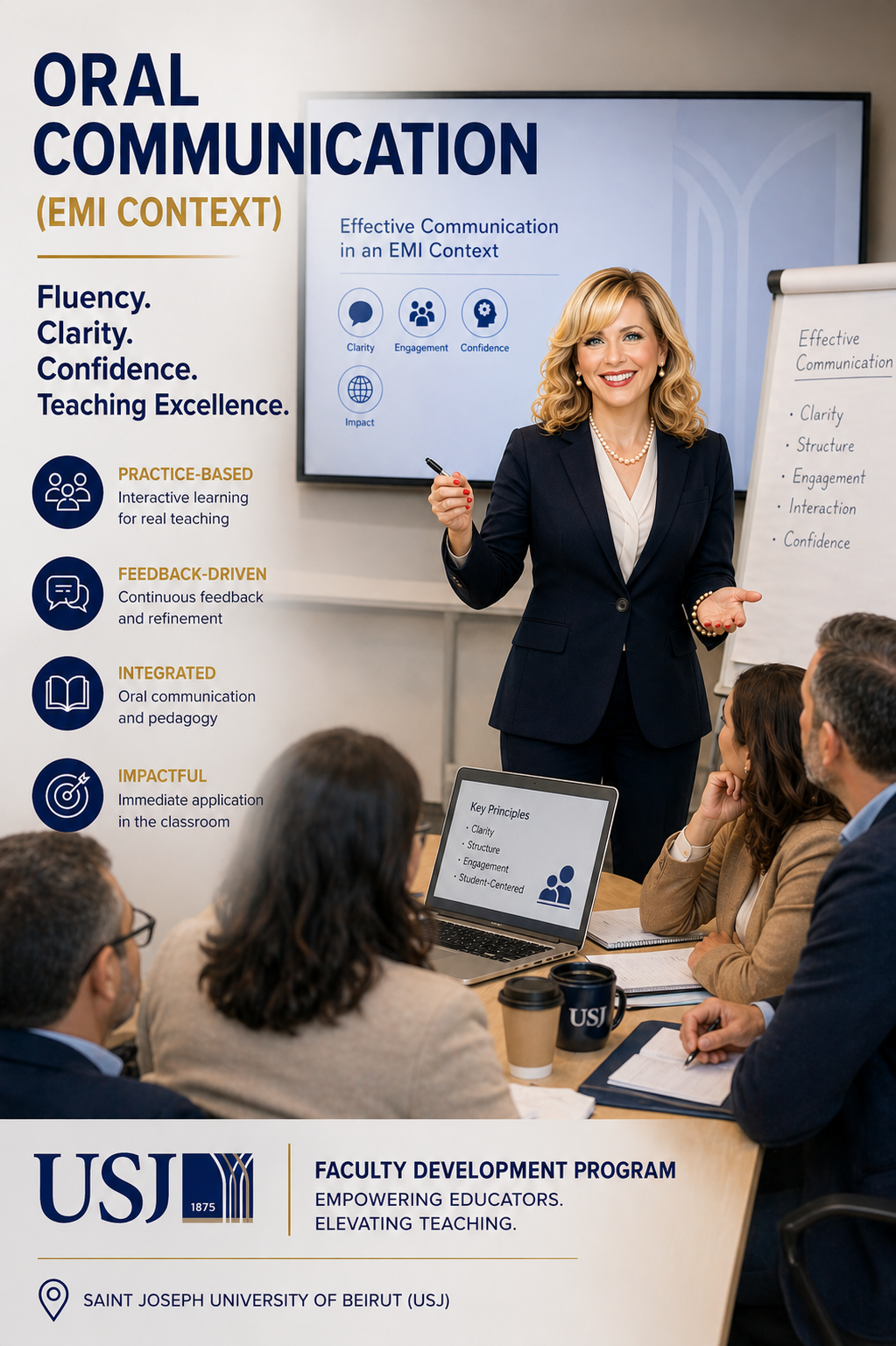
ORAL COMMUNICATION
English-Medium Instruction (EMI) Context
Clarity. Confidence. Teaching Excellence.
Saint Joseph University of Beirut (USJ)
OBJECTIVE
To empower faculty across disciplines to improve oral fluency, communicate clearly and confidently in English, and teach more effectively in an English-Medium Instruction (EMI) context.
CORE EMI PRINCIPLES
CORE EMI PRINCIPLES
Foundation of effective teaching in English.
Focus
-
- Communicating content clearly in English
- Supporting understanding in multilingual classrooms
- Creating structured and engaging learning experiences
Core Elements
-
- Clarity over complexity
- Structured delivery
- Scaffolding for understanding
- Comprehension checking
- Strategic use of language
- Student engagement
- Psychological safety
In Practice
-
- Use simple, direct language instead of complex or translated sentences
- Organize explanations using clear structure (e.g., Why - How - What)
- Break down complex ideas step by step
- Check understanding regularly through targeted questions
- Rephrase, repeat, and emphasize key concepts
- Encourage participation and interaction
- Create a safe environment where students feel comfortable speaking
Outcome
-
- Clearer and more effective communication in English
- Improved student understanding and participation
- More structured, engaging, and supportive teaching

Session Details
🟡 SESSION 4 — ADVANCED LANGUAGE ACCURACY & CLEAR TEACHING LANGUAGE
Reduce linguistic interference. Increase instructional clarity.
Focus
- Reducing language patterns that weaken instructional clarity
- Improving spoken precision and real-time accuracy in EMI teaching
- Strengthening natural, listener-friendly teaching language
Core Elements
- Advanced false friends and academic interference patterns
- High-frequency French-influenced grammar and sentence structure errors
- Correction and reformulation drills using authentic teaching situations
- Advanced sentence simplification and restructuring exercises
- Real-time correction and controlled speaking activities
- Reinforcement of grammar and false-friend structures introduced in Session 2
Language Integration
- Clear spoken structures (if / then / because / first / next)
- Cause-and-effect language
- Comparison and clarification language
- Replacing complex translated sentences with clear English
- Reformulating overloaded or translated explanations into natural teaching language
EMI Principles in Action
- Clarity over complexity
- Strategic use of language
- Structured delivery
Outcome
- Personal linguistic interference correction checklist
- More accurate and natural spoken English
- Improved real-time grammatical control and instructional clarity
🟡 SESSION 4 DETAILS— ADVANCED LANGUAGE ACCURACY & CLEAR TEACHING LANGUAGE
Reduce linguistic interference. Increase instructional clarity.
A. Main Objective
By the end of this session, you will be able to communicate more accurately, naturally, and strategically in English by identifying linguistic interference, improving real-time language control, and reformulating explanations more effectively for multilingual EMI classrooms.
The goal is not perfect English.
The goal is to reduce cognitive overload and make explanations easier for students to process, follow, and understand in real time.
This session focuses on instructional language management:
- Monitoring language while teaching,
- Identifying communication breakdowns,
- Simplifying overloaded explanations,
- Improving grammatical control during spontaneous speech,
- Repairing explanations strategically in real time.
This is NOT a traditional grammar session.
This is a session about: Instructional Language Management.
B. Agenda
1. Advance Organizer — Bridging Old and New Knowledge (30 min)
1.1. Quickly reviewing Last Session Content
1.2. Whole Class Homework Review — Stress & Intelligibility Recordings
1.3. Riddle-Based Communication Warm-Up
1.4. Exploring This Session Content
(+ Core EMI Principles)
2. Oral Practice — Advanced Language Accuracy & Instructional Clarity (65+ min)
2.1. Weekly Speaking Reflection
2.2. TED Talk Reflection — WHY → HOW → WHAT
2.3. Aristotle & Communication in EMI Teaching
2.4. Advanced False Friends & Academic Interference Patterns
2.5. Grammar, Tenses, & Error Analysis for EMI Clarity
2.6. Transition Language & Logical Flow in Teaching
2.7. Reformulation & Real-Time EMI Language Repair
3. PollEverywhere Mid-Course Reflection & Whole-Class Review (20 min)
4. EMI Principles in Action (3 min)
5. Recap (2 min)
HW + TED Talk (2 min)
Extra: Closing Reflection — Emotionally Intelligent EMI Communication (3–4 min)
🎵 Song Reflection
🎥 Final TED Talk Reflection (Krashen)
C. Core (Session Content & Activities)
1. Advance Organizer — Bridging Old and New Knowledge (30 min)
1.1. Reviewing Last Session (3 min)
Whole-Class Reflection
Discuss together:
- Which pronunciation patterns improved most last session?
- Which words still feel difficult to pronounce naturally?
- How does stress influence listener understanding?
- Why does pacing improve comprehension?
- What happens when pronunciation is unclear in EMI classrooms?
Key Ideas
- Clearer stress improves comprehension
- Pacing supports listener processing
- Pronunciation affects confidence
- Intelligibility matters more than accent
- EMI communication is listener-centered communication
1.2. Homework Review — Stress & Intelligibility Recording (6 min)
EMI Listening Analysis
Several volunteers play short sections from their homework recordings.
As a class, analyze:
- stress clarity
- pacing
- rhythm
- intelligibility
- listener processing
- remaining French interference
Guided Coaching Questions
- Which stress patterns improved?
- Which words remained unclear?
- Was the pacing effective?
- Was the explanation easy to follow?
- Which pronunciation features supported comprehension?
- Which features increased cognitive load?
1.3. Session 3 Review- Stress Riddle Challenge (8-10 min)
Goal
Review high-impact academic and EMI words that are frequently mispronounced or mis-stressed by French speakers.
- Guess the word
- Pronounce it aloud
- Identify the stressed syllable
- Repeat the word correctly as a class
WORD BANK
- academic
- anesthesia
- categories
- colleague
- collaboration
- communication
- consequences
- curiosity
- curriculum
- development
- diagnosis
- emphasis
- examine
- hygiene
- intelligibility
- occur
- pedagogy
- possess
- pronunciation
- pursue
- research
- salmon
- scaffolding
- sequencing
- threshold
EMI STRESS RIDDLES
1. Teachers and professionals constantly try to improve skills and programs.
What is the word?
2. Doctors make me after examining symptoms and tests.
What am I?
3. I help speech sound clear and understandable.
What am I?
4. Researchers and scientists conduct me to discover new knowledge.
What am I?
5. I happen when people work together professionally and effectively.
What am I?
6. I describe how understandable spoken English is for listeners.
What am I?
7. I describe the exchange of meaning between people.
What am I?
8. I give special force to an important word in a sentence.
What am I?
9. I help teachers guide students progressively through difficult content.
What am I?
10. Universities expect teachers to demonstrate me in their field.
What am I?
11. I help teachers explain ideas step by step instead of overwhelming students.
What am I?
12. Dentists use me so patients do not feel pain during procedures.
What am I?
13. Teachers use me to group ideas into organized sections.
What am I?
14. I work with you professionally at the university or hospital.
What am I?
15. I am the results that follow an action or decision.
What am I?
16. I make people ask questions and want to learn more.
What am I?
17. I happen when something takes place or appears.
What am I?
18. Dentists constantly remind patients about me.
What am I?
19. I describe the science and philosophy of teaching.
What am I?
20. Researchers and students often continue working hard to achieve goals.
What is the word?
21. I mean to have, own, or demonstrate a quality or skill.
What am I?
22. Many people think I am a fish with a clearly pronounced “L,” but native speakers often pronounce me differently. What am I?
23. Universities design me to organize courses, learning outcomes, and instruction.
What am I?
24. Teachers and doctors both do me carefully to understand situations better.
What am I?
25. I describe the point at which something begins to change significantly.
What am I?
KEY
1.3. Session 3 Review- Stress Riddle Challenge (8-10 min)
Goal
Review high-impact academic and EMI words that are frequently mispronounced or mis-stressed by French speakers.
- Guess the word
- Pronounce it aloud
- Identify the stressed syllable
- Repeat the word correctly as a class
WORD BANK
- academic
- anesthesia
- categories
- colleague
- collaboration
- communication
- consequences
- curiosity
- curriculum
- development
- diagnosis
- emphasis
- examine
- hygiene
- intelligibility
- occur
- pedagogy
- possess
- pronunciation
- pursue
- research
- salmon
- scaffolding
- sequencing
- threshold
EMI STRESS RIDDLES
1. Teachers and professionals constantly try to improve skills and programs.
What is the word?
✅ development
✅ Stress: de-VEL-op-ment
2. Doctors make me after examining symptoms and tests.
What am I?
✅ diagnosis
✅ Stress: di-ag-NO-sis
3. I help speech sound clear and understandable.
What am I?
✅ pronunciation
✅ Stress: pro-nun-ci-A-tion
4. Researchers and scientists conduct me to discover new knowledge.
What am I?
✅ research
✅ Stress: RE-search
5. I happen when people work together professionally and effectively.
What am I?
✅ collaboration
✅ Stress: col-lab-o-RA-tion
6. I describe how understandable spoken English is for listeners.
What am I?
✅ intelligibility
✅ Stress: in-tel-li-gi-BIL-i-ty
7. I describe the exchange of meaning between people.
What am I?
✅ communication
✅ Stress: com-mu-ni-CA-tion
8. I give special force to an important word in a sentence.
What am I?
✅ emphasis
✅ Stress: EM-pha-sis
9. I help teachers guide students progressively through difficult content.
What am I?
✅ scaffolding
✅ Stress: SCAF-fold-ing
10. Universities expect teachers to demonstrate me in their field.
What am I?
✅ academic
✅ Stress: ac-a-DEM-ic
11. I help teachers explain ideas step by step instead of overwhelming students.
What am I?
✅ sequencing
✅ Stress: SE-quenc-ing
12. Dentists use me so patients do not feel pain during procedures.
What am I?
✅ anesthesia
✅ Stress: an-es-THE-ZA
13. Teachers use me to group ideas into organized sections.
What am I?
✅ categories
✅ Stress: CAT-e-go-ries or CateGOries
14. I work with you professionally at the university or hospital.
What am I?
✅ colleague
✅ Stress: COL-league
15. I am the results that follow an action or decision.
What am I?
✅ consequences
✅ Stress: CON-se-quences
16. I make people ask questions and want to learn more.
What am I?
✅ curiosity
✅ Stress: curi-OS-i-ty
17. I happen when something takes place or appears.
What am I?
✅ occur
✅ Stress: oc-CUR
18. Dentists constantly remind patients about me.
What am I?
✅ hygiene
✅ Stress: HY-giene
19. I describe the science and philosophy of teaching.
What am I?
✅ pedagogy
✅ Stress: PED-a-GO-gy
20. Researchers and students often continue working hard to achieve goals.
What is the word?
✅ pursue
✅ Stress: pur-SUE
21. I mean to have, own, or demonstrate a quality or skill.
What am I?
✅ possess
✅ Stress: pos-SESS (Zess)
22. Many people think I am a fish with a clearly pronounced “L,” but native speakers often pronounce me differently. What am I?
✅ salmon
✅ Stress: SAM-on
23. Universities design me to organize courses, learning outcomes, and instruction.
What am I?
✅ curriculum
✅ Stress: cur-RIC-u-lum
24. Teachers and doctors both do me carefully to understand situations better.
What am I?
✅ examine
✅ Stress: ex-AM-ine
25. I describe the point at which something begins to change significantly.
What am I?
✅ threshold
✅ Stress: THRESH-old
1.4. Exploring This Session (1 min)
In this session, you will learn how to:
- reduce linguistic interference patterns
- improve spoken precision and instructional clarity
- identify and repair communication breakdowns
- improve grammar and sentence structure in real teaching situations
- reformulate explanations more naturally and effectively
- use clearer transition and sequencing language during instruction
👉 Key shift:
From being understood clearly → to communicating more clearly, naturally, and strategically during real EMI teaching.
(+ Core EMI Principles — 1 min)
- Clarity over complexity
- Structured delivery
- Scaffolding for understanding
- Comprehension checking
- Strategic use of language
- Student engagement
- Psychological safety
We will apply:
- Clarity over complexity
- Structured delivery
- Strategic use of language
👉 Focus on communication that students can process easily, follow clearly, and understand in real time.
2. Oral Practice — Advanced Language Accuracy & Instructional Clarity (65+ min)
2.1. Weekly Speaking Reflection + WHY Do You Teach? (8 min MAX)
Step 1 — Quick Individual Reflection (1 min)
Think about your week:
- Did you explain or teach something in English?
- Did you struggle to organize an explanation naturally?
- Did you mentally translate from French?
- Did you notice any communication breakdown?
ANYTHING YOU WOULD LIKE TO SHARE WITH THE WHOLE CLASS?
REFLECT ON THIS QUESTION:
WHY DO YOU TEACH?
2.2. TED Talk Reflection — WHY → HOW → WHAT (12 min)
TED Talk:
Simon Sinek — How Great Leaders Inspire Action
💡 Key Communication Structure
| Level | Function |
|---|---|
| WHY | purpose / belief |
| HOW | process / approach |
| WHAT | content / action |
Discussion
- Which one do teachers usually communicate the most?
- Which one creates connection and motivation?
- Why does WHY engage listeners more effectively?
- How does communication structure influence understanding?
- How can this improve EMI teaching?
👉 Key idea:
Strong teaching communication is not only about information/content. It is about:
- purpose,
- connection,
- structure,
- listener engagement.
In multilingual classrooms, students understand more easily when communication is purposeful, structured, and human.
Stephen Krashen’s Affective Filter
- When anxiety, fear, embarrassment, or lack of confidence increase, learning decreases.
- When learners feel SAFE, RESPECTED, ENCOURAGED, and SUPPORTED, participation and learning improve.
- Clear pronunciation, supportive communication, pacing, and psychological safety help reduce the affective filter.
- In EMI classrooms, students are often processing both content and language simultaneously. If stress and fear increase, participation decreases.
The Pygmalion Effect
Teacher expectations shape student communicative behavior.
In EMI classrooms, this becomes even MORE important because students are already vulnerable linguistically.
In practice:
When teachers communicate:
- impatience,
- frustration,
- excessive correction,
- disappointment,
- or intellectual intimidation,
students often:
- participate less,
- speak less,
- take fewer risks,
- simplify their thinking,
- avoid asking questions,
- and mentally disengage.
Especially in English.
Their affective filter rises.
But when teachers communicate:
- belief,
- encouragement,
- calmness,
- patience,
- supportive reformulation,
- psychological safety,
- and confidence in learner capability,
students often:
- participate more,
- process more actively,
- attempt more English,
- tolerate mistakes better,
- and improve more rapidly.
That is the Pygmalion Effect in EMI.
2.3. Aristotle & Communication in EMI Teaching (5–6 min)
Ethos — Credibility
How does a teacher build trust and confidence?
Pathos — Engagement
How does communication affect learner motivation and psychological safety?
Logos — Clarity & Logic
How does structure improve comprehension?
Reflection
Discuss:
- Which element is strongest in your own teaching?
- Which element needs improvement?
- How do clarity and structure affect student understanding?
👉 Strong EMI communication combines:
credibility, human connection, and logical clarity.
2.4. Advanced False Friends & Academic Interference Patterns (18–20 min)
👉 Focus
Certain French-influenced vocabulary patterns reduce clarity and create confusion in EMI teaching.
The goal is not sophisticated vocabulary.
The goal is listener-friendly communication.
Activities include:
- advanced false friends
- academic interference patterns
- dentistry & higher education examples
- real-time correction activities
- teaching-language reformulation drills
👉 Focus on comprehension, not perfection.
ACTIVITY 1 — Whole-Class EMI Language Analysis [NOT THE BEST EXERCISE! NEEDS REVISION]
Correct and Reformulate the Following Sentences
1. Actually, we will discuss this concept today.
2. I assisted the seminar last week.
3. We need to control the patient data carefully.
4. Eventually, we can start the procedure.
5. This explanation is very sensible.
6. The students demand more explanations.
7. The doctor realized the operation yesterday.
8. This chapter treats oral inflammation.
9. The experience was very interesting for the students.
10. The professor passed an exam to the students.
11. We will elaborate this concept later.
12. The pathology is severe actually.
13. The teacher insisted on the importance of hygiene eventually.
14. The student supported the exam successfully.
15. This information is very pertinent actually.
16. The patient presented a grave infection.
17. The teacher animated the discussion.
18. The article proposes a problematic approach.
19. The intervention lasted during two hours.
20. We will precise the procedure later.
Whole-Class Reflection Questions
- Which false friends appear most frequently in your teaching?
- Which expressions sound translated from French?
- Which errors increase cognitive overload for students?
- Why is simpler language often more effective in EMI classrooms?
KEY
KEY — Whole-Class Correction & EMI Reformulation
1.
❌ Actually ✅ Today / In fact
2.
❌ assisted ✅ attended
3.
❌ control ✅ monitor / analyze / review
4.
❌ eventually ✅ finally
5.
❌ sensible ✅ clear / understandable / logical
6.
❌ demand ✅ ask for / request
7.
❌ realized ✅ performed / carried out
8.
❌ treats ✅ discusses / examines / addresses
9.
❌ experience ✅ experiment / activity
10.
❌ passed an exam ✅ gave an exam
11.
❌ elaborate ✅ explain / develop
12.
❌ actually ✅ currently / at the moment
13.
❌ eventually ✅ finally
14.
❌ supported the exam ✅ took the exam
15.
❌ actually ✅ currently / indeed
16.
❌ grave ✅ serious / severe
17.
❌ animated ✅ led / facilitated
18.
❌ problematic ✅ challenging / questionable / difficult
19.
❌ during two hours ✅ for two hours
20.
❌ precise ✅ clarify / specify
2.5. Grammar, Tenses, & Error Analysis for EMI Clarity (20 min)
👉 Focus
Certain grammar and sentence structure patterns increase cognitive load and reduce instructional clarity.
Examples include:
- overloaded sentence structures
- tense inconsistency
- article misuse
- translated French structures
- unclear sequencing
- excessive complexity
ACTIVITY 1 — Grammar & Tense Repair for EMI Communication
Correct the Following Sentences
1. Yesterday we discuss the treatment protocol.
2. The patient suffer from inflammation since Monday.
3. If bacteria accumulates, the gums become inflamed.
4. The students was confused during the explanation.
5. We explained already this concept.
6. The teacher give many examples last session.
7. The patient didn’t understood the procedure.
8. When the infection spreads, the tissue became swollen.
9. The article discuss several treatment methods.
10. The students are understanding better now.
11. The professor explained the lesson very quick.
12. The explanation was too much difficult.
13. The teacher spoke about many informations.
14. The patient has a severe inflammation yesterday.
15. The experiment shown important results.
16. The students needs more clarification.
17. We are studying actually periodontal disease.
18. The treatment depends of the diagnosis.
19. The teacher explained again because students didn’t followed.
20. The explanation was not enough clear.
KEY
KEY — Grammar & Tense Repair
1.
✅ Yesterday we discussed the treatment protocol.
2.
✅ The patient has suffered from inflammation since Monday.
3.
✅ If bacteria accumulate, the gums become inflamed.
4.
✅ The students were confused during the explanation.
5.
✅ We already explained this concept.
6.
✅ The teacher gave many examples last session.
7.
✅ The patient didn’t understand the procedure.
8.
✅ When the infection spreads, the tissue becomes swollen.
9.
✅ The article discusses several treatment methods.
10.
✅ The students understand better now.
11.
✅ The professor explained the lesson very quickly.
12.
✅ The explanation was too difficult.
13.
✅ The teacher spoke about a lot of information.
14.
✅ The patient had severe inflammation yesterday.
15.
✅ The experiment showed important results.
16.
✅ The students need more clarification.
17.
✅ We are currently studying periodontal disease.
18.
✅ The treatment depends on the diagnosis.
19.
✅ The teacher explained again because students didn’t follow.
20.
✅ The explanation was not clear enough.
In EMI classrooms, simplifying language does NOT mean simplifying thinking. It means reducing unnecessary cognitive load so students can focus on meaning.
ACTIVITY 2 — EMI Sentence Simplification & Cognitive Load Reduction
Reformulate the Following Explanations for First-Year Students
1. Actually, concerning this important phenomenon related to bacterial accumulation, we can observe modifications at the gingival level.
2. The periodontal tissues demonstrate progressive inflammatory reactions eventually leading to severe pathological consequences.
3. This procedure necessitates the realization of multiple sequential interventions before treatment initiation.
4. The pathology develops progressively because the patient doesn’t control correctly oral hygiene.
5. The explanation of this phenomenon requires a very sophisticated understanding of immunological mechanisms.
6. The treatment protocol contains several important elements which are necessary to realize before surgery.
7. The patient supported the intervention during two hours.
8. Actually, this concept is very sensible for understanding oral pathology.
9. The article treats inflammatory mechanisms at the gingival level.
10. The students didn’t understand because the explanation was too much complex.
11. The experiment demonstrated modifications which were difficult to interpret eventually.
12. The doctor elaborated the procedure very rapidly.
13. The explanation lacked logical organization and students progressively lost concentration.
14. This phenomenon is related to bacterial proliferation and inflammatory tissue destruction.
15. The students demand more precisions concerning the procedure.
16. The intervention was realized yesterday morning.
17. The teacher utilized very sophisticated terminology during the explanation.
18. The pathology affects progressively the surrounding tissues.
19. The explanation was technically correct but difficult to process.
20. The sequence of explanation lacked transitions and logical progression.
KEY
EMI REFORMULATION KEY
1.
✅ Bacteria accumulate around the gums and gradually cause tissue changes.
2.
✅ Over time, inflammation can seriously damage the periodontal tissues.
3.
✅ Several steps must be completed before treatment begins.
4.
✅ The disease develops because oral hygiene is poor.
5.
✅ Understanding this concept requires basic knowledge of the immune system.
6.
✅ Several important steps must be completed before surgery.
7.
✅ The patient underwent the procedure for two hours.
8.
✅ This concept is very important for understanding oral disease.
9.
✅ The article discusses inflammation of the gums.
10.
✅ The explanation was too complex for students.
11.
✅ The results became difficult to interpret over time.
12.
✅ The doctor explained the procedure too quickly.
13.
✅ Students lost focus because the explanation was not organized clearly.
14.
✅ Bacteria spread and gradually damage the surrounding tissues.
15.
✅ The students need more clarification about the procedure.
16.
✅ The procedure was performed yesterday morning.
17.
✅ The teacher used terminology that was too advanced.
18.
✅ The disease gradually affects nearby tissues.
19.
✅ The explanation was correct but difficult to follow.
20.
✅ The explanation lacked structure and clear transitions.
2.6. Transition Language & Logical Flow in Teaching (10 min)
👉 Focus
Transitions help multilingual learners:
- follow explanations,
- process information,
- understand logical relationships more easily.
HIGH-IMPACT EMI TRANSITIONS
Sequencing
- first
- next
- then
- finally
- the first step is
- let’s begin with
Cause & Effect
- because
- therefore
- as a result
- this leads to
- consequently
Clarification
- in other words
- let me clarify
- to simplify this
- the key idea is
Examples
- for example
- for instance
- imagine that
Contrast
- however
- in contrast
- on the other hand
WHOLE-CLASS MINI-ACTIVITY
Improve the Logical Flow of These Explanations
1. Bacteria accumulate. The tissue becomes inflamed. Patients experience pain.
2. The procedure is complex. Students need a simpler explanation.
3. The patient had severe inflammation. Surgery became necessary.
4. The explanation lacked structure. Students became confused.
5. The infection spread rapidly. The patient required immediate treatment.
6. The tissue was damaged. Oral hygiene was poor.
7. Students struggled with the terminology. The explanation was too technical.
8. The concept is difficult. Examples improve understanding.
9. The teacher spoke quickly. Students missed key information.
10. The sequence was unclear. Students could not follow the explanation.
KEY
SAMPLE TRANSITION REFORMULATIONS
1.
✅ First, bacteria accumulate. As a result, the tissue becomes inflamed, and patients begin to experience pain.
2.
✅ Because the procedure is complex, students need a simpler explanation.
3.
✅ The patient had severe inflammation; therefore, surgery became necessary.
4.
✅ Because the explanation lacked structure, students became confused.
5.
✅ The infection spread rapidly; consequently, the patient required immediate treatment.
6.
✅ The tissue was damaged because oral hygiene was poor.
7.
✅ Students struggled with the terminology because the explanation was too technical.
8.
✅ Although the concept is difficult, examples improve understanding.
9.
✅ The teacher spoke quickly; as a result, students missed important information.
10.
✅ The sequence was unclear, so students could not follow the explanation.
2.7. Reformulation & Real-Time Teaching Language Repair Activities (12 min)
👉 Goal
Learn to:
- monitor explanations while speaking,
- identify confusion,
- repair communication dynamically in real time.
Examples:
❌ overloaded explanation
✅ simplified and strategically restructured explanation
Overloaded Explanation
“Actually, concerning the inflammatory phenomenon which progressively develops at the gingival level because bacteria accumulates over time, we can observe modifications which are important to analyze for understanding the pathology.”
Possible Reformulation
“Bacteria gradually accumulate around the gums. As a result, inflammation develops. These tissue changes help us understand the disease.”
Activity: Improve These Explanations > Reformulate
1. Actually, this phenomenon is very sensible for understanding pathology.
2. The students didn’t followed because the explanation was too much difficult.
3. The pathology develops progressively because oral hygiene is not controlled correctly.
4. The teacher elaborated the explanation very rapidly.
5. The article treats bacterial accumulation at the gingival level.
6. The explanation lacked transitions and logical organization.
7. Students became confused because the terminology was too sophisticated.
8. The sequence was overloaded and difficult to process.
9. The professor explained the procedure without clarifying the key steps.
10. The explanation was grammatically correct but cognitively overwhelming.
KEY
SAMPLE EMI REPAIR RESPONSES
1.
✅ This concept is very important for understanding the disease.
2.
✅ Students could not follow the explanation because it was too difficult.
3.
✅ The disease develops because oral hygiene is poor.
4.
✅ The teacher explained the concept too quickly.
5.
✅ The article discusses bacterial accumulation around the gums.
6.
✅ The explanation lacked structure and clear transitions.
7.
✅ Students became confused because the vocabulary was too advanced.
8.
✅ The explanation contained too much information at once.
9.
✅ The professor did not clearly explain the main steps.
10.
✅ The explanation was correct but difficult for students to process.
3. POLLEVERYWHERE:
ECH- Oral Communication Course 1: MID-COURSE REFLECTION
This reflection is designed to:
- increase self-awareness,
- identify recurring communication patterns,
- connect theory to real EMI teaching,
- and help guide the rest of the course strategically.
The questions below are intentionally connected to:
- the actual course content,
- the 10 EMI communication challenges,
- and real teaching situations in higher education.
The 10 Biggest Challenges in EMI Oral Communication
The 10 Biggest Challenges in EMI Oral Communication
Why Awareness of These Challenges Matters
Many communication problems in EMI teaching are difficult to improve because instructors are often unaware that they are happening.
Teachers may not realize that:
- explanations are becoming too long,
- important ideas are getting buried,
- pronunciation is reducing intelligibility,
- students are cognitively overloaded,
- or French-influenced language patterns are creating confusion in English.
As a result, these habits may continue automatically during teaching, even among highly knowledgeable and experienced professors.
Awareness matters because instructors cannot improve communication habits they do not notice.
Recognizing these challenges helps teachers:
- communicate more clearly,
- organize explanations more effectively,
- reduce misunderstanding,
- improve listener comprehension,
- and create more accessible multilingual learning environments.
The goal is not perfection or native-like English.
The goal is clearer, more effective communication that helps students understand, follow, and engage more successfully in EMI classrooms.
The 10 Biggest Challenges in EMI Oral Communication
(For Highly Educated French-Educated Instructors)
- Limited Self-Awareness During Communication
- Mental Translation During Speaking
- Overloaded Sentence Structure
- False Friends & Misleading Academic Vocabulary
- Monotonous Rhythm, Stress, & Intonation
- Weak Information Hierarchy
- Weak Transition & Signposting Language
- Excessive Abstractness & Limited Scaffolding
- Insufficient Real-Time Reformulation & Listener Awareness
- Reduced Teaching Presence & Fear of Imperfection
- Limited Self-Awareness During Communication
“Not noticing the communication habits that reduce clarity.”
Many instructors are initially unaware of:
- hesitation,
- unclear phrasing,
- sentence breakdown,
- ineffective pacing,
- or listener confusion.
As a result, communication problems may continue unconsciously during teaching.
Reflection
- Do I notice my own communication habits while teaching?
- Am I aware of how students experience my explanations?
- Which communication patterns do I notice more clearly now?
Goal
Move from:
unconscious communication → to reflective communication.
- Mental Translation During Speaking
“Thinking in French while speaking in English.”
This often creates:
- hesitation,
- unnatural phrasing,
- delayed fluency,
- fragmented explanations,
- and increased cognitive load.
The speaker may know exactly what they want to say intellectually, but the message becomes slower and less natural during delivery.
Reflection
- Do I mentally translate while speaking?
- Which situations trigger translation most strongly?
- When do I speak most naturally in English?
Goal
Move from:
translation → to direct communication.
- Overloaded Sentence Structure
“Too much information in one sentence.”
Many explanations become:
- too dense,
- too long,
- cognitively exhausting,
- and difficult to follow in real time.
Important ideas may become buried inside complex sentence structures.
Reflection
- Do my explanations become too long?
- Do students need to “search” for the main point?
- Could I simplify my sentence structure?
Goal
Move from:
complexity → to clarity.
- False Friends & Misleading Academic Vocabulary
“Using French-influenced vocabulary that creates confusion in English.”
Examples:
- actually
- eventually
- sensible
- assist
- comprehensive
- experience
These may sound correct to French speakers but often communicate unintended meanings in English.
This can reduce:
- clarity,
- credibility,
- precision,
- and listener comprehension.
Reflection
- Which false friends do I use unconsciously?
- Which English words do I confuse most often?
- Do I sometimes translate academic vocabulary directly from French?
Goal
Move from:
translated vocabulary → to natural academic English.
- Monotonous Rhythm, Stress, & Intonation
“Correct English that is difficult to process.”
Even accurate English may become unclear when:
- stress is weak,
- pacing is too fast,
- rhythm is flat,
- or emphasis is missing.
Listeners may struggle to identify:
- key ideas,
- important contrasts,
- or logical progression.
Reflection
- Do I stress key words clearly?
- Do I pause intentionally?
- Does my pacing support understanding?
Goal
Move from:
flat delivery → to intelligible communication.
- Weak Information Hierarchy
“Everything sounds equally important.”
Many instructors:
- delay the main point,
- overload explanations with detail,
- and fail to prioritize key information clearly.
Students may therefore struggle to identify:
- the main idea,
- the learning objective,
- or what they should remember most.
Reflection
- Do I state the main idea early enough?
- Do students know what is most important?
- Do I emphasize key information clearly?
Goal
Move from:
information overload → to guided understanding.
- Weak Transition & Signposting Language
“Ideas are connected in my mind, but not clearly for listeners.”
Without transitions, students may struggle to follow:
- sequencing,
- comparisons,
- cause-and-effect relationships,
- and explanation flow.
Even strong content may become difficult to process if communication lacks structure.
Reflection
- Do I guide students clearly through explanations?
- Do I use transitions consistently?
- Which transition phrases feel natural to me?
Goal
Move from:
unclear progression → to structured communication.
- Excessive Abstractness & Limited Scaffolding
“Too conceptual, not concrete enough.”
Students understand more easily when teachers:
- simplify ideas,
- provide examples,
- scaffold explanations,
- and reduce cognitive overload progressively.
Highly conceptual explanations without sufficient support may reduce comprehension and engagement.
Reflection
- Do I explain ideas concretely enough?
- Do I use examples regularly?
- Could students visualize what I mean more easily?
Goal
Move from:
abstract explanation → to accessible teaching.
- Insufficient Real-Time Reformulation & Listener Awareness
“Continuing to explain without adapting to student understanding.”
Strong EMI instructors:
- monitor comprehension,
- notice confusion,
- reformulate dynamically,
- and adjust explanations in real time.
Many instructors continue speaking even when learners appear confused or cognitively overloaded.
Reflection
- Do I notice confusion quickly?
- Do I reformulate naturally when students struggle?
- How aware am I of listener processing during explanations?
Goal
Move from:
one-way delivery → to responsive communication.
- Reduced Teaching Presence & Fear of Imperfection
“Losing confidence, warmth, or spontaneity when teaching in English.”
Some instructors become:
- overly cautious,
- emotionally distant,
- excessively formal,
- or less interactive in English.
This may reduce:
- engagement,
- participation,
- confidence,
- and psychological safety in the classroom.
Reflection
- Does my personality change when I switch to English?
- Do I sound less confident in English?
- How comfortable am I interacting spontaneously in English?
Goal
Move from:
performance anxiety → to confident human communication.
The Most Important Principle of This Course
Your job is not simply to speak English well.
Your job is to make thinking easier for learners.
That is the heart of effective EMI communication.
Continuous Reflection Tracker
Throughout the course, reflect regularly on the following questions:
|
Reflection Area |
Current Strength |
Needs More Work |
|
Fluency |
||
|
Pronunciation & Intelligibility |
||
|
Sentence Structure |
||
|
Transition Language |
||
|
Real-Time Reformulation |
||
|
Listener Awareness |
||
|
Confidence |
||
|
Clarity of Explanations |
||
|
Classroom Presence |
||
|
Psychological Safety |
Closing Thought
Effective EMI communication is not about sounding native.
It is about:
- clarity,
- structure,
- responsiveness,
- intelligibility,
- human connection,
- and helping learners think more easily.
“Teaching begins with believing in every learner’s potential.”
— Nada Salem Abisamra
4. EMI Principles in Action (3 min)
4.1. Clarity over Complexity (1 min)
Clearer language reduces cognitive overload and improves understanding immediately.
Focus on:
- manageable sentences
- logical sequencing
- strategic simplification
- listener processing
4.2. Strategic Use of Language (2 min)
Use EMI communication-support phrases:
- “Let me clarify that.”
- “In other words…”
- “Let’s simplify this.”
- “The key idea is…”
- “Let’s examine this step by step.”
- “What matters most is…”
- “Let’s focus on the main concept.”
5. Recap (2 min)
✔ Clear teaching language improves comprehension
✔ Overloaded explanations increase cognitive load
✔ Strategic reformulation improves EMI communication
✔ Logical transitions improve listener processing
✔ Effective EMI teaching requires real-time language management
✔ Grammar matters because it affects understanding
✔ Listener-friendly communication is more important than sophistication
HW & TED Talk (2 min)
2-Minute Strategic Teaching Recording
Choose ONE:
- explain a concept
- explain a procedure
- simplify a difficult explanation from your course
Requirements:
- use transition language
- reduce sentence overload
- reformulate at least once
- clarify one difficult idea
- use structured sequencing
TED Talk Reflection
Watch the selected TED Talk:
The art of being yourself | Caroline McHugh | TEDxMiltonKeynesWomen
Many EMI teachers focus so much on correctness that they lose authenticity, confidence, and communicative presence. Effective communication is not only about accuracy. It is also about being human, clear, and genuinely connected to learners.
Reflect briefly:
- How does the speaker create emotional connection with the audience?
- How does authenticity influence listener engagement?
- How does the speaker guide listener attention and maintain interest?
- Which communication techniques make the message feel natural and convincing?
- How does pacing, emphasis, and storytelling influence comprehension?
- How does the speaker balance clarity with emotional impact?
- How can authenticity improve teaching presence in EMI classrooms?
- How can emotionally intelligent communication reduce anxiety and increase participation?
- Which ideas from the talk connect most strongly to your own teaching philosophy?
FINAL REFLECTION QUESTION
“How can teachers remain intellectually rigorous while still communicating in a human, authentic, and emotionally supportive way?”
Extra: Closing Reflection — Emotionally Intelligent EMI Communication (3–4 min)
🎵 Song Reflection — You Raise Me Up (Josh Groban)
Brief Reflection
- How can encouragement influence student confidence and participation?
- How can supportive communication reduce anxiety in multilingual classrooms?
- How does emotional safety affect willingness to speak and take risks?
- How can teachers “raise students up” intellectually, emotionally, and communicatively?
- How do tone, pacing, and emotional presence influence the impact of communication?
- Which lines from the song connect most strongly to teaching and learning?
Key EMI Reflection
Great EMI teaching is not only about transmitting information.
It is also about:
- clarity,
- structure,
- encouragement,
- emotional intelligence,
- listener awareness,
- psychological safety,
- and helping learners process meaning successfully.
Final Reflection
“Students often remember not only what teachers taught, but also how teachers made them feel while learning.”
Believe in your students' potential!

Program FAQs
What is the course format?
The course is highly interactive, practice-based, and performance-driven.
Each session combines:
- Short, focused input
- Guided speaking practice
- Real teaching simulations (micro-teaching)
- Immediate feedback from the instructor and peers
Participants will:
- Record and analyze their own speaking
- Apply communication strategies to real teaching scenarios
- Engage in live activities using tools such as Poll Everywhere and Mentimeter
The course follows a progressive structure, allowing participants to build fluency, clarity, and confidence step by step.
Where will the sessions take place?
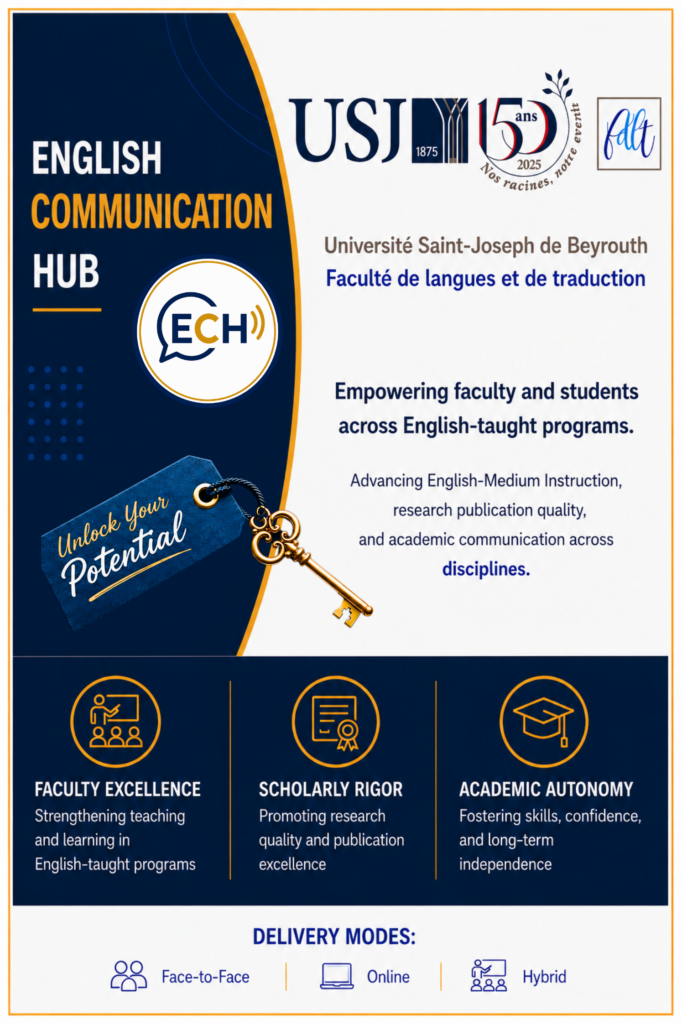
The sessions will take place at USJ (on campus), online, or hybrid.
What is the main objective of the course?
The Main Objective of the Course:
To transform how instructors teach in English by developing their ability to deliver clear, structured, and effective instruction in multilingual classrooms—moving beyond language fluency to achieve real student understanding and engagement in an English-Medium Instruction (EMI) context.
Who teaches the course?
The course is taught by Nada M. Salem, President/CEO of AFEE and IFWE.
 Nada M. Salem is a passionate educator with extensive experience in leading academic institutions in the United States and abroad. Over more than twenty years, she has taught school students, college students, student teachers, teachers, and leaders. She co-created and co- taught a methods course for teachers at The George Washington University Graduate School of Education. Nada is the Co-Editor in Chief of “Teaching World Languages: A Practical Guide- Arabic Edition” (The National Capital Language Resource Center, Washington, DC).
Mrs. Salem holds a teaching diploma, two master's degrees, one in translation and another in education, and has successfully completed most courses (40 credits) towards a doctorate (Ed.D.) in Curriculum and Instruction & Educational Technology Leadership at The George Washington University Graduate School of Education. Additionally, she holds an Executive Certificate in Public Leadership from Harvard University. Mrs. Salem formerly served as Administrative Director and Assessment of Learning Coordinator for AACSB Accreditation at the GWU School of Business’s Master of Science in Finance Program. In September 2019, Mrs. Salem was selected as a WOMAN LEADER by the University of Maryland‘s Kahlil Gibran Chair for Values and Peace. She is a member of the Marquis WHO'S WHO® list of Prominent Business Professionals, and she was featured among Marquis Who's Who's Top Executives in Education and Leadership.
Mrs. Salem is the Founding President/CEO of the American Foundation for Educational Excellence (AFEE), an organization whose mission is to help, on a worldwide basis, influencers, leaders, HR professionals, and managers of educational institutions, profit and non-profit organizations and corporations, to pursue excellence by improving leadership skills, managerial competencies and educational programs, namely through face-to-face and online trainings. AFEE is an Approved Provider for both HRCI & SHRM.
Mrs. Salem is also the Founding President/CEO of AFEE’s subsidiaries, the Center for Excellence in Languages: Teaching, Editing, Translating, and Interpreting, and the International Foundation for Women's Empowerment (IFWE) which seeks to empower all women and help them thrive on the personal and professional levels, regardless of nationality and religion.

TERMS OF SERVICE: We reserve the right, in our sole discretion, to reject or remove anyone who has registered or gained access under false pretenses, provided false information, or for any other action or behavior that we deem inappropriate, before, during or after the sessions, with or without prior notice or explanation, and without liability.
IMPORTANT DISCLAIMER: All rights reserved. The information on this page shall be considered proprietary information not to be used, copied or reproduced in any way. No part of our presentations / workshops / webinars may be reproduced, distributed, or transmitted in any form or by any means, including photocopying, recording, or other electronic or mechanical methods.