ECH Program on Oral Communication- EMI
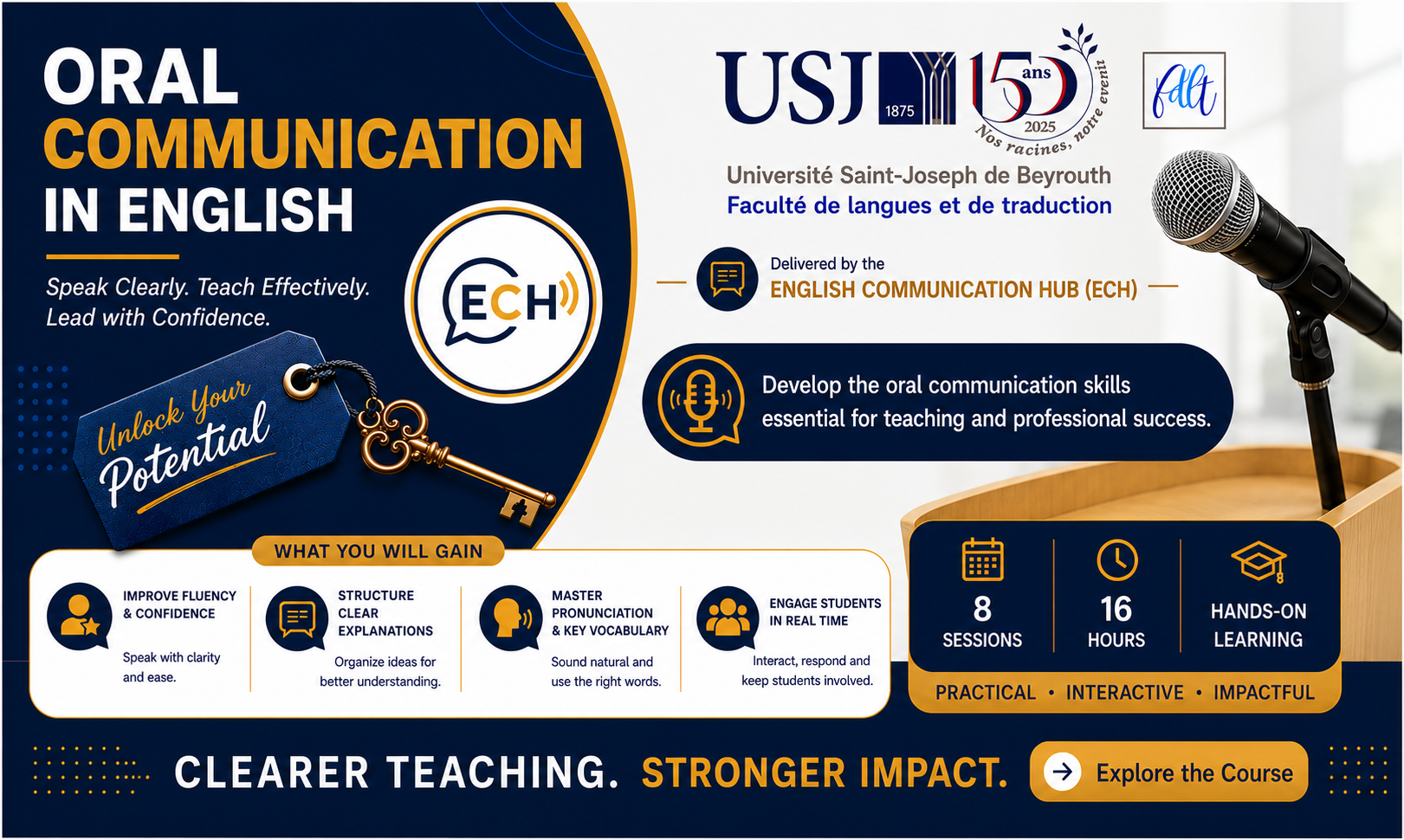
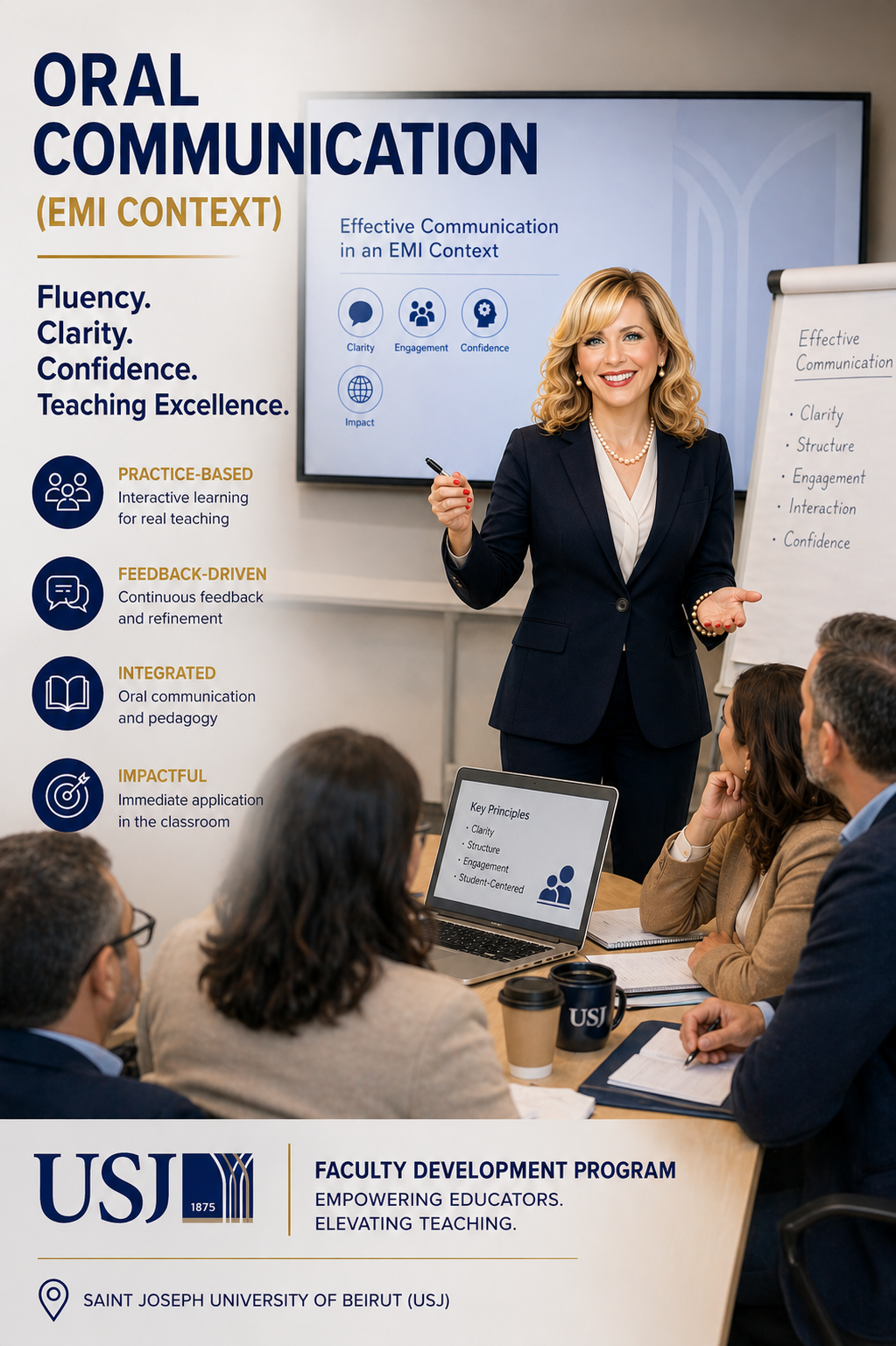
This program is aimed at educators who wish to hone their skills in oral communication in English-Medium Instruction (EMI) contexts.
It develops professors into clear and confident communicators in English, capable of teaching complex concepts using the structure, clarity, and engagement of the American teaching approach.
ORAL COMMUNICATION
English-Medium Instruction (EMI) Context
Clarity. Confidence. Teaching Excellence.
Saint Joseph University of Beirut (USJ)
OBJECTIVE
To empower faculty across disciplines to improve oral fluency, communicate clearly and confidently in English, and teach more effectively in an English-Medium Instruction (EMI) context.
CORE EMI PRINCIPLES
CORE EMI PRINCIPLES
Foundation of effective teaching in English.
Focus
-
- Communicating content clearly in English
- Supporting understanding in multilingual classrooms
- Creating structured and engaging learning experiences
Core Elements
-
- Clarity over complexity
- Structured delivery
- Scaffolding for understanding
- Comprehension checking
- Strategic use of language
- Student engagement
- Psychological safety
In Practice
-
- Use simple, direct language instead of complex or translated sentences
- Organize explanations using clear structure (e.g., What–Why–How)
- Break down complex ideas step by step
- Check understanding regularly through targeted questions
- Rephrase, repeat, and emphasize key concepts
- Encourage participation and interaction
- Create a safe environment where students feel comfortable speaking
Outcome
-
- Clearer and more effective communication in English
- Improved student understanding and participation
- More structured, engaging, and supportive teaching

Session Details
🟣 SESSION 5 — STRUCTURED TEACHING (AMERICAN EMI APPROACH)
Clarity is structure.
Focus
- Organizing explanations for understanding
- Teaching with clarity and purpose
- Structuring information progressively in real time
Core Elements
- Advance organizers
- Why–How–What explanation model
- Signposting and transitions
- Chunking information for comprehension
- Making explanations meaningful and convincing
Language Integration
- Teaching phrases:
- “Today we will…”
- “The key idea is…”
- “This is important because…”
- “Let’s break this down…”
- “First… then… finally…”
EMI Principles in Action
- Structured delivery
- Comprehension checking
- Scaffolding for understanding
Outcome
- Structured explanation template
- Structured explanation framework for EMI teaching
- Clearer and more effective teaching delivery
- Improved organization, pacing, and instructional clarity
🟣 SESSION 5 DETAILS — STRUCTURED TEACHING (AMERICAN EMI APPROACH)
Clarity is structure.
From ideas to organized teaching
Review Exercises (As Needed)
EXERCISE 1 — EMI INTELLIGIBILITY CHALLENGE
Read the following sentences aloud.
Focus on:
- stress
- rhythm
- problematic sounds
- listener-friendly pronunciation
- Knowledge develops through experience and reflection.
- We must pursue continuous improvement.
- Communication problems often occur during complex explanations.
- Let me repeat the main idea.
- Do not assume students already understand.
- Students must possess strong analytical skills.
- Academic communication requires clarity.
- Please listen to the recordings before next week.
- The consequences can be significant.
- Curiosity promotes deeper learning.
- The curriculum should support understanding.
- Let us examine the evidence carefully.
- Expertise develops over time.
- I insist on clear communication.
- This thesis examines student engagement.
- Several theses were submitted this year.
- Every crisis creates opportunities.
- The analyses revealed important findings.
- The criteria are clearly defined.
- This criterion is essential.
EXERCISE 2 — WORD STRESS CHALLENGE
Underline the stressed syllable before reading aloud.
- knowledge
- pursue
- occur
- repeat
- assume
- possess
- academic
- recordings
- consequences
- curiosity
- curriculum
- examine
- expertise
- psychological
- eligible
- conscientious
- evaluate
- categories
- diligent
- attitude
EXERCISE 3 — ADVANCED PRONUNCIATION DRILL
Read the word pairs aloud.
- colleague – college
- advice – advise
- content (noun) – content (adjective)
- use (noun) – use (verb)
- increase (noun) – increase (verb)
- exercise (noun) – exercise (verb)
- record (noun) – record (verb)
- present (noun) – present (verb)
- conduct (noun) – conduct (verb)
- process (noun) – process (verb)
Discuss:
- Which pronunciation changes?
- Which syllable receives the stress?
EXERCISE 4 — SINGULAR OR PLURAL?
Choose the correct form.
- The data _____ convincing.
a) is
b) are - The criterion _____ important.
a) is
b) are - The criteria _____ important.
a) is
b) are - This thesis _____ well written.
a) is
b) are - These theses _____ well written.
a) is
b) are - The analysis _____ complete.
a) is
b) are - The analyses _____ complete.
a) is
b) are - The diagnosis _____ confirmed.
a) was
b) were - The diagnoses _____ confirmed.
a) was
b) were - The basis _____ clear.
a) is
b) are - The bases _____ clear.
a) is
b) are - This information _____ useful.
a) is
b) are - The advice _____ helpful.
a) was
b) were - A number of students _____ absent.
a) is
b) are - The number of students _____ increasing.
a) is
b) are
EXERCISE 5 — COMMON EMI COLLOCATIONS
Choose the correct expression.
- make / take a decision
- make / take an exam
- pass / succeed an exam
- responsible for / responsible of
- insist on / insist to
- jealous of / jealous from
- based on / based in
- on time / in time
- eat on the table / eat at the table
- contribute to / contribute in
- benefit from / profit from
- transfer knowledge / transfer a knowledge
- pieces of advice / advices
- make progress / do progress
- pay attention / make attention
- do a mistake / make a mistake
- do the bed / make the bed
EXERCISE 6 — TEACHER LANGUAGE REPAIR
Correct the following sentences.
- I insist to arrive on time.
- We are responsible of the project.
- I am not jealous from my colleagues.
- Students made an exam yesterday.
- The students succeeded the exam.
- Please give me some advices.
- The informations are useful.
- We arrived at time.
- The books are at the table.
- I took a decision yesterday.
- The report is based in recent research.
- We need to transfer knowledges.
- The patient was nauseous after surgery.
- The teacher contributed in the discussion.
- The professor insisted to continue.
EXERCISE 7 — CHOOSE THE CORRECT FORM
- The professor gave excellent __________.
a) advice
b) advise - I would like to __________ a different approach.
a) advice
b) advise - This doctoral __________ examines EMI communication.
a) thesis
b) theses - Several master's __________ were submitted this year.
a) thesis
b) theses - The __________ for admission is clearly stated.
a) criterion
b) criteria - The admission __________ are clearly stated.
a) criterion
b) criteria - The dentist confirmed the __________.
a) diagnosis
b) diagnoses - The researchers compared several __________.
a) diagnosis
b) diagnoses - The statistical __________ supports the conclusion.
a) analysis
b) analyses - Several __________ were conducted.
a) analysis
b) analyses - The theoretical __________ is clearly explained.
a) basis
b) bases - The argument rests on several theoretical __________.
a) basis
b) bases - Her __________ helps her become a better researcher.
a) curiosity
b) curious - She is very __________ about educational technology.
a) curiosity
b) curious - His __________ of educational theory is impressive.
a) philosophy
b) philosopher - He is a famous educational __________.
a) philosophy
b) philosopher - Students must __________ strong communication skills.
a) possession
b) possess - The university is in __________ of extensive data.
a) possession
b) possess - Place the __________ on the key findings.
a) emphasis
b) emphasize - We should __________ the importance of clarity.
a) emphasis
b) emphasize - My __________ helped me redesign the course.
a) colleague
b) college - My son attends a Jesuit __________.
a) colleague
b) college
EXERCISE 8 — DENTISTRY EMI PRONUNCIATION PRACTICE
Read aloud.
- The diagnosis was confirmed after examination.
- Several diagnoses were discussed during the conference.
- The patient suffers from periodontal disease.
- Hypoglycemia may occur during treatment.
- The consequences can be severe.
- The methodology was carefully designed.
- The criteria for evaluation are clearly stated.
- Professionalism is essential in dentistry.
- The curriculum includes clinical practice.
- Students should evaluate the results carefully.
EXERCISE 9 — STRESS & RHYTHM SENTENCES
Read naturally and emphasize the bold idea.
- The KEY IDEA is patient safety.
- The FIRST STEP is diagnosis.
- The MOST IMPORTANT THING is prevention.
- The MAIN CAUSE is bacterial accumulation.
- The CRITERIA are clearly defined.
- The CONSEQUENCES can be serious.
- The RATIONALE is explained in the article.
- The METHODOLOGY was carefully selected.
- The DATA support the conclusion.
- The CURRICULUM focuses on practical application.
EXERCISE 10 — EMI COMMUNICATION DETECTIVES
Whole-Class Challenge
Many English words change pronunciation, stress, grammatical function, and meaning without changing spelling.
Let us analyze the following sentence pairs.
For each pair, we will discuss:
- What changed?
- How did the pronunciation change?
- How did the meaning change?
- Which form do EMI teachers use most often?
- Create a dentistry or teaching example using both forms.
Pair 1
A. The students received useful advice.
B. I would advise students to review the material.
Pair 2
A. His belief influences his teaching philosophy.
B. I believe students learn best through practice.
Pair 3
A. Take a deep breath before speaking.
B. Please breathe slowly.
Pair 4
A. Technology has many practical uses.
B. We use technology to support learning.
Pair 5
A. There was a significant increase in participation.
B. Active learning can increase participation.
Pair 6
A. Regular exercise improves health.
B. Students should exercise critical thinking.
Pair 7
A. The present situation requires action.
B. I will present the results tomorrow.
Pair 8
A. The record was updated yesterday.
B. Please record your explanation.
Pair 9
A. Professional conduct is essential.
B. Teachers should conduct regular reviews.
Pair 10
A. The manufacturing process is complex.
B. Students need time to process information.
Pair 11
A. The main object is student success.
B. Some students may object to the proposal.
EXERCISE 11 — THE / /ðiː/ OR /ðə/ ?
Read aloud.
- the university
- the article
- the explanation
- the examination
- the evidence
- the objective
- the student
- the teacher
- the curriculum
- the idea
- the umbrella
- the union
- the unprofessional artist
- the onion
EXERCISE 12 — EMI RAPID-FIRE CHALLENGE
Read each sequence smoothly without stopping.
- knowledge → pursue → occur → repeat
- assume → possess → academic → recordings
- consequences → curiosity → curriculum → examine
- expertise → insist on → evaluate → categories
- diligent → colleague → methodology → careful
- psychological → eligible → conscientious → attitude
- diagnosis → diagnoses → analysis → analyses
- thesis → theses → crisis → crises
- professionalism → professionally → performance
- philosophy → cognitive → scaffolding → facilitator
- variables → relevant → diseases → hypoglycemia
- contribute → constantly → possession → success
- process → consent → rationale → criterion
- cognitive → suppression → lemonade → salmon
- shrimp → lamb → vowel → historical → threshold
EXERCISE 13 — CHALLENGING WORDS FOR FRENCH SPEAKERS
Read aloud and mark the stressed syllable.
- knowledge
- pursue
- occur
- repeat
- academic
- consequences
- curiosity
- curriculum
- expertise
- psychological
- conscientious
- methodology
- professionalism
- diagnosis
- analyses
- criteria
- facilitator
- cognitive
- rationale
- hypoglycemia
EXERCISE 14 — EMI MICRO-TEACHING CHALLENGE
Explain the following concept to a first-year student in 30 seconds.
Use:
- First...
- Then...
- For example...
- The key idea is...
- Finally...
Topics:
- Hypoglycemia
- Professionalism
- Patient consent
- Diagnosis
- Curriculum design
- Academic integrity
- Data analysis
- Evidence-based practice
- Critical thinking
- Cognitive load
- Dental plaque
- Gingivitis
- Periodontal disease
- Oral hygiene
- Dental caries
- Local anesthesia
- Infection control
- Patient-centered care
- Lifelong learning
- Artificial intelligence in healthcare
Whole-Class Challenge
Choose one topic.
You have 30 seconds to explain it to a first-year student using the required structure.
As you listen, identify:
- Was the explanation clear?
- Was it logically structured?
- Was the language easy to understand?
- Were examples used effectively?
- Did the speaker reduce cognitive overload?
EMI Reflection
After each explanation, discuss:
- What made the explanation easy to follow?
- Which signposting phrases were used effectively?
- How could the explanation be simplified further?
- What would help a multilingual learner understand more easily?
Key EMI Principle
Great EMI teaching is not demonstrating how much the teacher knows.
Great EMI teaching is helping students understand what they need to know.
Program FAQs
What is the course format?
The course is highly interactive, practice-based, and performance-driven.
Each session combines:
- Short, focused input
- Guided speaking practice
- Real teaching simulations (micro-teaching)
- Immediate feedback from the instructor and peers
Participants will:
- Record and analyze their own speaking
- Apply communication strategies to real teaching scenarios
- Engage in live activities using tools such as Poll Everywhere and Mentimeter
The course follows a progressive structure, allowing participants to build fluency, clarity, and confidence step by step.
Where will the sessions take place?
The sessions will take place at USJ (on campus), online, or hybrid.
What is the main objective of the course?
The Main Objective of the Course:
To transform how instructors teach in English by developing their ability to deliver clear, structured, and effective instruction in multilingual classrooms—moving beyond language fluency to achieve real student understanding and engagement in an English-Medium Instruction (EMI) context.
Who teaches the course?
The course is taught by Nada M. Salem, President/CEO of AFEE and IFWE.
 Nada M. Salem is a passionate educator with extensive experience in leading academic institutions in the United States and abroad. Over more than twenty years, she has taught school students, college students, student teachers, teachers, and leaders. She co-created and co- taught a methods course for teachers at The George Washington University Graduate School of Education. Nada is the Co-Editor in Chief of “Teaching World Languages: A Practical Guide- Arabic Edition” (The National Capital Language Resource Center, Washington, DC).
Mrs. Salem holds a teaching diploma, two master's degrees, one in translation and another in education, and has successfully completed most courses (40 credits) towards a doctorate (Ed.D.) in Curriculum and Instruction & Educational Technology Leadership at The George Washington University Graduate School of Education. Additionally, she holds an Executive Certificate in Public Leadership from Harvard University. Mrs. Salem formerly served as Administrative Director and Assessment of Learning Coordinator for AACSB Accreditation at the GWU School of Business’s Master of Science in Finance Program. In September 2019, Mrs. Salem was selected as a WOMAN LEADER by the University of Maryland‘s Kahlil Gibran Chair for Values and Peace. She is a member of the Marquis WHO'S WHO® list of Prominent Business Professionals, and she was featured among Marquis Who's Who's Top Executives in Education and Leadership.
Mrs. Salem is the Founding President/CEO of the American Foundation for Educational Excellence (AFEE), an organization whose mission is to help, on a worldwide basis, influencers, leaders, HR professionals, and managers of educational institutions, profit and non-profit organizations and corporations, to pursue excellence by improving leadership skills, managerial competencies and educational programs, namely through face-to-face and online trainings. AFEE is an Approved Provider for both HRCI & SHRM.
Mrs. Salem is also the Founding President/CEO of AFEE’s subsidiaries, the Center for Excellence in Languages: Teaching, Editing, Translating, and Interpreting, and the International Foundation for Women's Empowerment (IFWE) which seeks to empower all women and help them thrive on the personal and professional levels, regardless of nationality and religion.

TERMS OF SERVICE: We reserve the right, in our sole discretion, to reject or remove anyone who has registered or gained access under false pretenses, provided false information, or for any other action or behavior that we deem inappropriate, before, during or after the sessions, with or without prior notice or explanation, and without liability.
IMPORTANT DISCLAIMER: All rights reserved. The information on this page shall be considered proprietary information not to be used, copied or reproduced in any way. No part of our presentations / workshops / webinars may be reproduced, distributed, or transmitted in any form or by any means, including photocopying, recording, or other electronic or mechanical methods.