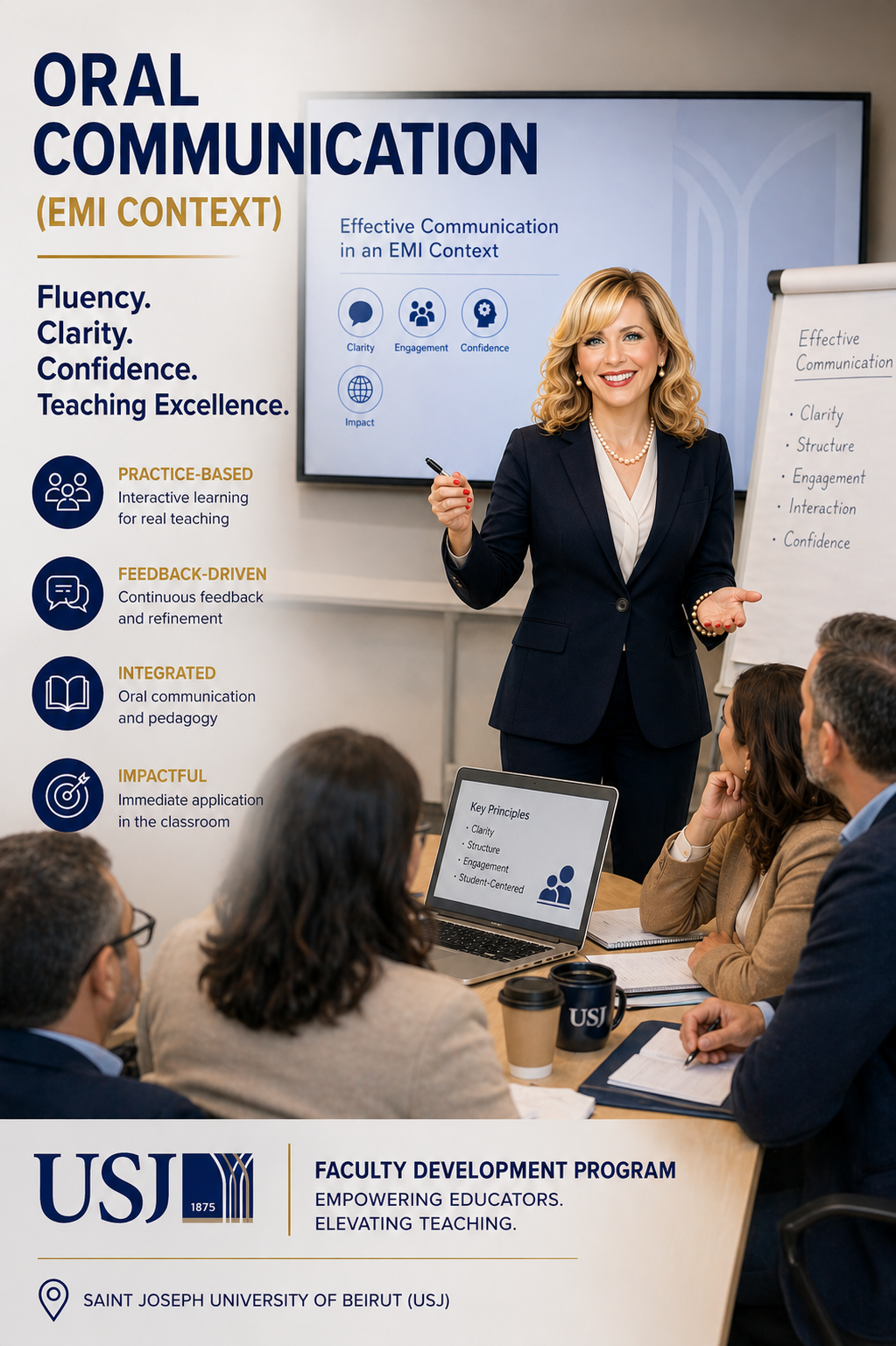
ECH Program on Oral Communication- EMI
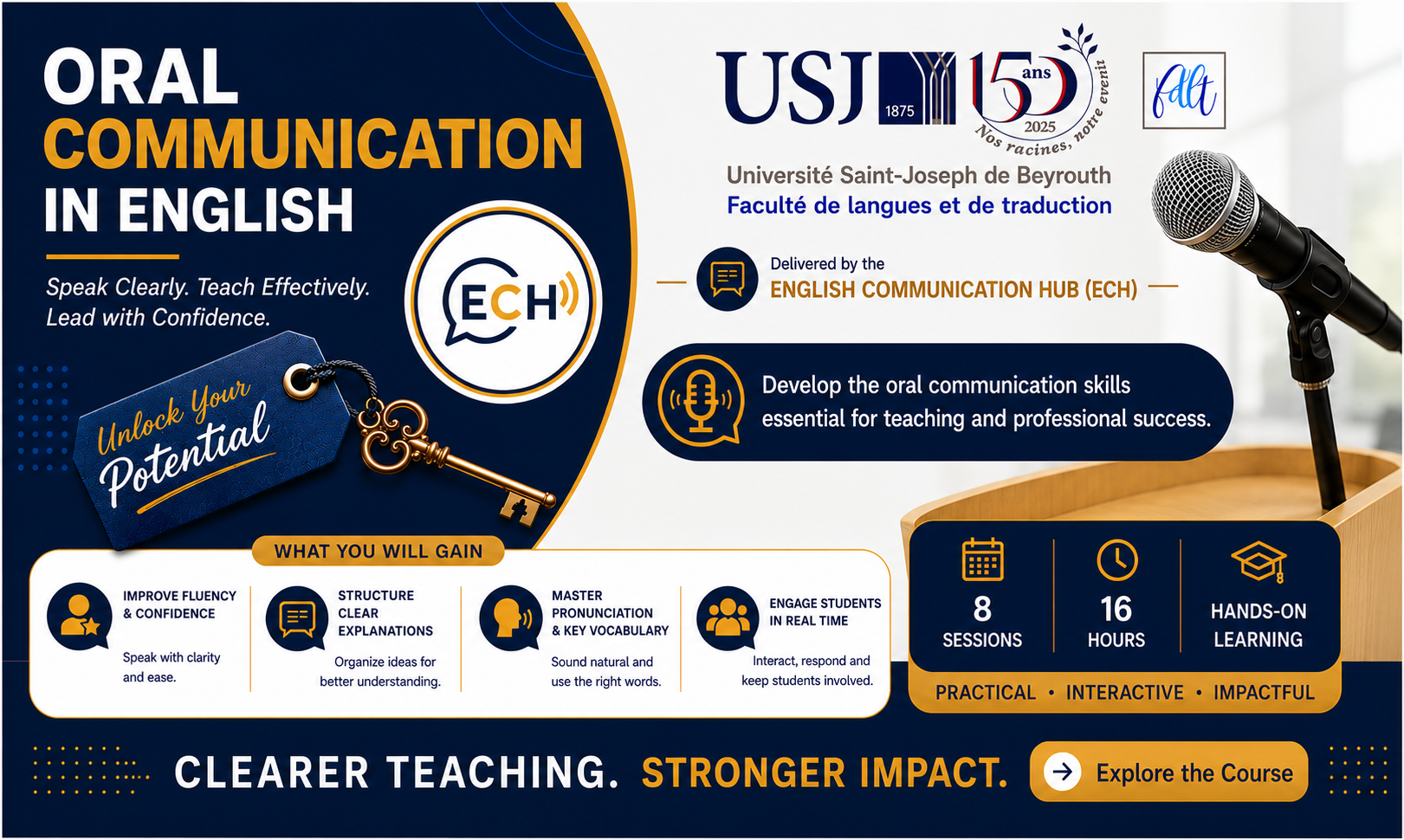
This program is aimed at educators who wish to hone their skills in oral communication in English-Medium Instruction (EMI) contexts.
It develops professors into clear and confident communicators in English, capable of teaching complex concepts using the structure, clarity, and engagement of the American teaching approach.
ORAL COMMUNICATION
English-Medium Instruction (EMI) Context
Clarity. Confidence. Teaching Excellence.
Saint Joseph University of Beirut (USJ)
OBJECTIVE
To empower faculty across disciplines to improve oral fluency, communicate clearly and confidently in English, and teach more effectively in an English-Medium Instruction (EMI) context.
CORE EMI PRINCIPLES
CORE EMI PRINCIPLES
Foundation of effective teaching in English.
Focus
-
- Communicating content clearly in English
- Supporting understanding in multilingual classrooms
- Creating structured and engaging learning experiences
Core Elements
-
- Clarity over complexity
- Structured delivery
- Scaffolding for understanding
- Comprehension checking
- Strategic use of language
- Student engagement
- Psychological safety
In Practice
-
- Use simple, direct language instead of complex or translated sentences
- Organize explanations using clear structure (e.g., Why - How - What)
- Break down complex ideas step by step
- Check understanding regularly through targeted questions
- Rephrase, repeat, and emphasize key concepts
- Encourage participation and interaction
- Create a safe environment where students feel comfortable speaking
Outcome
-
- Clearer and more effective communication in English
- Improved student understanding and participation
- More structured, engaging, and supportive teaching

Session Details
🟠 SESSION 6 — SCAFFOLDING & STUDENT ENGAGEMENT
Make understanding visible.
Focus
- Supporting multilingual learners
- Increasing interaction
- Reducing cognitive overload in EMI classrooms
Core Elements
- Scaffolding strategies for comprehension
- Questioning techniques (checking, probing, guiding)
- Interactive tools: Poll Everywhere and/or Mentimeter
- Chunking and pacing information for multilingual learners
- Monitoring comprehension during explanations
Language Integration
- Questioning language:
- “Why do you think…?”
- “What happens if…?”
- Rephrasing for clarity
- Clarification and comprehension-checking language
- Encouraging participation through guided questioning
EMI Principles in Action
- Scaffolding for understanding
- Student engagement
- Comprehension checking
Outcome
- Engagement and questioning framework
- Improved comprehension monitoring strategies
- Increased student participation
- Stronger learner interaction and understanding
🟠 SESSION 6 DETAILS — SCAFFOLDING & STUDENT ENGAGEMENT
Make understanding visible.
From explaining content to ensuring understanding
A. Main Objective
By the end of this session, you will be able to support multilingual learners more effectively by making explanations easier to process, follow, and understand.
You will learn practical scaffolding strategies that reduce cognitive overload, increase student participation, and help students remain engaged throughout your teaching.
You will also develop questioning techniques that allow you to monitor comprehension in real time, identify misunderstandings early, and guide learners toward deeper understanding through structured interaction.
The goal is not simply to deliver information, but to continuously make learning visible by checking, clarifying, rephrasing, and engaging students throughout the learning process.
This session therefore extends Session 5's focus on structured explanations by exploring how effective EMI teachers scaffold understanding, encourage participation, and monitor comprehension while teaching.
B. Agenda
1. Advance Organizer & Review — Connecting Structure to Understanding (10 min)
1.1. Reviewing Sessions 4 & 5 Content
Review:
-
- Session 4: 2.5 activity 2; 2.6; 2.7
- Session 5: Aristotle (Video)
- Session 5: 3.2 > Advance Organizers + The American Teaching Structure Model or the ECH Structured Teaching Framework
- Session 5: 3.3 > Signposting & Transition Language Practice
- Session 5: 3.4 (intro to scaffolding- video)
- Session 5: 5 > Chunking Information
- EXTRAS (from session 2):
1.2. Exploring This Session
(+ Core EMI Principles)
2. Understanding Scaffolding in EMI Teaching (10 min)
2.1. What Is Scaffolding?
2.2. Why Multilingual Learners Need Scaffolding
2.3. Reducing Cognitive Overload
2.4. Making Understanding Visible
3. Questioning for Understanding (15 min)
3.1. Checking Questions
3.2. Probing Questions
3.3. Guiding Questions
3.4. Rephrasing & Clarification Techniques
4. Student Engagement in EMI Classrooms (15 min)
4.1. Using Poll Everywhere (session 4) and/or Mentimeter
4.2. Encouraging Participation Through Guided Questioning
4.3. Monitoring Comprehension During Explanations
4.4. Responding to Misunderstandings Supportively
5. EMI Micro-Teaching Challenge (5 min)
Applying:
- Scaffolding
- Chunking
- Questioning
- Comprehension Checking
6. EMI Principles in Action (3 min)
7. Recap & Takeaways (2 min)
HW (Optional)
C. Core (Session Content & Activities)
1. Advance Organizer & Review — Connecting Structure to Understanding (10 min)
1.1. Reviewing Session 5
Brief discussion:
- Why is structure important in EMI teaching?
- How does organization support comprehension?
Review key concepts:
- Advance Organizers
- Signposting
- Chunking
- Structured Explanations
Discussion:
Can a well-structured explanation still fail?
Why?
A structured explanation helps students follow information.
Scaffolding helps students understand information.
1.2. Exploring This Session
Today's Question:
How do we know students are actually understanding?
Core EMI Principle:
Teaching is not delivering information.
Teaching is helping learners construct understanding.
2. Understanding Scaffolding in EMI Teaching (10 min)
2.1. What Is Scaffolding?
Simple definition:
Scaffolding is temporary support that helps learners understand, participate, and succeed.
Examples:
- Giving examples
- Breaking information into smaller parts
- Providing prompts
- Rephrasing difficult ideas
- Using visuals
- Providing guided questions
2.2. Why Multilingual Learners Need Scaffolding
Students are simultaneously processing:
- New content
- New vocabulary
- New language structures
- New concepts
Effective EMI teachers therefore reduce unnecessary cognitive load.
2.3. Reducing Cognitive Overload
Instead of:
Explaining everything at once
Try:
- First...
- Next...
- Finally...
- Pause regularly.
- Allow processing time.
2.4. Making Understanding Visible
Ask:
How can we see what students understand?
Possible answers:
- Questions
- Polls
- Summaries
- Examples
- Student explanations
3. Questioning for Understanding (15 min)
3.1. Checking Questions
Purpose: Verify understanding.
Examples:
- "What is the main idea?"
- "What is the first step?"
- "Can someone summarize?"
3.2. Probing Questions
Purpose: Promote deeper thinking.
Examples:
- "Why do you think that?"
- "What evidence supports your answer?"
- "What might happen if...?"
3.3. Guiding Questions
Purpose: Lead students toward understanding.
Examples:
- "What do we already know?"
- "What comes before this step?"
- "How is this connected?"
3.4. Rephrasing & Clarification Techniques
Useful language:
- "In other words..."
- "Let me explain that differently."
- "Another way to think about it is..."
4. Student Engagement in EMI Classrooms (15 min)
4.1. Poll Everywhere and/or Mentimeter
Demonstration:
Quick comprehension-check activity.
Examples:
Multiple choice
Word cloud
Ranking question
4.2. Encouraging Participation Through Guided Questioning
Useful language:
"What do you think?"
"Who can add to that idea?"
"Can someone give an example?"
4.3. Monitoring Comprehension During Explanations
Observe:
- Student responses
- Facial expressions
- Participation levels
- Questions asked
- Poll results
4.4. Responding to Misunderstandings Supportively
Avoid:
"No, that's wrong." [DO NOT SHOVE IT IN THEIR FACES!]
Use:
- "Interesting idea."
- "Let's explore that."
- "You're close. Let's build on that."
- "Let's think about it another way."
5. EMI Micro-Teaching Challenge (5 min)
Participants explain a simple concept from their discipline.
Requirements:
- Use chunking.
- Ask one checking question.
- Ask one probing or guiding question.
- Rephrase one explanation.
Observers identify:
- Scaffolding used
- Questioning used
- Comprehension checks used
6. EMI Principles in Action (3 min)
- Scaffolding for Understanding
- Student Engagement
- Comprehension Checking
- Psychological Safety
- Strategic Use of Language
7. Recap & Takeaways (2 min)
The most effective EMI teachers:
✓ Structure information
✓ Scaffold understanding
✓ Ask purposeful questions
✓ Monitor comprehension continuously
✓ Encourage participation safely
✓ Make learning visible
Key Takeaway:
If Session 5 taught us how to explain clearly,
Session 6 teaches us how to ensure students actually understand.
Program FAQs
What is the course format?
The course is highly interactive, practice-based, and performance-driven.
Each session combines:
- Short, focused input
- Guided speaking practice
- Real teaching simulations (micro-teaching)
- Immediate feedback from the instructor and peers
Participants will:
- Record and analyze their own speaking
- Apply communication strategies to real teaching scenarios
- Engage in live activities using tools such as Poll Everywhere and Mentimeter
The course follows a progressive structure, allowing participants to build fluency, clarity, and confidence step by step.
Where will the sessions take place?
The sessions will take place at USJ (on campus), online, or hybrid.
What is the main objective of the course?
The Main Objective of the Course:
To transform how instructors teach in English by developing their ability to deliver clear, structured, and effective instruction in multilingual classrooms—moving beyond language fluency to achieve real student understanding and engagement in an English-Medium Instruction (EMI) context.
Who teaches the course?
The course is taught by Nada M. Salem, President/CEO of AFEE and IFWE.
 Nada M. Salem is a passionate educator with extensive experience in leading academic institutions in the United States and abroad. Over more than twenty years, she has taught school students, college students, student teachers, teachers, and leaders. She co-created and co- taught a methods course for teachers at The George Washington University Graduate School of Education. Nada is the Co-Editor in Chief of “Teaching World Languages: A Practical Guide- Arabic Edition” (The National Capital Language Resource Center, Washington, DC).
Mrs. Salem holds a teaching diploma, two master's degrees, one in translation and another in education, and has successfully completed most courses (40 credits) towards a doctorate (Ed.D.) in Curriculum and Instruction & Educational Technology Leadership at The George Washington University Graduate School of Education. Additionally, she holds an Executive Certificate in Public Leadership from Harvard University. Mrs. Salem formerly served as Administrative Director and Assessment of Learning Coordinator for AACSB Accreditation at the GWU School of Business’s Master of Science in Finance Program. In September 2019, Mrs. Salem was selected as a WOMAN LEADER by the University of Maryland‘s Kahlil Gibran Chair for Values and Peace. She is a member of the Marquis WHO'S WHO® list of Prominent Business Professionals, and she was featured among Marquis Who's Who's Top Executives in Education and Leadership.
Mrs. Salem is the Founding President/CEO of the American Foundation for Educational Excellence (AFEE), an organization whose mission is to help, on a worldwide basis, influencers, leaders, HR professionals, and managers of educational institutions, profit and non-profit organizations and corporations, to pursue excellence by improving leadership skills, managerial competencies and educational programs, namely through face-to-face and online trainings. AFEE is an Approved Provider for both HRCI & SHRM.
Mrs. Salem is also the Founding President/CEO of AFEE’s subsidiaries, the Center for Excellence in Languages: Teaching, Editing, Translating, and Interpreting, and the International Foundation for Women's Empowerment (IFWE) which seeks to empower all women and help them thrive on the personal and professional levels, regardless of nationality and religion.

TERMS OF SERVICE: We reserve the right, in our sole discretion, to reject or remove anyone who has registered or gained access under false pretenses, provided false information, or for any other action or behavior that we deem inappropriate, before, during or after the sessions, with or without prior notice or explanation, and without liability.
IMPORTANT DISCLAIMER: All rights reserved. The information on this page shall be considered proprietary information not to be used, copied or reproduced in any way. No part of our presentations / workshops / webinars may be reproduced, distributed, or transmitted in any form or by any means, including photocopying, recording, or other electronic or mechanical methods.