ECH Program on Oral Communication- EMI
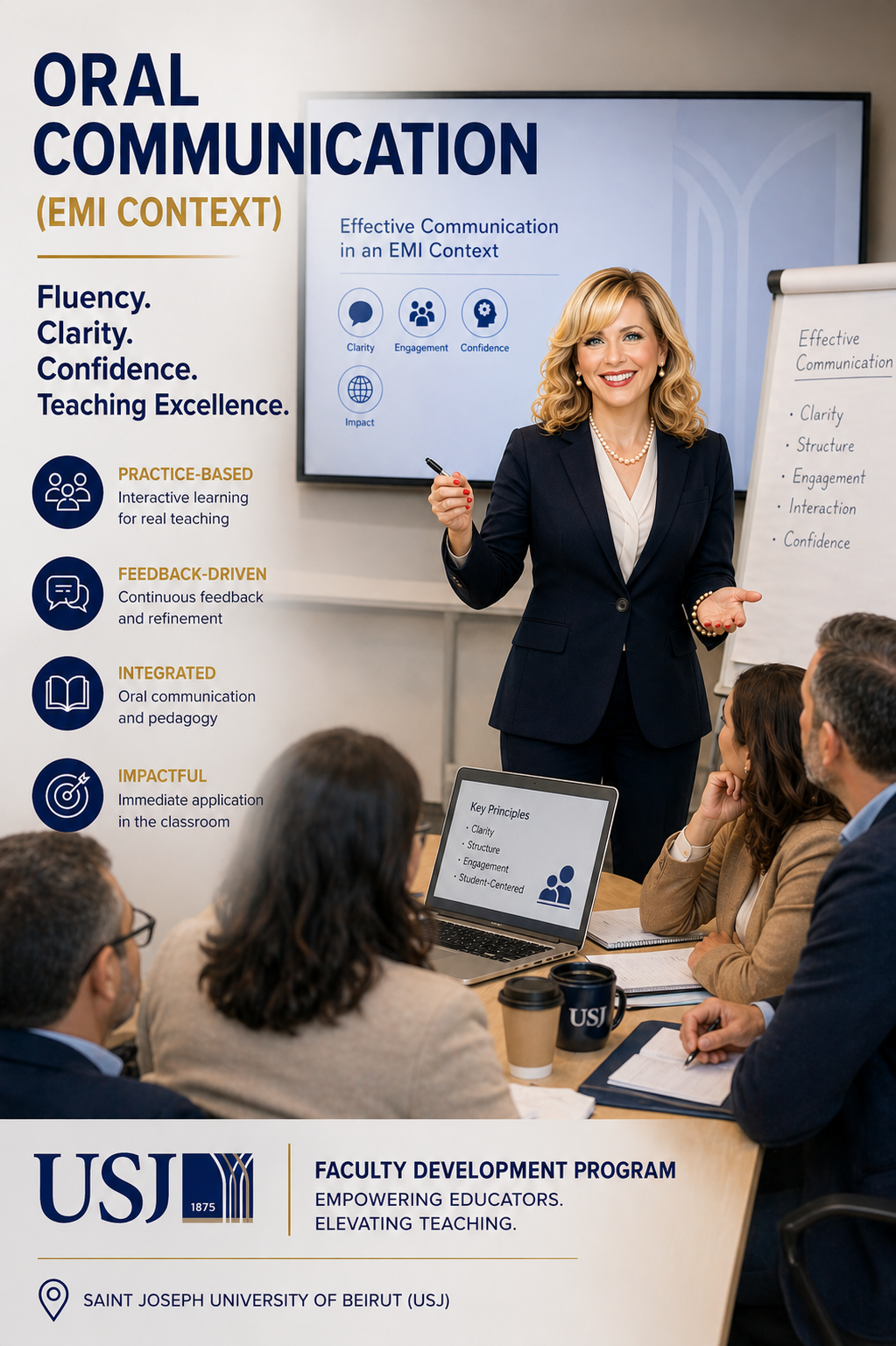
This program is aimed at educators who wish to hone their skills in oral communication in English-Medium Instruction (EMI) contexts.
It develops professors into clear and confident communicators in English, capable of teaching complex concepts using the structure, clarity, and engagement of the American teaching approach.
ORAL COMMUNICATION
English-Medium Instruction (EMI) Context
Clarity. Confidence. Teaching Excellence.
Saint Joseph University of Beirut (USJ)
OBJECTIVE
To empower faculty across disciplines to improve oral fluency, communicate clearly and confidently in English, and teach more effectively in an English-Medium Instruction (EMI) context.
PROGRAM APPROACH
- Practice-based and interactive
- Immediate application to real teaching contexts
- Continuous feedback and structured refinement
- Integration of oral communication and teaching practices
FINAL IMPACT
By the end of the program, participants will:
- Be more fluent in oral communication
- Be more confident when teaching in English
- Be more clear and structured in their explanations
- Be more effective in engaging and supporting students

Program Details
ORAL COMMUNICATION (EMI CONTEXT) – 16 HOURS
English-Medium Instruction (EMI) focuses on how to communicate content clearly, effectively, and accessibly in English so all students can understand and engage.
Format: 8 sessions × 2 hours
COURSE OBJECTIVES
By the end of this program, participants will be able to:
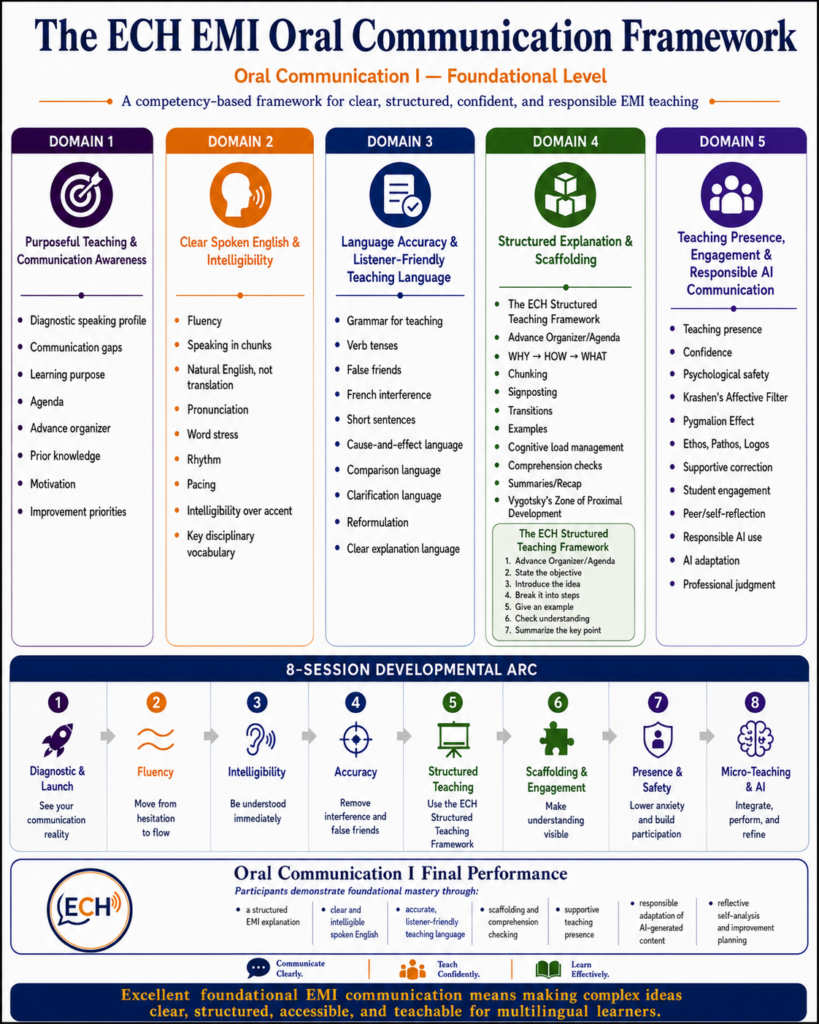
- Understand and apply core EMI principles in oral instruction
- Improve oral fluency in English for teaching, with greater ease and reduced hesitation
- Enhance clarity, pronunciation, stress, and pacing for multilingual comprehension
- Recognize and correct French–English pronunciation differences and interference patterns
- Identify and avoid false friends and common spoken errors
- Use clear and effective sentence structures in oral teaching
- Use discipline-specific vocabulary accurately and clearly
- Deliver structured explanations using the American teaching approach, including advance organizers and clear sequencing
- Apply scaffolding strategies to support student understanding
- Ask effective questions to check and deepen understanding
- Increase engagement using tools such as Poll Everywhere and/or Mentimeter
- Develop a confident, supportive, and inclusive teaching presence
- Make explanations clear, meaningful, and convincing
- Improve performance through practice, recording, and feedback
- Use videos and podcasts for continuous development
- Adapt AI-generated content into clear, structured oral explanations that support student understanding
CORE EMI PRINCIPLES
CORE EMI PRINCIPLES
Foundation of effective teaching in English.
Focus
-
- Communicating content clearly in English
- Supporting understanding in multilingual classrooms
- Creating structured and engaging learning experiences
Core Elements
-
- Clarity over complexity
- Structured delivery
- Scaffolding for understanding
- Comprehension checking
- Strategic use of language
- Student engagement
- Psychological safety
In Practice
-
- Use simple, direct language instead of complex or translated sentences
- Organize explanations using clear structure (e.g., What–Why–How)
- Break down complex ideas step by step
- Check understanding regularly through targeted questions
- Rephrase, repeat, and emphasize key concepts
- Encourage participation and interaction
- Create a safe environment where students feel comfortable speaking
Outcome
-
- Clearer and more effective communication in English
- Improved student understanding and participation
- More structured, engaging, and supportive teaching
[Password Protected]
Program FAQs
What is the course format?
The course is highly interactive, practice-based, and performance-driven.
Each session combines:
- Short, focused input
- Guided speaking practice
- Real teaching simulations (micro-teaching)
- Immediate feedback from the instructor and peers
Participants will:
- Record and analyze their own speaking
- Apply communication strategies to real teaching scenarios
- Engage in live activities using tools such as Poll Everywhere and Mentimeter
The course follows a progressive structure, allowing participants to build fluency, clarity, and confidence step by step.
Where will the sessions take place?
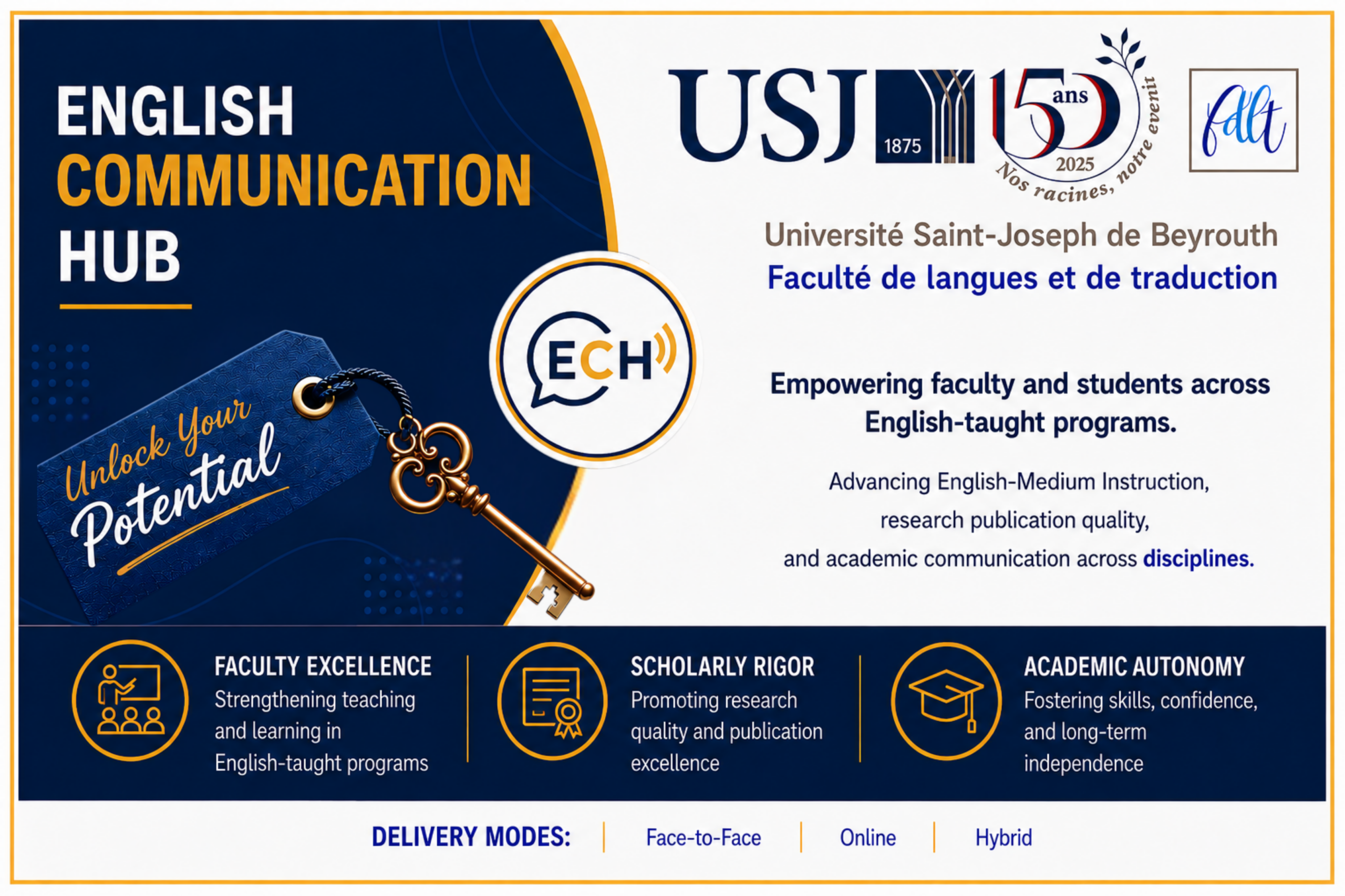
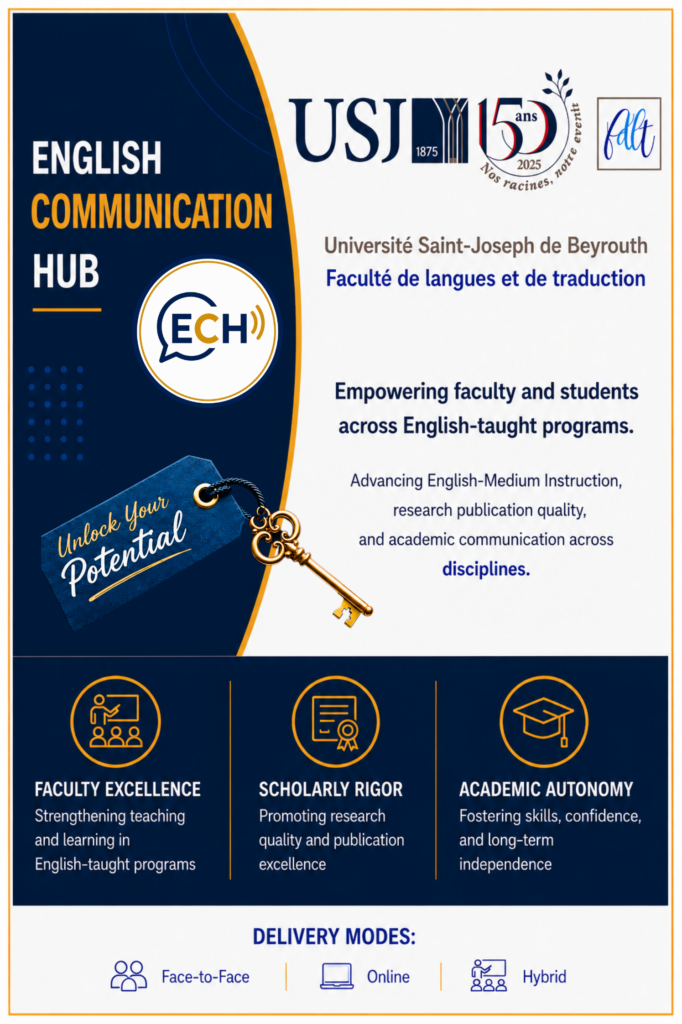
The sessions will take place at USJ (on campus), online, or hybrid.
What is the main objective of the course?
The Main Objective of the Course:
To transform how instructors teach in English by developing their ability to deliver clear, structured, and effective instruction in multilingual classrooms—moving beyond language fluency to achieve real student understanding and engagement in an English-Medium Instruction (EMI) context.
Who teaches the course?
The course is taught by Nada M. Salem, President/CEO of AFEE and IFWE.

Nada M. Salem is an academic leader, institutional strategist, and educator working at the intersection of educational excellence, leadership development, and transformation in the AI era.
She is the Founding President and CEO of the American Foundation for Educational Excellence (AFEE) and the International Foundation for Women’s Empowerment (IFWE), through which she designs and leads high-impact initiatives, builds institutional partnerships, and advances leadership and education across the United States, Lebanon, and internationally.
She is also the Founding Director of the Center for Excellence in Languages (CEL), a subsidiary of AFEE specializing in teaching, editing, translation, and interpreting, further strengthening her work in language education and academic communication.
She serves as Adjunct Professor at The George Washington University, where she teaches academic writing, instructional course design, educational technology, and English communication, and mentors international scholars and faculty.
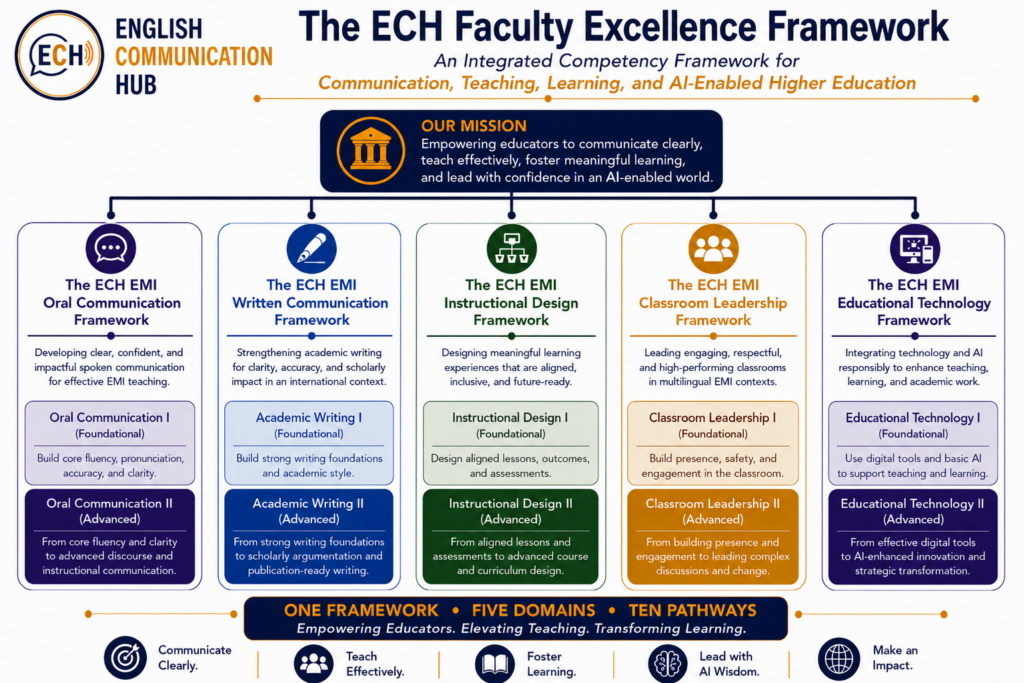
At Saint Joseph University of Beirut, she is Director of the English Communication Hub (ECH), leading university-wide efforts to elevate English-Medium Instruction (EMI), strengthen research publication, and advance academic communication to international standards. She previously served as Representative of the Rector for Educational Excellence and Philanthropy in the United States, contributing to strategic partnerships and institutional outreach.
Her doctoral work advances a framework for learning in the AI era centered on transferable mastery and cognitive agency, examining how universities can redesign curricula, assessment, and teaching practices in AI-mediated environments.
Across her career, she has designed and led academic and leadership programs, trained faculty, and supported institutional development across universities, foundations, and international organizations, bridging pedagogy, communication, and strategy in diverse educational contexts.
She holds a degree in languages and a Master’s in Translation from Saint Joseph University of Beirut, as well as a Teaching Diploma and a Master’s in TEFL from the American University of Beirut. She completed 40 credit hours toward a Doctorate (Ed.D.) in Curriculum & Instruction and Educational Technology Leadership at The George Washington University, and holds an Executive Certificate in Public Leadership from Harvard Kennedy School of Government.
She was selected as a Woman Leader by the University of Maryland’s Kahlil Gibran Chair for Values and Peace and recognized among Marquis Who’s Who Top Executives in Education and Leadership.
Her work is dedicated to advancing mastery-based, AI-ready education systems and developing leaders capable of shaping institutions in an era of profound technological and societal transformation.

TERMS OF SERVICE: We reserve the right, in our sole discretion, to reject or remove anyone who has registered or gained access under false pretenses, provided false information, or for any other action or behavior that we deem inappropriate, before, during or after the sessions, with or without prior notice or explanation, and without liability.
IMPORTANT DISCLAIMER: All rights reserved. The information on this page shall be considered proprietary information not to be used, copied or reproduced in any way. No part of our presentations / workshops / webinars may be reproduced, distributed, or transmitted in any form or by any means, including photocopying, recording, or other electronic or mechanical methods.