ECH Program on Oral Communication- EMI
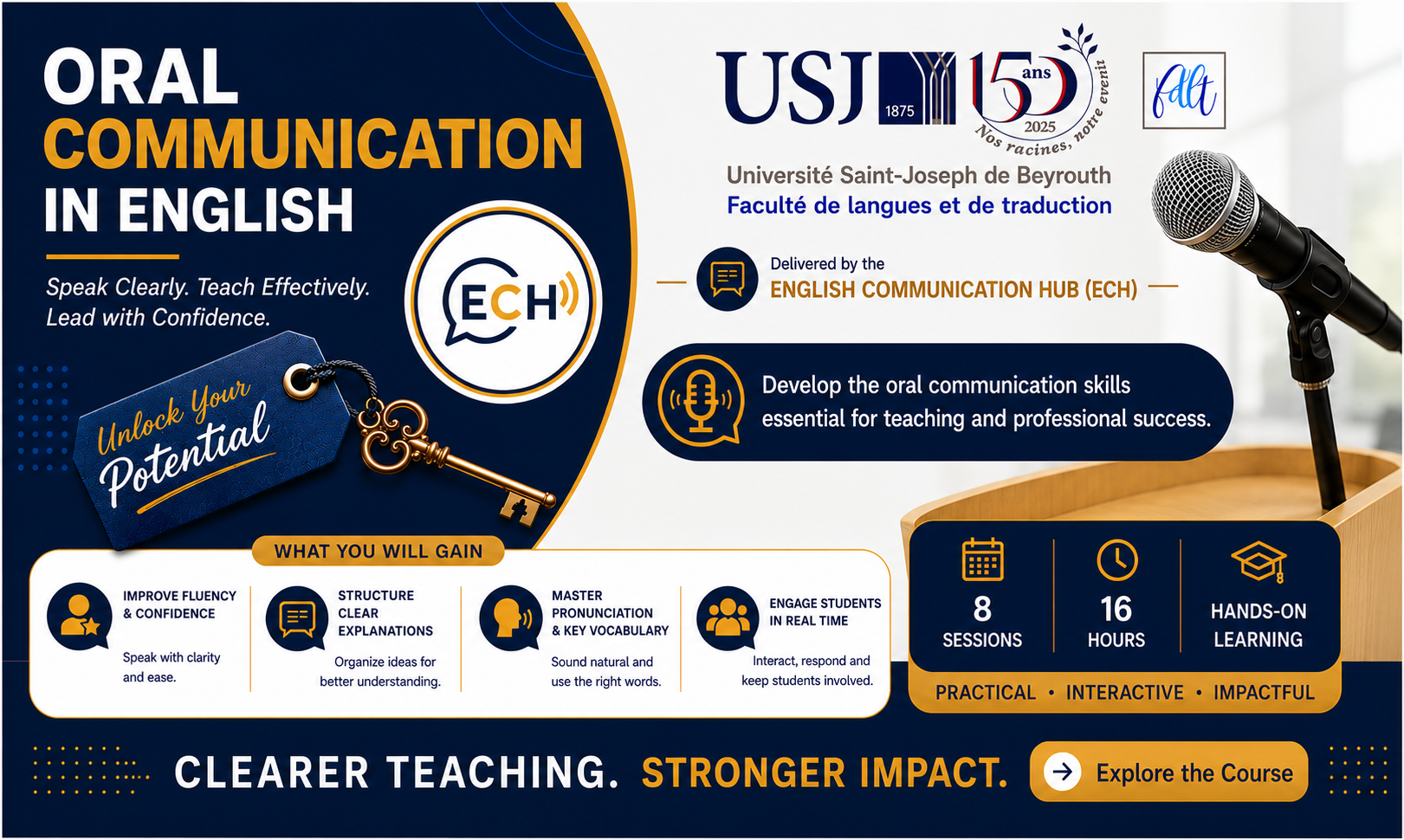
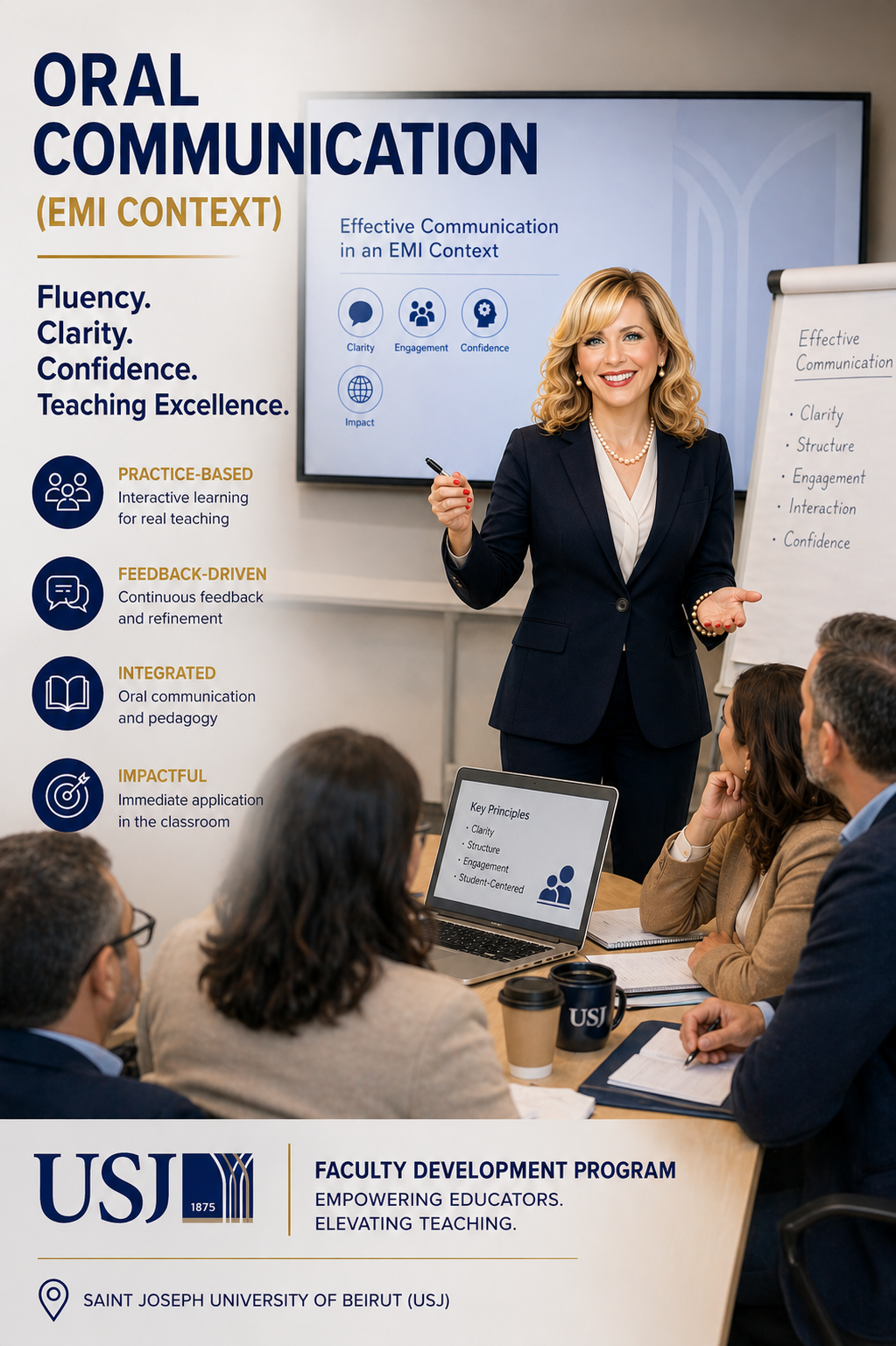
This program is aimed at educators who wish to hone their skills in oral communication in English-Medium Instruction (EMI) contexts.
It develops professors into clear and confident communicators in English, capable of teaching complex concepts using the structure, clarity, and engagement of the American teaching approach.
ORAL COMMUNICATION
English-Medium Instruction (EMI) Context
Clarity. Confidence. Teaching Excellence.
Saint Joseph University of Beirut (USJ)
OBJECTIVE
To empower faculty across disciplines to improve oral fluency, communicate clearly and confidently in English, and teach more effectively in an English-Medium Instruction (EMI) context.
CORE EMI PRINCIPLES
CORE EMI PRINCIPLES
Foundation of effective teaching in English.
Focus
-
- Communicating content clearly in English
- Supporting understanding in multilingual classrooms
- Creating structured and engaging learning experiences
Core Elements
-
- Clarity over complexity
- Structured delivery
- Scaffolding for understanding
- Comprehension checking
- Strategic use of language
- Student engagement
- Psychological safety
In Practice
-
- Use simple, direct language instead of complex or translated sentences
- Organize explanations using clear structure (e.g., What–Why–How)
- Break down complex ideas step by step
- Check understanding regularly through targeted questions
- Rephrase, repeat, and emphasize key concepts
- Encourage participation and interaction
- Create a safe environment where students feel comfortable speaking
Outcome
-
- Clearer and more effective communication in English
- Improved student understanding and participation
- More structured, engaging, and supportive teaching

Session Details
🟣 SESSION 5 — STRUCTURED TEACHING (AMERICAN EMI APPROACH)
Clarity is structure.
Focus
- Organizing explanations for understanding
- Teaching with clarity and purpose
- Structuring information progressively in real time
Core Elements
- Advance organizers
- Why–How–What explanation model
- Signposting and transitions
- Chunking information for comprehension
- Making explanations meaningful and convincing
Language Integration
- Teaching phrases:
- “Today we will…”
- “The key idea is…”
- “This is important because…”
- “Let’s break this down…”
- “First… then… finally…”
EMI Principles in Action
- Structured delivery
- Comprehension checking
- Scaffolding for understanding
Outcome
- Structured explanation template
- Structured explanation framework for EMI teaching
- Clearer and more effective teaching delivery
- Improved organization, pacing, and instructional clarity
🟣 SESSION 5 DETAILS — STRUCTURED TEACHING (AMERICAN EMI APPROACH)
Clarity is structure.
From ideas to organized teaching
A. Main Objective
By the end of this session, you will be able to strengthen accuracy and clarity in EMI teaching by reviewing key Session 4 communication skills, including purpose-driven communication, emotionally supportive teaching, advanced false friends, grammar repair, and listener-friendly reformulation.
You will also be able to organize explanations clearly and logically, guide students step-by-step through ideas, and deliver structured EMI explanations that are easier to follow, understand, and remember.
The goal is not to sound sophisticated, but to communicate ideas accurately, clearly, and humanely in a way that students can process with confidence.
This session therefore connects accuracy before structure: first, by reducing linguistic interference and improving teaching-language clarity; then, by using structure, sequencing, signposting, and scaffolding to reduce cognitive overload during real-time EMI teaching.
B. Agenda
1. Advance Organizer & Targeted Review — Bridging Old and New Knowledge (30+ min- depending on need)
1.1. Reviewing last session content [Click HERE for Review Exercises]
1.2. Exploring this session content
(+ Core EMI Principles)
2. Session 4 Reinforcement — Accuracy Before Structure (25–30 min)
2.1.-2.2. Purpose-Driven Communication Review
Review Session 4:
- Part 2.1. Weekly Speaking Reflection + WHY Do You Teach?
- Part 2.2. TED Talk Reflection — WHY → HOW → WHAT
2.3. EMI Communication Foundations Review
Review Session 4:
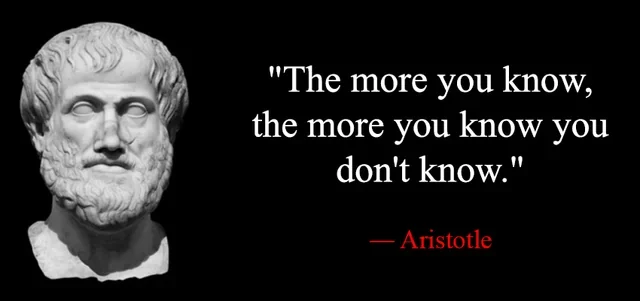
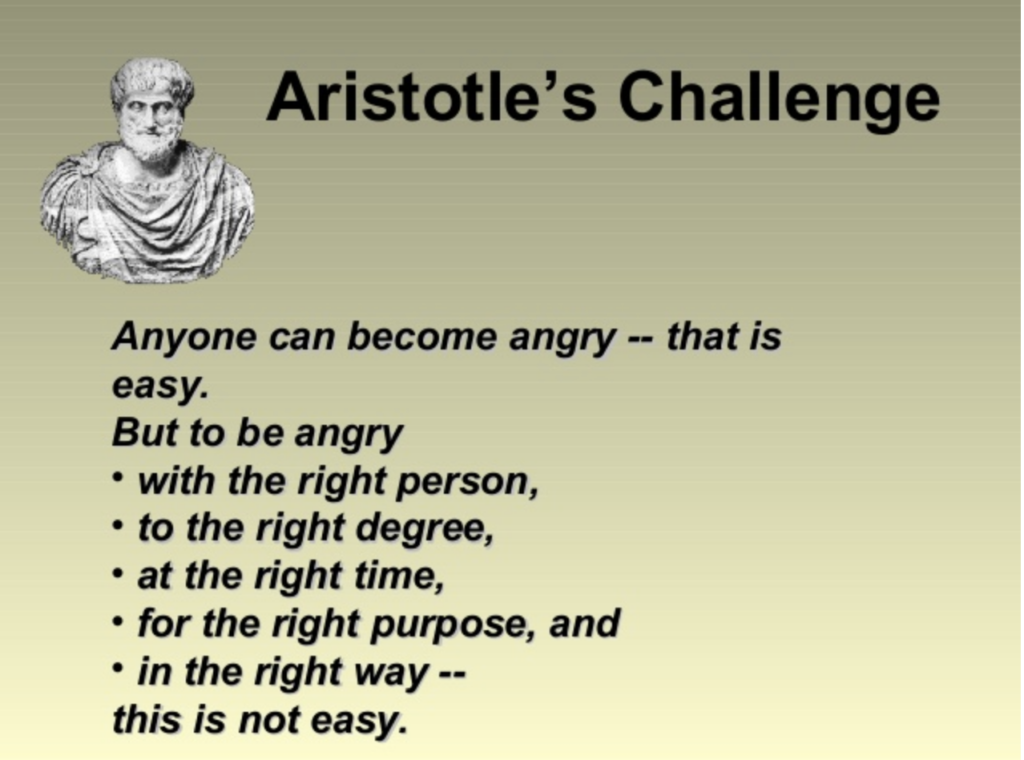
- Part 2.3. Aristotle & Communication in EMI Teaching
- Stephen Krashen's Affective Filter
- The Pygmalion Effect
2.4. Advanced False Friends & Academic Interference Patterns
Complete:
- Session 4 → Part 2.4 → Activity 1 (Whole-Class EMI Language Analysis)
- Use Session 4 Answer Key.
2.5. Grammar, Tenses & Error Analysis for EMI Clarity
Complete:
- Session 4 → Part 2.5 → Activity 1 (Grammar & Tense Repair for EMI Communication)
3. Oral Practice — Structured Speaking & Teaching Flow (56–72 min)
3.1. TED Talk reflection (The Art of Being Yourself)
3.2. Organizing explanations step-by-step
3.3. Signposting & transition language practice
3.4. Video-based structured explanation practice
4. Clarity & Practice (20 min)
4.1. Simplifying complex explanations
4.2. EMI Micro-Teaching Challenge
5. Chunking Information
6. EMI Principles in Action (5 min)
7. Recap (2 min)
HW + TED Talk (1 min)
C. Core (Session Content & Activities)
1. Advance Organizer & Targeted Review — Bridging Old and New Knowledge (30+ min- depending on need)
1.1. Reviewing Last Session (As needed)
1.2. Exploring This Session
In this session, you will learn how to:
- organize explanations clearly
- guide students step-by-step
- use transition language effectively
- make explanations easier to follow
👉 Key shift: From speaking continuously → to speaking structurally
(+ Core EMI Principles — 1 min)
- Clarity over complexity
- Structured delivery
- Scaffolding for understanding
- Comprehension checking
- Strategic use of language
- Student engagement
- Psychological safety
We will apply:
- Structured delivery
- Scaffolding for understanding
👉 Focus on helping students follow your thinking
2. Session 4 Reinforcement — Accuracy Before Structure (25–30 min)
Before moving into explanation structure, we will complete several high-impact activities from Session 4 that directly support clear and effective EMI teaching.
2.1.+ 2.2. Purpose-Driven Communication Review
See Session 4:
- Part 2.1. Weekly Speaking Reflection + WHY Do You Teach?
- Part 2.2. TED Talk Reflection — WHY → HOW → WHAT
2.3. EMI Communication Foundations Review
See Session 4:
- Part 2.3. Aristotle & Communication in EMI Teaching
- Stephen Krashen's Affective Filter
- The Pygmalion Effect
2.4. Advanced False Friends & Academic Interference Patterns
Complete:
Session 4 → Part 2.4 → Activity 1 (Whole-Class EMI Language Analysis)
2.5. Grammar, Tenses & Error Analysis for EMI Clarity
Complete:
Session 4 → Part 2.5
→ Activity 1 (Grammar & Tense Repair for EMI Communication)
[→ Activity 2 — EMI Sentence Simplification & Cognitive Load Reduction]
If we have enough time...
[2.6. Transition Language & Logical Flow in Teaching
Complete:
Session 4 → Part 2.6
2.7. Reformulation & Real-Time Teaching Language Repair Activities
Complete:
Session 4 → Part 2.7]
POLLEVERYWHERE:
ECH- Oral Communication Course 1: MID-COURSE REFLECTION
+ The 10 Biggest Challenges in EMI Oral Communication (session 4)
3. Oral Practice — Structured Speaking & Teaching Flow (50+ min)
3.1. TED Talk Reflection (10–12 min)
TED Talk:
[Briefly discuss: "The Art of Being Yourself" - Caroline McHugh
Many EMI teachers focus so much on correctness that they lose authenticity, confidence, and communicative presence. Effective communication is not only about accuracy. It is also about being human, clear, and genuinely connected to learners.
REFLECTION QUESTION: “How can teachers remain intellectually rigorous while still communicating in a human, authentic, and emotionally supportive way?”]
Then: “How to speak so that people want to listen” — Julian Treasure
Work with a partner.
💡 Key Ideas from the Talk
Good speakers:
- guide listeners clearly
- structure ideas carefully
- use pacing effectively
- emphasize key points
- make ideas easy to process
👉 Step 1 — Pair Discussion (5–6 min)
Discuss with your partner:
- What makes the speaker easy to follow?
- How does he organize ideas?
- What makes explanations memorable?
- How does pacing affect understanding?
- How can structure improve EMI teaching?
👉 Step 2 — Whole-Class Discussion (4–6 min)
Be ready to share:
- one communication technique you noticed
- one thing you want to improve in your own teaching
3.2. Organizing Explanations Step-by-Step (12–15 min)
The “American Teaching” Structure Model or the ECH Structured Teaching Framework
Use the following structure:
ADVANCE ORGANIZER, THEN
- State the objective
- Introduce the idea
- Break it into steps
- Give an example
- Check understanding
- Summarize the key point
Whole-Class Demonstration
Choose a simple concept from your discipline.
Examples:
- Dental plaque
- Gingivitis
- Hypoglycemia
- Patient consent
- Academic integrity
As a class, organize the explanation using the six-step model.
EMI Reflection
Discuss:
- Which step is most often missing from university teaching?
- Which step helps students most?
- How does structure reduce cognitive overload?
Exercise: Organizing Explanations Clearly
👉 Focus
- one idea at a time
- logical sequence
- clear progression
- short explanation blocks
Examples
❌ “Photosynthesis is a process that involves several mechanisms related to energy conversion and chlorophyll activity which we will examine now.”
✅ “Photosynthesis is how plants produce energy. First, plants absorb sunlight. Then, they convert it into energy.”
❌ “The treatment includes several procedures that may vary depending on patient conditions and additional factors.”
✅ “The treatment has three main steps. First… Second… Finally…”
Exercise — Reorganize the Explanation
👉 Simplify and organize the explanation.
- Periodontal disease results from bacterial accumulation, inflammation, lifestyle factors, and individual susceptibility that together affect oral health.
- Evidence-based practice integrates scientific evidence, clinical expertise, and patient preferences to support decision-making.
- Academic integrity involves honesty, transparency, proper citation, and ethical behavior throughout academic work.
- Local anesthesia blocks nerve signals, reducing pain perception during dental procedures.
- Artificial intelligence can support diagnosis, treatment planning, and data analysis in healthcare.
3.3. Signposting & Transition Language Practice
Useful Signposting Language
Beginning
- Today we will discuss...
- Let us start with...
- The objective is...
Sequencing
- First...
- Next...
- Then...
- Finally...
Clarifying
- In other words...
- What this means is...
- Let me simplify that...
Emphasizing
- The key idea is...
- It is important to remember...
Transitioning
- Now let us move to...
- This leads us to...
- Another important point is...
Exercise 1 — Add Signposting
Add appropriate signposting language.
- We examine the symptoms. We identify the cause. We select treatment.
- We collect the data. We analyze the results. We draw conclusions.
- We review the literature. We identify the gap. We formulate the research question.
- We assess the patient. We establish the diagnosis. We create a treatment plan.
- We explain the procedure. We obtain consent. We begin treatment.
Exercise 2 — Whole-Class Speaking Challenge
Choose one topic:
- Oral hygiene
- Dental caries
- Professionalism
- Patient-centered care
- Evidence-based practice
Explain it using at least:
- one sequence marker
- one clarification phrase
- one transition phrase
The class identifies the signposts used.
Exercise 3 — Add Signposting
👉 Focus
- guide the listener
- show progression
- make connections explicit
👉 Add transition language to these explanations.
Example:
“We analyze the symptoms. We identify the cause. We choose treatment.”
✅ “First, we analyze the symptoms. Then, we identify the cause. Finally, we choose treatment.”
- We review the article. We evaluate the evidence. We apply the findings.
- We explain the procedure. We answer questions. We obtain consent.
- We collect patient information. We assess risks. We develop a treatment plan.
- We identify the learning objective. We design activities. We assess understanding.
Example
Example
“First, we identify the patient’s symptoms. Then, we analyze the possible causes. In other words, we try to understand why the condition is happening. This leads us to the treatment plan. Finally, we choose the most appropriate intervention.”
Sequence Marker:
- First
- Then
- Finally
Clarification Phrase:
- In other words
Transition Phrase:
- This leads us to…
3.4. Video-Based Structured Explanation Practice — From Theory to Structured Teaching (12–15 min)
In the previous sessions, we focused on speaking more fluently.
This session, we focus on helping students follow our explanations more clearly.
Video
Task
Watching the short video above: The Secret to Better Learning in the Classroom, by John Spencer.
Step 1 — Quick Understanding
- What is the main idea of the video?
- How did the speaker organize the explanation?
- What made the explanation easy to follow?
👉 Focus not only on the content, but also on how the speaker teaches the idea.
Step 2 — Observe the Teaching Techniques
Structure
- How did the speaker introduce the concept?
- How did he sequence ideas?
- Did the explanation feel easy to follow? Why?
Scaffolding
- How did the speaker simplify the concept?
- How did visuals support understanding?
- How did examples reduce confusion?
EMI Communication
- What transition language did the speaker use?
- How did pacing affect understanding?
- What made the explanation clear?
👉 Focus on communication techniques you can apply in your own EMI teaching.
Step 3 — Explain the Idea
As a whole class, reconstruct the explanation using:
- Objective
- Step-by-step explanation
- Example
- Summary
👉 Use signposting language such as:
- First…
- Then…
- For example…
- The key idea is…
- Finally…
👉 Keep explanations short, clear, and organized.
🎥💡Key Ideas from the Video Above
Key Ideas from the Video:
The Secret to Better Learning in the Classroom — John Spencer
Good learning happens in the “learning zone”
Students learn best when tasks are:
- not too easy
- not too difficult
- appropriately challenging with support
Scaffolding supports learning
Effective teachers:
- guide students progressively
- break learning into manageable steps
- provide support before expecting independence
Learning should be gradual
Students should move from:
- supported understanding
→ guided practice
→ independent performance
Confusion can reduce learning
When explanations are:
- too fast
- too dense
- poorly organized
students may disengage or stop understanding.
Structure improves understanding
Clear explanations often include:
- objectives
- sequencing
- examples
- transitions
- summaries
Visual organization helps comprehension
Visuals can:
- simplify complex ideas
- clarify relationships
- reduce cognitive overload
- support memory and attention
Examples make abstract ideas clearer
Concrete examples help students:
- connect theory to practice
- understand difficult concepts more easily
- retain information better
Good teaching reduces cognitive overload
Effective EMI teaching does not overload students with:
- long explanations
- unnecessary vocabulary
- too many ideas at once
Clear communication matters in EMI
In EMI contexts, teachers should:
- speak clearly
- structure explanations carefully
- guide students step-by-step
- check understanding frequently
Teaching is not only delivering content
Good teaching means:
- organizing learning
- guiding understanding
- supporting progression
- helping students think clearly
Connection to EMI Teaching
👉 In EMI classrooms, students are processing:
- content
- language
- structure
at the same time.
This means that:
- clear organization,
- scaffolding,
- signposting,
- and simplified explanations
become essential for effective learning.
4. Clarity & Practice (20+ min)
4.1. Simplifying Complex Explanations (10–12 min)
👉 Focus
- avoid overload
- reduce unnecessary detail
- simplify language
- teach progressively
Examples
❌ “The pathophysiology of the condition demonstrates multifactorial interactions.”
✅ “Several factors interact to cause this condition.”
❌ “This phenomenon can be interpreted through multidimensional analysis.”
✅ “We can understand this using several perspectives.”
Exercise — Simplify & Teach
👉 Explain each idea as if speaking to first-year students.
- The process requires multiple interacting mechanisms.
- The results demonstrate significant variation among participants.
- This concept involves several interconnected variables.
- The treatment protocol must be adjusted according to patient response.
- The theory explains how learning develops progressively over time.
- The methodology incorporates both qualitative and quantitative approaches.
- Cognitive load may interfere with information processing.
- Professional judgment requires the integration of multiple sources of evidence.
- Diagnosis depends on the interpretation of several clinical indicators.
- Academic performance is influenced by multiple environmental and personal factors.
KEY
Answer Key — Simplify & Teach
1. The process requires multiple interacting mechanisms.
✅ Simplified Explanation
This process happens because several factors work together. Each factor plays a role, and all of them influence the final result.
✅ Structured Explanation
The objective is to understand how this process works.
First, several factors become active.
Then, these factors interact with one another.
For example, one factor may trigger another, creating a chain of events.
The key idea is that no single factor causes the result alone.
Finally, the process occurs because multiple mechanisms work together.
2. The results demonstrate significant variation among participants.
✅ Simplified Explanation
The results were not the same for everyone. Different participants showed different outcomes.
✅ Structured Explanation
The objective is to understand the results.
First, researchers examine the outcomes of all participants.
Then, they compare the results.
For example, some participants may improve significantly while others show little change.
The key idea is that participants do not always respond in the same way.
Finally, variation is a normal part of research findings.
3. This concept involves several interconnected variables.
✅ Simplified Explanation
This concept depends on several factors that influence one another. If one factor changes, the others may change as well.
✅ Structured Explanation
The objective is to understand how different factors are related.
First, identify the main variables involved.
Then, examine how they influence one another.
For example, changing one variable may affect several others.
The key idea is that the variables are connected rather than independent.
Finally, understanding these relationships helps explain the concept more clearly.
4. The treatment protocol must be adjusted according to patient response.
✅ Simplified Explanation
Not all patients respond in the same way. Therefore, treatment may need to be modified based on how the patient reacts.
✅ Structured Explanation
The objective is to understand individualized treatment.
First, a treatment plan is developed.
Then, the patient's response is monitored.
For example, if the patient experiences side effects, the treatment may need to be modified.
The key idea is that treatment should be adapted to the patient's needs.
Finally, effective treatment requires ongoing evaluation and adjustment.
5. The theory explains how learning develops progressively over time.
✅ Simplified Explanation
This theory explains that learning happens gradually. Students build knowledge step by step over time.
✅ Structured Explanation
The objective is to understand how learning develops.
First, students acquire basic knowledge.
Then, they build on that knowledge through practice and experience.
For example, students learn simple concepts before tackling more complex ones.
The key idea is that learning occurs gradually.
Finally, knowledge and skills develop step by step over time.
6. The methodology incorporates both qualitative and quantitative approaches.
✅ Simplified Explanation
This method uses two types of data. It includes numerical data and descriptive information to provide a more complete understanding.
✅ Structured Explanation
The objective is to understand the research methodology.
First, researchers collect numerical data.
Then, they gather descriptive information.
For example, they may analyze survey scores and interview responses.
The key idea is that different types of data provide different insights.
Finally, combining both approaches creates a more complete understanding of the problem.
7. Cognitive load may interfere with information processing.
✅ Simplified Explanation
When students receive too much information at once, it becomes harder for them to understand and remember what they are learning.
✅ Structured Explanation
The objective is to understand cognitive load.
First, the brain processes new information.
Then, too much information may overwhelm the learner.
For example, students may struggle when a teacher introduces many new concepts at once.
The key idea is that excessive information can reduce learning.
Finally, teachers should present information in manageable steps.
8. Professional judgment requires the integration of multiple sources of evidence.
✅ Simplified Explanation
Professionals should not rely on only one piece of information. They should consider different types of evidence before making a decision.
✅ Structured Explanation
The objective is to understand professional judgment.
First, professionals collect information from different sources.
Then, they evaluate the quality of that information.
For example, a dentist may consider research findings, clinical experience, and patient needs.
The key idea is that good decisions should not rely on a single source.
Finally, professional judgment involves combining evidence before reaching a conclusion.
9. Diagnosis depends on the interpretation of several clinical indicators.
✅ Simplified Explanation
Doctors and dentists use several signs and symptoms to identify a condition. A diagnosis is based on examining all of this information together.
✅ Structured Explanation
The objective is to understand diagnosis.
First, clinicians collect information about the patient.
Then, they examine signs, symptoms, and test results.
For example, a dentist may evaluate pain, inflammation, and radiographic findings.
The key idea is that diagnosis requires interpreting multiple pieces of information.
Finally, all clinical indicators must be considered together before making a diagnosis.
10. Academic performance is influenced by multiple environmental and personal factors.
✅ Simplified Explanation
Student success depends on many factors. These may include study habits, motivation, health, family support, and the learning environment.
✅ Structured Explanation
The objective is to understand student performance.
First, personal factors such as motivation and study habits influence learning.
Then, environmental factors such as family support and classroom conditions also play a role.
For example, two students with similar abilities may perform differently because of their learning environments.
The key idea is that success depends on many interacting factors.
Finally, academic performance cannot be explained by a single cause.
These models reinforce all four Session 5 skills simultaneously:
✔ Structure
✔ Sequencing
✔ Signposting
✔ Simplification
4.2. EMI Micro-Teaching Challenge (12–15 min)
Now apply everything we have practiced:
- structure
- sequencing
- signposting
- simplification
- listener awareness
Choose ONE topic.
You have 30–60 seconds to explain it to a first-year student.
Use:
- Objective
- Step-by-step explanation
- Example
- Summary
Topics:
- Hypoglycemia
- Professionalism
- Patient consent
- Diagnosis
- Curriculum design
- Academic integrity
- Data analysis
- Evidence-based practice
- Critical thinking
- Cognitive load
- Dental plaque
- Gingivitis
- Periodontal disease
- Oral hygiene
- Dental caries
- Local anesthesia
- Infection control
- Patient-centered care
- Lifelong learning
- Artificial intelligence in healthcare
Whole-Class Feedback
Discuss:
- Was the explanation clear?
- Was it logically structured?
- Were signposts used effectively?
- Was the language easy to understand?
- How could it be improved?
Key EMI Principle
Great EMI teaching is not demonstrating how much the teacher knows.
Great EMI teaching is helping students understand what they need to know.
5. Chunking Information for Comprehension
Chunking is the process of breaking complex information into smaller, meaningful sections and presenting them in a logical sequence so learners can understand one idea before moving to the next.
In EMI classrooms, chunking reduces cognitive overload and helps students process information progressively rather than all at once.
How We Can Use Chunking:
5.1. Using the WHY → HOW → WHAT Framework
Instead of presenting all information simultaneously, we organized explanations into three manageable chunks:
WHY – Why is this important?
- Establishes relevance and motivation.
HOW – How does it work?
- Explains the process or mechanism.
WHAT – What do students need to know?
- Presents the key concepts, facts, or takeaways.
Example: Periodontal Disease
WHY
- Why is periodontal disease important?
- It is a major cause of tooth loss and affects oral health.
HOW
- How does it develop?
- Plaque accumulates, inflammation occurs, and supporting tissues become damaged.
WHAT
- What should students know?
- Signs, symptoms, prevention, and treatment options.
5.2. Using Advance Organizers
Without Chunking
"We'll discuss causes, symptoms, diagnosis, treatment, and prevention of periodontal disease."
With Chunking
"Today we will examine periodontal disease in four steps:
- Causes
- Symptoms
- Treatment
- Prevention"
Benefit: Students know where they are and what comes next.
5.3. Using Signposting and Transitions
Without Chunking
"The patient presents with inflammation and plaque accumulation and we should evaluate risk factors and discuss treatment options and long-term maintenance."
With Chunking
"First, let's identify the problem."
"Next, let's examine the causes."
"Now, let's discuss treatment."
"Finally, we'll review long-term maintenance."
Benefit: The information remains the same, but the organization improves comprehension.
5.4. Explaining a Procedure Step by Step
Without Chunking
"The procedure begins with examination followed by anesthesia preparation tissue management implant placement suturing and postoperative instructions."
With Chunking
"Let's break this procedure into five steps:
Step 1: Examination
Step 2: Anesthesia
Step 3: Implant Placement
Step 4: Suturing
Step 5: Postoperative Care"
Benefit: Students can process each stage before moving to the next.
Chunking is one of the practical ways we implement:
✓ Structured delivery
✓ Advance organizers
✓ Signposting and transitions
✓ WHY → HOW → WHAT explanations
✓ Clarity over complexity
Key Takeaway
Chunking means organizing information into small, meaningful sections so students can understand one idea at a time and build understanding progressively.
Structure organizes the explanation; chunking makes the explanation learnable.
6. EMI Principles in Action (5 min)
6.1. Structured Delivery (2 min)
Use:
- objectives
- steps
- examples
- summaries
instead of long improvised explanations.
6.2. Scaffolding for Understanding (3 min)
Break difficult ideas into smaller parts.
Guide students progressively.
Use transitions and comprehension checks frequently.
Good EMI teaching is not giving students
all the information at once.
Good EMI teaching is guiding students
progressively through understanding.
7. Recap (2 min)
✔ Organize explanations step-by-step
✔ Use signposting language
✔ Guide students clearly through ideas
✔ Reduce cognitive overload
✔ Prioritize clarity over complexity
HW
2-minute Structured Explanation Recording
Choose ONE:
- Explain a concept
- Explain a process
- Explain a procedure
Requirements
- clear structure
- signposting language
- short explanation blocks
- one example
- one summary sentence
🎥 TED Talk (Homework)
Watch:
“The secret structure of Steve Jobs's speech" by Nancy Duarte
🔚 Final Reflection & Closing (3–4 min || If time permits)
Before we finish, try one more time:
👉 Explain one idea in 20–30 seconds using:
objective → steps → example → summary
Was your explanation clearer than before?
👉 Key idea: Good EMI teaching is not only about speaking English — it is about organizing thinking clearly for students.
Program FAQs
What is the course format?
The course is highly interactive, practice-based, and performance-driven.
Each session combines:
- Short, focused input
- Guided speaking practice
- Real teaching simulations (micro-teaching)
- Immediate feedback from the instructor and peers
Participants will:
- Record and analyze their own speaking
- Apply communication strategies to real teaching scenarios
- Engage in live activities using tools such as Poll Everywhere and Mentimeter
The course follows a progressive structure, allowing participants to build fluency, clarity, and confidence step by step.
Where will the sessions take place?
The sessions will take place at USJ (on campus), online, or hybrid.
What is the main objective of the course?
The Main Objective of the Course:
To transform how instructors teach in English by developing their ability to deliver clear, structured, and effective instruction in multilingual classrooms—moving beyond language fluency to achieve real student understanding and engagement in an English-Medium Instruction (EMI) context.
Who teaches the course?
The course is taught by Nada M. Salem, President/CEO of AFEE and IFWE.
 Nada M. Salem is a passionate educator with extensive experience in leading academic institutions in the United States and abroad. Over more than twenty years, she has taught school students, college students, student teachers, teachers, and leaders. She co-created and co- taught a methods course for teachers at The George Washington University Graduate School of Education. Nada is the Co-Editor in Chief of “Teaching World Languages: A Practical Guide- Arabic Edition” (The National Capital Language Resource Center, Washington, DC).
Mrs. Salem holds a teaching diploma, two master's degrees, one in translation and another in education, and has successfully completed most courses (40 credits) towards a doctorate (Ed.D.) in Curriculum and Instruction & Educational Technology Leadership at The George Washington University Graduate School of Education. Additionally, she holds an Executive Certificate in Public Leadership from Harvard University. Mrs. Salem formerly served as Administrative Director and Assessment of Learning Coordinator for AACSB Accreditation at the GWU School of Business’s Master of Science in Finance Program. In September 2019, Mrs. Salem was selected as a WOMAN LEADER by the University of Maryland‘s Kahlil Gibran Chair for Values and Peace. She is a member of the Marquis WHO'S WHO® list of Prominent Business Professionals, and she was featured among Marquis Who's Who's Top Executives in Education and Leadership.
Mrs. Salem is the Founding President/CEO of the American Foundation for Educational Excellence (AFEE), an organization whose mission is to help, on a worldwide basis, influencers, leaders, HR professionals, and managers of educational institutions, profit and non-profit organizations and corporations, to pursue excellence by improving leadership skills, managerial competencies and educational programs, namely through face-to-face and online trainings. AFEE is an Approved Provider for both HRCI & SHRM.
Mrs. Salem is also the Founding President/CEO of AFEE’s subsidiaries, the Center for Excellence in Languages: Teaching, Editing, Translating, and Interpreting, and the International Foundation for Women's Empowerment (IFWE) which seeks to empower all women and help them thrive on the personal and professional levels, regardless of nationality and religion.


TERMS OF SERVICE: We reserve the right, in our sole discretion, to reject or remove anyone who has registered or gained access under false pretenses, provided false information, or for any other action or behavior that we deem inappropriate, before, during or after the sessions, with or without prior notice or explanation, and without liability.
IMPORTANT DISCLAIMER: All rights reserved. The information on this page shall be considered proprietary information not to be used, copied or reproduced in any way. No part of our presentations / workshops / webinars may be reproduced, distributed, or transmitted in any form or by any means, including photocopying, recording, or other electronic or mechanical methods.